


On a beautiful summer evening, I taught my son how to keep score at Yankee Stadium.
The Yankees happened to be playing the Detroit Tigers.
They lost.
The game featured home runs, momentum swings, pitching changes and more than enough action to satisfy any baseball fan. But by the time we left the Bronx for Manhattan, the score that mattered most wasn’t on the scoreboard.
That score we kept by hand. Before the first pitch, we unfolded the paper scorecard, sharpened a pencil and began filling in the little diamonds and boxes that generations of fans have used to record the story of a game. Strikeouts and walks, groundouts and singles to left, runners advancing on sacrifice flies: he learned why a routine ground ball to shortstop becomes “6-3,” and why every inning tells its own story.
Healthy societies need institutions that teach presence.
Keeping score is an odd ritual in the digital age.
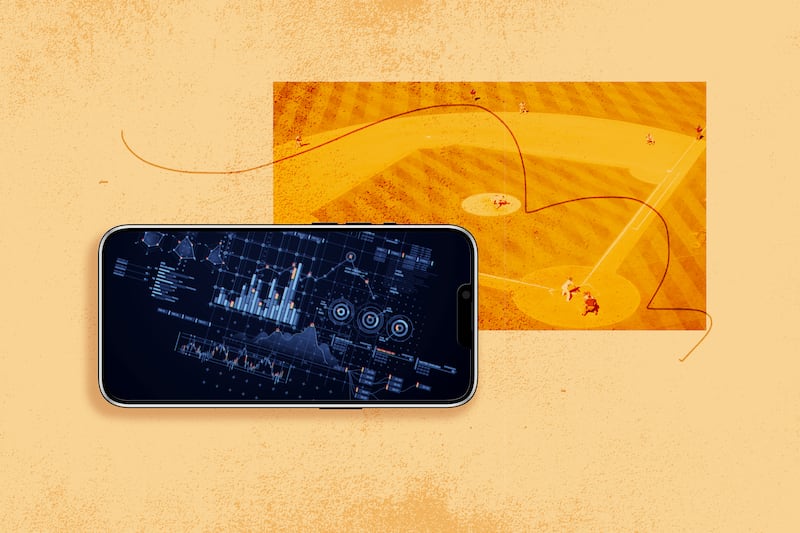
Every statistic from every pitch is instantly available on our phones; before we reached the subway, we could have summoned spray charts, exit velocities and win probabilities with a few taps. But a scorecard was never meant to preserve the game. It was meant to teach someone how to watch one.
You cannot keep score without paying attention; every pitch matters, every out requires you to look up and every mark on the page is a small declaration that I was here, and I saw this. Phones create perfect records; traditions create participants.
As the game unfolded, I found myself looking around the stadium, where nearly every head was tilted downward. People scrolled, answered texts and watched videos. Others held their phones above the crowd, recording the game instead of watching it, until entire innings disappeared behind glowing screens.
I said nothing. A few innings later, my son did. “Dad,” he asked, “why is anyone even here?”
It was one of those questions children ask that adults spend a lifetime trying to answer.
Why were we there?
Yankee Stadium has long been known as “The House That Ruth Built.” For generations, Americans have treated great ballparks almost the way earlier generations treated town squares — places where grandparents bring grandchildren, parents teach children, strangers cheer together and traditions are handed from one generation to the next.
They remind us that communities are formed not merely by occupying the same space, but by directing our attention toward the same thing.
That may be why my son’s question has stayed with me. It was about something much larger than baseball.
We usually treat the smartphone as an individual problem, and the research linking heavy screen time to anxiety, loneliness, poor sleep and declining mental health is real enough. But that is only part of the story.
The deeper loss is civic. Families, friendships, congregations and neighborhoods are all built on shared attention, and democracy itself depends on it, because before citizens can deliberate together they must first learn to notice the same things together. That habit is becoming harder to sustain.
I realized we have become extraordinarily good at documenting our lives and much worse at inhabiting them.
The philosopher Simone Weil once observed that “attention is the rarest and purest form of generosity,” and she was describing something deeper than courtesy.
Attention is among the primary ways human beings communicate love. Children experience that love not only through what we provide, but through what we consistently notice; they learn what matters by watching what captures our attention, and if our eyes are always somewhere else, they soon conclude theirs should be too.
The constant pull of the screen quietly inverts that relationship, insisting that there is always something more deserving of our attention than the person sitting beside us. The email can wait, we tell ourselves, but the notification cannot; before long, the person beside us receives only the attention left over after the screen. We rarely make that choice consciously. We simply make it a thousand times a day.
Perhaps that is why the Sabbath feels so urgently relevant now. Long before smartphones, Jewish tradition recognized a permanent truth about human nature: attention must sometimes be reclaimed deliberately, or it will be spent for us.
A day set apart was never simply about resting from work. It was about turning ourselves back toward God, family, neighbor and community — a weekly insistence that not everything of value can win our attention in the ordinary rush of life. Even for those who keep no religious Sabbath, the wisdom holds.
Healthy societies need institutions that teach presence. Baseball has long been one of those institutions. Unlike almost everything else in modern life, the game refuses optimization. It does not hurry. It leaves room for silence between pitches, conversation between innings and the stories that pass from one generation to the next. Those pauses are not flaws in the game; they are its genius, the space in which relationships are built. Or at least they once were.
Looking around the stadium, I realized we have become extraordinarily good at documenting our lives and much worse at inhabiting them.
An archive is not a memory, and a video is not an experience; a phone can preserve an event forever while quietly preventing us from living it. That is why keeping score struck me, in that moment, as such a beautiful inheritance. The scorecard was never really about statistics. It was a way of training the next generation to pay attention.
If we lose the habit of gathering together and giving our full attention to something larger than ourselves, we will have lost far more than baseball.
My own tradition begins with a command that is often translated simply as “Hear, O Israel.” But Shema means something richer than hearing. It means listening with full attention. It assumes that attention is not automatic, that it is a discipline.
Before Judaism asks us to believe, it asks us to listen.
Our institutions once formed citizens almost without our noticing. Ballparks taught patience. Houses of worship taught reverence. Family dinners taught conversation. Camps taught independence. Museums taught inheritance. Civic ceremonies taught us that we belonged to something larger than ourselves. None of them could do that work unless we first gave them our attention. Participation, not mere attendance, was always the point. Institutions shape us only when we give ourselves to them. We cannot inherit traditions we never fully attend.
As we left Yankee Stadium that night, my son carried his completed scorecard, and mine was filled as well. Years from now, I doubt either of us will remember every pitching change or even the final score. But I suspect we will both remember learning to keep score together.
We often ask how we might rebuild stronger families, healthier communities and a more connected nation. Those are enormous ambitions, and they may begin with something surprisingly small: looking up, watching the next pitch, finishing the conversation, leaving the phone in our pocket long enough to become participants rather than spectators in our own lives.
My son’s question still lingers. “Dad, why is anyone even here?” If we lose the ability to answer it — if we lose the habit of gathering together and giving our full attention to something larger than ourselves, we will have lost far more than baseball.
A free society depends on citizens who know how to give themselves, if only for a little while, to something outside themselves.
That habit begins with attention. Like every civic virtue a free people hope to preserve, attention itself must be taught.