

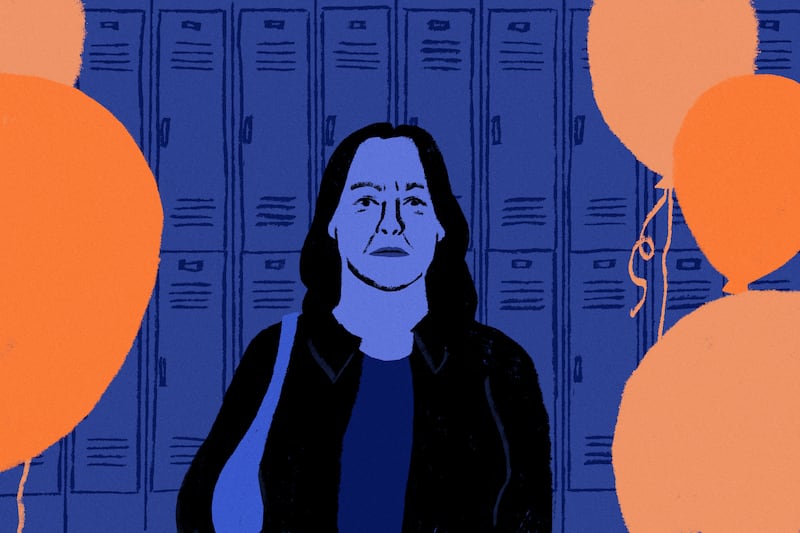

There are many sensible reasons to stay away from a high school reunion. Finances and schedules may be tight, belts may be even tighter, and wrinkles may finally be staging a revolt against any cover-up job.
Personal regrets and challenging memories can also make attending a reunion feel counterintuitive — even more so when current life circumstances are especially difficult.
There are a lot of knocks against gathering with old classmates. But it might be good to go anyway — for lots of reasons. As modern society fragments into monocultural interest groups, attending a reunion of any kind is a radical act of broader solidarity and community.
Especially when the past was challenging, gathering like this can be surprisingly healing. What’s better than fresh, healthier experiences with people from our past to place hurtful memories truly behind us?
One of the most well-known drivers of trauma healing, according to expert Bessel van der Kolk, is simply having new experiences that are positive.
There’s no guarantee of that outcome, of course. Bethany Clary reflected on social media about feeling out of place at her 20th reunion due to broader factors outside of her high school experience in Kentucky. “I doubt I’m the only person who has ever quietly felt out of place, unwelcome, or unable to comfortably afford attending these events.”
‘I hated high school’
As her own 20th reunion at Viewmont High School in Bountiful, Utah, approached in 2016, Amy Royall kept seeing posts by others expressing excitement about attending. So she decided to be honest about her own feelings on a Facebook page for her class of 1996: “You will not see me there. I hated high school.”
“I never got asked to one dance (and) not because I didn’t know anyone,” she wrote. “There’s only like 2 or 3 of you that I’ve talked to in twenty years and even then, it’s like once a year. I don’t care what you’re doing, you don’t care what I’m doing. Let’s leave it at that.”
“I’m glad someone finally said what a bunch of us are thinking,” Jonalynn Hansen responded. Others chimed in, like Jill Asay: “Yeah, high school wasn’t the happiest time of my life either.”
With that self-reinforcing social media echo chamber kicking in, Royall had never felt more sure of her feelings. But then something else happened.
Others started to share.
Stunned by how classmates really felt
“I always thought you were so popular and had so many friends,” wrote Jessica Andersen. “I had no idea you felt this way until now.”
“I wonder if high school is just really hard for a lot of kids,” added Kristin Willingham Dirkmaat. “I always thought it was just me.”
Others expressed regrets: “A lot of us did stupid stuff in high school. We were young and learning how to treat people,” said Eric Last. “Hopefully most of us have grown up and are better adults than we were kids.”
Royall was still undeterred. Pushing back, she wrote, “Look, people of my past, I’m happy. And I have no desire to go back to a place where I wasn’t.”
“I’m sure everyone has grown up and turned out to be great people.”
But her classmates weren’t going to let Royall off that easy. “By going to the reunion you allow all of us to get past the B.S.,” Jared Ericksen wrote. “I’m going to the reunion to get to know people I didn’t know well in high school, not to hang out with my best friends.”
“It’s nice sometimes to just say, ‘Hey, I’m glad you’re still on the planet,’” Jeremy Johnson remarked. “I hope you reconsider and we see you there.”
After seeing the reunion announcement, Andrea Cahill admitted that many early insecurities had come up. But then she said, “I could care less how I look now. I just care about people. I’ve decided it’s more important to be a good person than to look good. That’s what I think growing up is. 🙂”
Nearly 450 comments later, Royall threw in the towel. She decided to go to the reunion after all — stunned by how many people remembered her and told her they would love to see her.
And how did the reunion go? Royall told the Deseret News that all night people came up to talk with her “that I never would have talked to before in high school ever.”
“In high school you don’t know who you are,” she reflected, “and I never really went out of my way to talk to anyone. And if they didn’t talk to me, I just thought, ‘well, they don’t like me then.’ But that probably wasn’t the case at all.”
Christine Nelson described reading the many responses to Royall’s viral Facebook post with her teenage daughter, which “helped her see that what we perceive isn’t always the case as she struggles to survive the drama that is junior high.”
Surprising common ground
By a 20th or 30th reunion, of course — and maybe even by the 10th — most classmates know for themselves how complicated life really can be. Royall felt surprised by “how many people had gotten sick or had kids that had gotten sick” along with other “major life things like divorce and depression.”
Regardless of differing politics or theology, this sense of shared suffering and humanity can become a surprising common ground, effectively acting as a powerful social equalizer.
For any of us, a quietly dawning awareness as we age that life is short can lower defenses, nudge us to release adolescent grudges and increase empathy.
Stanford psychologist Laura Carstensen reports that as people age and realize their time horizons are narrowing, they naturally shift away from status-seeking and social competition to instead prioritize deeper, emotionally meaningful connections.
Gathering with “people of our past” thus offers a rare, tangible space to discover for yourself that beneath the old high school hierarchies, everyone was just trying to find their way through the dark.
If awkward, even painful, memories remain from high school, join the club. Let those motivate your participation — with an openness to new, positive, healing interactions — rather than acting as a mental excuse to keep you away.
Cornell University gerontologist Karl Pillemer, who has spent years studying how people heal deep relational rifts, notes that reconciliation becomes possible when a focus on the shared present begins to supersede any rumination about the past.
A need to remember
Emily Boyle, president of the Viewmont class of 1996 (which I also attended), believes that there’s “something deep in us — a need — to both remember and be remembered.”
“Ultimately, we all have a need to feel like we matter,” she told the Deseret News. “I think we all have that ability inside of us to remind other people that they are seen, they’re remembered, and they matter.
“The feeling that we feel when we see a face that we haven’t seen for a long time is remarkable.”
You might not be sold yet, but Amy Royall sure is. With her 30th reunion coming up this fall, she’s planning to attend — and maybe even nudge other classmates to give it a chance too.