

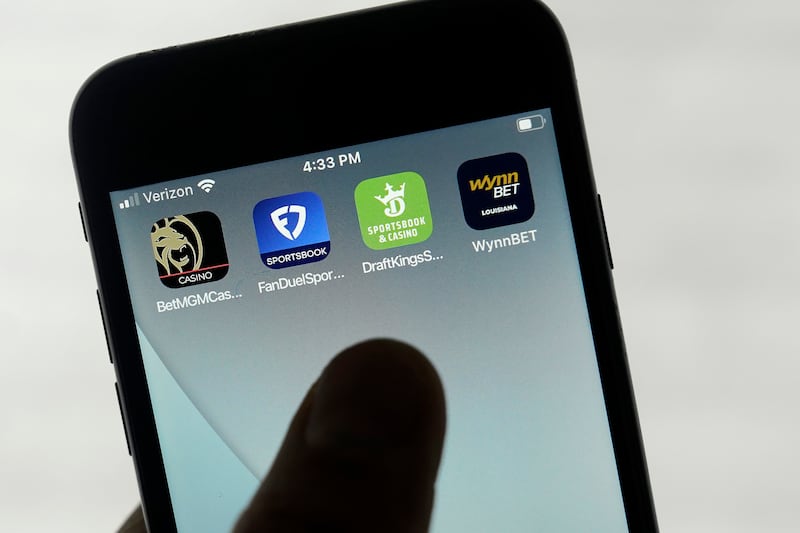

One of the sad ironies of the day is that, despite an explosion of legal gambling from coast to coast, no one in Washington is studying what this is doing to the nation.
Yes, Utah Rep. Blake Moore is, together with New York Democratic Rep. Dan Goldman, sponsoring the “Gambling Disorder Health Study Act,” which a press release said would use 10% of a federal excise tax Washington imposes on state gambling to study the “causes, development and long-term effects of gambling disorder,” and would look at ways to prevent and treat the problem.
But the nation already has missed the chance to see how this plague has grown during the first eight years since the U.S. Supreme Court allowed states to legalize sports betting, which has spread its tentacles to the nation’s most vulnerable citizens — the 18–35 age group.
Young adults
That’s a group that ought to be struggling to finish school, find a career, deal with the expenses of life, marry and start a family. Life is already tough for this group. A survey reported by Asset Funders in 2022 found that 64% of young people who had a college degree were struggling to pay off student loans, with an average balance of $20,000. Their mean credit card debt, meanwhile, was $2,119.
But even if no one in government is yet following the effects of the rise in gambling, some private groups are. One, an independent poker and iGaming affiliate called VIP-Grinders, just published a survey of 2,000 American adults.
The results are disturbing.
The average age of a visitor to a casino has fallen from 49.5 to 41.9 over the past seven years, signaling an increase in young gamblers.

Today, about 56 million Americans said they either often or always hide their gambling losses from loved ones. More than a quarter of the males surveyed admitted to this, while only 40% of all respondents said they had never done so.
“When one in five Americans is hiding gambling losses from a partner or family member, you’re not looking at isolated problem behavior. You’re looking at a culture where gambling has outpaced the conversation around it,” João Mourato, head of iGaming Product at VIP-Grinders, is quoted as saying in the survey.
“Social media and influencer culture have reframed gambling as a financial strategy. You see it constantly: ‘this is how I turned $100 into $5,000.’ That messaging skips the part where most people lose, and it creates shame around admitting losses.”
VIP-Grinders does not support restrictions on gambling. Mourato said the answer is greater transparency and education.
This is where Utah differs. Gambling’s legalization has led to a proliferation of anti-social behavior. Restrictions are in society’s best interest, as Utah has shown.
But I agree that transparency and education are important, and VIP-Grinders’ data shines an important light on the behaviors of today’s Americans.
Are winnings worth celebrating?

The survey found that adult Americans self-report an average largest winning payout of $9,058. But while this sounds like a lot, it is tempered by how often today’s gamblers use debt instead of cash to lay wagers.
More than a quarter (25.4%) of Americans said they had used a credit card to gamble, a figure that jumps to 36% among those in the 18–34 age group, among which 12 million also have sold personal possessions to raise money for wagers or to cover losses. Many others used overdrafts or borrowed money in some other way, and 16.1% of those 25 to 34 have used cryptocurrency.
“When a quarter of young adults are routinely going into debt to gamble, the conversation needs to shift from which platforms to restrict to how we equip players with the tools to manage their own bankroll and set their own boundaries,” the study quotes Mourato saying.
Brain development

However, plenty of reasons exist to question the reasoning abilities of young adults. Studies have shown that the human brain continues to mature and develop well into a person’s 20s.
A paper published by the American Psychological Association notes that “different parts of the brain mature at different rates in ways that predispose teenagers to gambling and other risk-taking behaviors. The prefrontal cortex, which regulates impulsivity and decision-making, is particularly late to develop, especially in boys.” Many of them aren’t equipped to make sound judgments in the face of relentless advertising and social media pressures.
It would be interesting to see a similar study among young people under the age of 18 who find ways to illegally wager on their smartphones.
Maybe Washington some day could devote time to similar studies, seeing how many of its citizens are succumbing to the daily prods and pressures to give their money to casinos and sportsbooks. Americans ought to insist on it.