

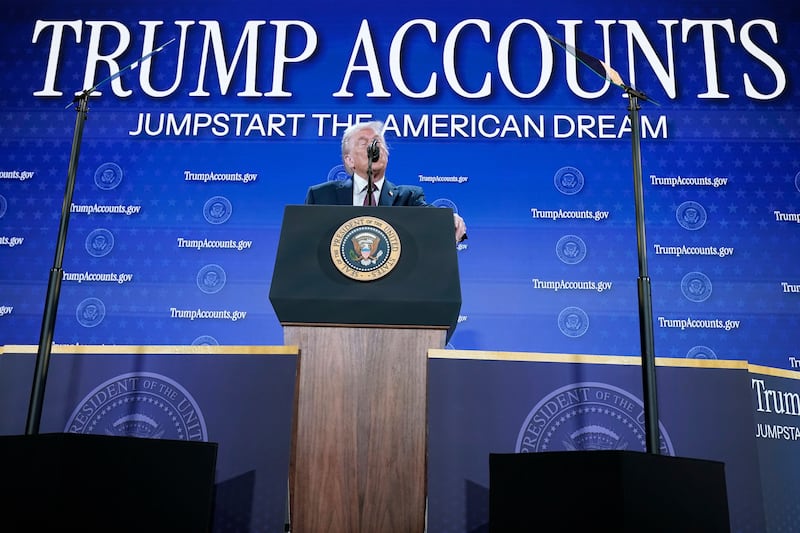

I rise to offer two cheers for Trump Accounts. I believe these tax-advantaged savings accounts for children, many of which are kick-started with a $1,000 donation from the federal government, represent the most important innovation in U.S. social policy in the past three decades. Let’s discuss why.
One main way that social policy helps people is through income support. We see that some Americans don’t have enough income, so we create policies to give them more. Fair enough. It’s an idea that anchors much of current social policy. But what if that idea is often inadequate? What if, for many and possibly most Americans, a better focus for social policy is not on income but on assets? Not on consuming now but on saving, owning and stewarding over time?
Among other things, this highlights a way of helping people in which those in need are not passive recipients but active participants in helping themselves while strengthening society.
Much of America was built on this idea. In the 1860s, the Homestead Act provided 1.6 million Americans with 160 acres of Western land on the condition that they live on these homesteads and cultivate them.
When homesteaders “staked a claim,” they were not only literally driving stakes into the ground to mark off their acres; they were staking claims in America itself. They received pieces of the country to own, to make bountiful, to build a dream on.
In his will, Benjamin Franklin, arguably our greatest American, created a revolving loan program in which young artisans of good character could borrow money at low interest to establish themselves in a trade, on the condition that the repaid loans would in turn be used to help more young artisans.
This was more than income support. It was seed money coupled with responsibility intended to perpetuate itself across generations.
This tradition of creating institutions and making seed gifts to help people build assets over time inspired Michael Sherraden, a professor at Washington University in St. Louis, to write the book “Assets and the Poor” in 1991. He then spent his career creating and testing what he called Child Development Accounts — a key model for today’s Trump Accounts.
Sherraden similarly inspired Brad Gerstner, an investor and entrepreneur, to found the nonprofit organization Invest America in 2023 to advocate for what became Trump Accounts. New Jersey Democratic Sen.
Cory Booker was likewise inspired several years ago to propose “Baby Bonds,” similar to Trump Accounts, and it inspired Texas Republican Sen. Ted Cruz to become the lead congressional sponsor of Trump Accounts.
Some specifics: All American children under age 18 are eligible for Trump Accounts, which can be opened on their behalf by a parent or other authorized adult. Anyone, from the children themselves to parents and family to third-party individuals and organizations, can contribute to the accounts.
In addition, all children born between Jan. 1, 2025, and Dec. 31, 2028 — the period of President Donald Trump’s current term — receive from the U.S. government a one-time, $1,000 gift to kick-start the accounts.
The money in these savings accounts is invested in diversified U.S. stocks, which is another way of saying it’s invested in the U.S. economy. When the savers reach age 18, they can (but are not required to) start using the money, primarily for their education, to purchase a home or to start a small business.
Sherraden and other scholars believe, and have data to show, that assets — the things we own and control — change us. They influence our aspirations. They change how we plan, interact with others and with institutions, and think about the future.
They shape our hopes.
Supporters of assets-based social policy — and count me as one — tend to emphasize the economic benefits to individuals. But we miss much of the story if we overlook the civic benefits as well.
Building wealth over time sparked by societal support does more than offer people a stake in our economy. It offers them a meaningful reason based in personal experience to believe in the country and care about their role as citizens.
Financial assets for individuals can also become civic assets for society.
Trump Accounts are no panacea. There are other (and in some contexts, likely better) ways for families to save for the future. There’s also the problem of enrollment. To date, fewer than 10% of all U.S. children for whom Trump Accounts are available have actually had one opened, and only about 1 in 4 children eligible for $1,000 seed gifts have actually claimed one.
Those numbers are likely to grow, since the program is still new, but it’s fair to worry that only a minority of children will benefit and that those who do will come from higher-income families.
If I had the authority to make some adjustments, we’d enroll every child at birth with a modest seed gift and use that institutional infrastructure to build out the program.
I’d also involve civil society organizations in sponsoring and promoting the accounts in order to inject grassroots energy and keep the initiative as close to the ground as possible.
And I wouldn’t call them Trump Accounts or make only those children born during the Trump presidency eligible for the seed gift, lest we promote the misleading idea that assets-based social policy is inherently politically partisan.
These are genuine challenges. But as a nation, we can and should dedicate ourselves to the unfinished but vital work of offering every child a stake in America.