

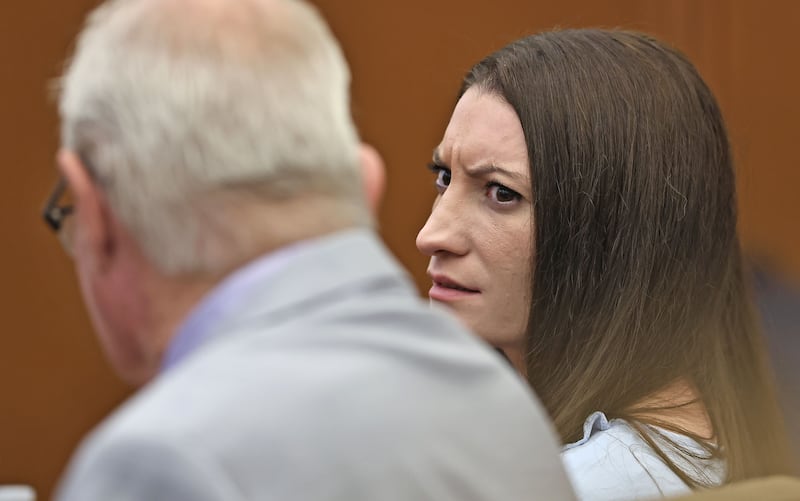

Except for the actual jury, everyone in America seems confident where to assign blame in the Lindsay Clancy trial. At least it appears that way on social media, where confidence tends to run higher than self-awareness. Like anything capturing our national consciousness, Clancy’s trial has been sucked into the vortex of professional opinionators, and the output is predictably split along culture war lines.
Right-wing pundit Matt Walsh has been chain-posting about Clancy’s guilt like his income depends on it.
“It’s extremely clear what happened and why it happened. There’s really no mystery. Lindsay Clancy is a psychopath,” he recently declared.
“The only chance for a fair trial in the Clancy case is with a jury of all men,” Walsh wrote, because “Clancy has become a folk hero to legions of braindead soulless women.”
Lindsay Clancy is not my hero, but for me, her case doesn’t line up so neatly on one side of good or evil.
Having four kids, I always got the blues after each birth. But for various reasons, having my fourth brought on full-blown postpartum depression. I didn’t want to hurt my children, but I did want to end my own life. That’s true for many moms hit by depression after giving birth.
“If you fantasize about dying while in the shower, just know that’s part of it,” one friend told me. As grim as that sounds, it was actually comforting to know that my painful abnormality was also, in another sense, kind of normal.
Still, why would a woman like me with her dream life — a supportive husband, a beautiful home, and four precious, healthy children — want to die? My natural state is optimistic and even-keeled.
Those feelings made no sense, and I knew I had everything to live for, but it didn’t change how I felt. And it took time, some treatment roulette, and good friends and family to get me through the worst pain I’d ever felt.
What this experience taught me is that life is complicated. Bad things can happen to anyone, for reasons beyond our understanding or control. There are many things we can control, like our diet, and even more things we can influence, like our overall health. We should take that seriously.
But no one is ever completely beyond the reach of tragedy. Cancer, car accidents or mental illness are just a few of the misfortunes that can take us by surprise, despite our best efforts. And if we believe such trials are only brought on by bad or evil choices, then when our turn comes, two obstacles may sideswipe us: the sudden trial itself and the blinding arrogance of believing it could never happen to us.
As awful as my experience was with postpartum depression, I’m grateful for it. Facing an illness I couldn’t control and pain that made me desperate showed me just how much I rely on God and others. I had no choice but to look for God’s ministering angels, who have time to render aid because they are not so busy assigning people to hell.
We can’t condemn our way to a safer or more just world.
As a result, I’m reluctant to condemn others. Without the compassion, understanding and help of many people, things could have turned out very differently for me. In fact, they have turned out differently for better souls than me.
I don’t know what happened in the Lindsay Clancy case, but I do know that it’s not an occasion for armchair quarterbacking. And however tempting it is to seize upon a major cultural touchpoint as yet one more opportunity to inveigh in the culture warfare, does anyone really need that?
Rather than modeling the “mourning with those who mourn” and “weeping with those who weep” so desperately needed in America, these voices with major influence end up simply pouring more gasoline on the cultural fire — sometimes forgetting the ache of the human tragedies providing fodder for their content generation.
For these and other reasons, pundits have an incentive to make everything tidy and rational — to distill life’s messiness into a set of simple axioms from which their judgments easily follow.
Denying the complex nature of problems in the real world is what allows them to confidently opine in real time on everything that crosses their notice, despite having little to no experience, expertise or sincere investment in the problems they’re analyzing.
This is how a man who has never given birth and has never studied mental health, medicine, law or criminal justice can not only condemn Clancy from afar but also anyone who doesn’t also condemn her.
While it’s true that some people use claims to expertise, lived experience or their own nuanced insight into the “full complexity” to undermine what’s right — even what’s obviously right — it doesn’t follow that reality is not complex, nor that expertise is not needed.
Ideologues draw on our vanity when they try to convince us that everything that’s right and good is simply self-evident — “everyone knows” … “it’s obvious to anyone who has studied this” … “this is clear to those thinking about this.”
The implication is that there is nothing beyond our experience or learning that might require us to defer judgment. If we can be puffed up into dismissing important medical and legal distinctions in Clancy’s case as nothing but elite hocus-pocus, then the ideologue’s position goes unchallenged.
And when the truth is self-evident, of course, then anyone who disagrees is either stupid or evil.
What is truly self-evident here is that what befell Clancy’s children is a horror beyond description, and that it should not have happened. But despite what any loud voices with big platforms might say, the question of whether Lindsay Clancy is criminally responsible for her actions is not simple given the circumstances.
And withholding judgment when you don’t have all of the facts is not the same as being indifferent to the crime. We can’t condemn our way to a safer or more just world. If postpartum psychosis is real and our treatment approaches are incomplete, but we don’t sufficiently account for how it can alter someone’s behavior, then none of this will be treated with the urgency it deserves, paving the way for more tragedies that could have been avoided.
My purpose is not to advocate for a not-guilty verdict but to encourage people to look at this case without the toxic certainty that so often characterizes the influencer class. If we can approach this tragedy with a measure of humility, perhaps we can learn something that allows us to prevent the agony from happening again.