

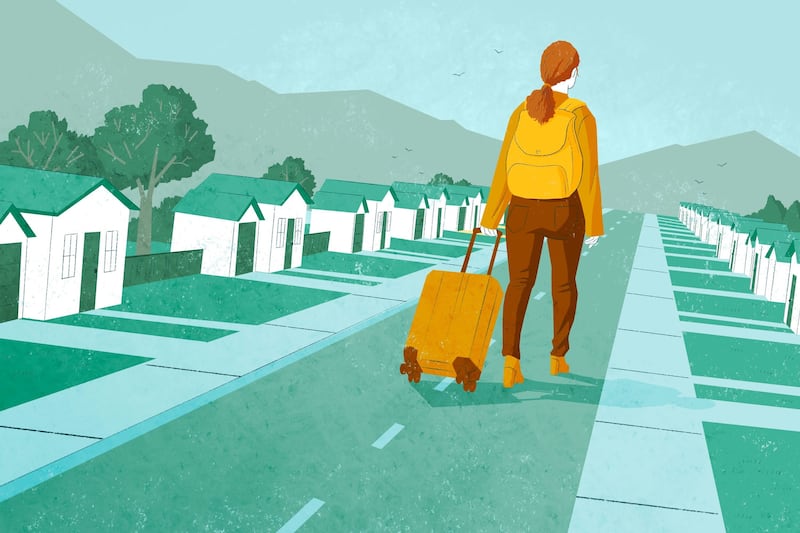

How do you know you’re an adult? A thousand years ago, a hundred years ago, no one asked this question. Once you were physically capable of supporting yourself, of protecting yourself, of bearing and raising your own children, of working to contribute to your tribe or your community, you joined the ranks of grown-ups.
But slowly we have extended childhood and added stages like adolescence, tweens, teens and young adulthood. Determining where childhood ends and where adulthood begins is hard.
The past few years have seen a dramatic rise in young adults cutting off all contact with their parents. According to research by Karl Pillemer, a professor of human development at Cornell University, about 25% of Americans have been estranged from, or have formally cut ties with, a close relative at any given time. One in 10 are estranged from a parent or a child. The findings of one recent survey suggest that therapy is to blame, with many counselors recommending that young adults cut off contact with their families for their own psychological well-being. Of around 7,000 estranged parents, a third believed their adult child’s therapist had influenced or recommended that they end the relationship.
“We are in a culture where we emphasize fragility, everything becomes trauma, and the solution increasingly is to split and leave,” William Doherty, a therapist and professor emeritus of family social science at the University of Minnesota, told The Wall Street Journal. Therapists who engage in “validation” of their clients also tend to make these adult children believe that whatever they say is correct and rarely seem to ask about how other people may see the situation.
Others have blamed widespread estrangement on our polarized political environment, where the wrong opinion can get you ostracized, even by your own flesh and blood. How can we even tolerate our Trump-voting uncle at Thanksgiving?
But what if the young people making these misguided decisions are simply struggling to find boundaries with their parents in a world that doesn’t really provide them?
The estrangement crisis is largely confined to America’s “haves.” (They are people who can afford therapy in the first place.) These are the young adults most likely to have been overparented at every step. During childhood, they were overscheduled and rarely spent a moment without either a parent, a babysitter, a coach or a teacher. Even when they went off to college they were tethered to their families by technology, calling their parents to find out what to do about a roommate crisis, a failing grade or what to have for lunch.
At some point, though, it becomes too much. Yes, they may become totally well-adjusted adults whose mother is their best friend. But there comes a point in almost every parent-child relationship where boundaries have to be established, and we have lost sight of where that is.
Are you an adult when you’ve finished high school or when you’re old enough to join the military? Maybe when you’ve finished college or gotten your first full-time job? Perhaps it should be when you’re old enough to smoke cigarettes or drink alcohol? When you can buy a gun? When you can get married? When you can afford your own place? When you have a child? When you are no longer covered by your parents’ health insurance? What about when they stop paying your cellphone bill?
It is easier when society provides clear markers. Women used to live with their parents until they got married, and almost everyone got married. Of course, parents may have still provided some help here or there, but a man who was actually dependent on his parents or his in-laws felt a loss of self-respect. It is possible that young people today are feeling that same loss of self-respect, but they don’t quite know why. They are flailing, trying to establish independence, but finding no clear path to do so.
None of this is to excuse a culture that encourages young people to cut ties with family members because of some imagined trauma or to excuse therapists who think estrangement is better than tolerating some discomfort and who fail to promote understanding of the idea that no one thinks their parents were perfect. Young adults naturally feel a desire to set out on their own. There may be other reasons (including economic ones) for their difficulty in doing so, but extending childhood and failing to provide clear markers for adulthood isn’t helping.