

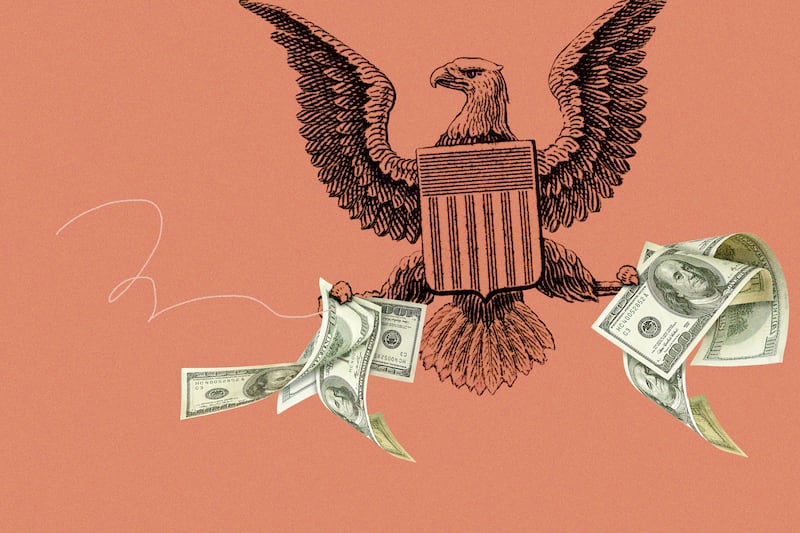
As Americans debate tax rates and worry about the rise in socialist tendencies among some young people, it’s valuable to step back and see how taxes burden (and help) us.
In France, the Institut économique Molinari just released a report on “Tax Freedom Day” in the European Union.
Tax Freedom Day is a concept trademarked by Dallas Hostetler, an American businessman, that calculates how many days it takes each year for residents of a particular nation to pay all tax obligations for that year if they were to apply all their income for that purpose, beginning Jan. 1.
The Tax Foundation, a private research group, once published this data yearly, breaking it down by state. A foundation official told The Wall Street Journal recently that freedom day in the United States came on April 16 this year.
Contrast that with the Molinari report, which found the average European Union resident wasn’t free from taxes until June 12 — an average spread across all 27 member nations. France brought up the rear, with its people theoretically having to pay taxes until July 22. Belgium and Austria were right behind with July 17.
Only five countries were found to be moving in the opposite direction. That is, their freedom days came earlier this year than in recent years. These were: Denmark, Finland, Sweden, Greece and Portugal.
What do you get for your taxes?
The report quotes the Molinari institute’s president, Cécile Philippe, saying, “In a number of key areas, the public is witnessing a deterioration in service levels, despite record levels of taxation.”
“To spend money wisely and protect taxpayers, one must have the courage to do a cost/benefit analysis. But we have lost the habit of taking this common-sense approach and correcting course when the value for money in collective services is inadequate.”
To many business-minded Americans, this will make sense. Government is often among the most expensive providers of services that might also be done by the private sector. This is especially true if it operates free from the downward pressure of market competition.
The national debt

Yes, Americans pay less in taxes than Europeans, but they should not feel any sense of smugness or superiority. An instructive and transparent feature of the old Tax Foundation freedom day report was that it would offer a different set of dates that took into account the national debt. Make no mistake, the debt belongs to all Americans and is a liability. A decade or more ago, the debt would add almost a month of worker servitude to government obligations.
We wonder what today’s debt, fast approaching $40 trillion, would add to this year’s April 16 freedom date. That national debt total is a figure that combines public debt, or money owed to investors through Treasury securities, with intra-governmental debt, or money owed from one part of the government to another, such as money taken from Social Security trust funds to fund a different part of the government.
Americans cannot pretend this debt doesn’t exist. It is a real liability against their income, and the interest on the debt is projected to cost more than $1 trillion this year.
Government healthcare
Other costs are worth considering, as well. Many Europeans will argue that their taxes fund universal healthcare benefits that give them peace of mind. Catastrophic illnesses will not destroy their personal finances nor lead them toward bankruptcy as they sometimes do in the United States.
Americans often counter with market-based arguments. But the truth is much more complicated than that in a system where private health insurance is vital. On average, each U.S. resident pays $15,474 per year on healthcare, according to the Centers for Medicare and Medicaid Services. That’s the most by residents of any industrialized nation by a wide margin, as the Peter G. Peterson Foundation reports.
This, too, is a factor that affects prosperity.
Still, Tax Freedom Day is instructive, especially when viewed from a historical perspective. Politicians promise benefits, and some programs truly are needed, but it’s sobering to note that Tax Freedom Day in 1910 was Jan. 19.
Perhaps, as Cécile Philippe said, it’s time for a cost-benefit analysis of all programs.