



As a bill that would dramatically shape the future of college athletics is expected to get a vote in the U.S. Senate next week, then move on for debate in the House of Representatives, college sports fans throughout the country are naturally wondering how the legislation would affect their favorite schools and programs.
For fans of the University of Utah and BYU football teams, the five-years-in-the-making bill, if passed, takes on even more significance because both schools are believed to be among the top 50 in the country in spending on their respective football rosters, according to The Athletic.
The Protect College Sports Act is about more than just football, but that sport is the engine that drives every other athletic endeavor on campus, with the possible exception of men’s basketball and, at some schools, women’s basketball and women’s gymnastics.
The Athletic, which is owned by The New York Times, recently estimated that BYU’s football roster budget in 2026 ranges from $21 million to $25 million (third in the Big 12), while Utah’s estimated budget is between $18 million and $22 million (middle of the Big 12).
Schools do not have to divulge how much is being spent on their entire athletic department rosters, but it is estimated that both BYU and Utah are north of the $30 million range annually.
According to ESPN, “roughly 30 football teams have a payroll of $30 million or more, according to industry sources that help facilitate player payments. About half of those have payrolls that exceed $40 million.”
So there’s big money involved, and a lot at stake for all of Utah’s college athletic departments, from Logan to St. George.
Before jumping into how the PCSA would affect BYU and Utah, primarily, let’s look at what it would do, if passed.
What is the Protect College Sports Act?
The PCSA would replace much of the current patchwork of NCAA rules, court decisions, state laws and federal standards governing eligibility, transfers, athlete compensation, NIL offerings and enforcement. The nonpartisan bill has undergone a myriad of changes since being introduced by Sens. Maria Cantwell, D-Wash., and Ted Cruz, R-Texas, and joined by cosponsors Chris Coons, D-Del., and Eric Schmitt, R-Mo.
“This is about reining in the bad practices that are happening in college sports today, the runaway costs … and the runaway arms race in sports spending,” said Cantwell last week.
Here are some of its key components:
- NIL rights: The bill would create a nationwide right for college athletes to earn money from their name, image and likeness, replacing a hodgepodge of state and local rules. Student-athletes have been receiving NIL funds since 2021.
- Revenue sharing caps: Direct school-to-athlete compensation, from the House vs. NCAA settlement case, would be capped at roughly $21.58 million, plus a $27.5 million pool for player retention.
- Athletic scholarships protected: The bill guarantees athletic scholarships for up to 10 years eligibility and protects them from being revoked due to injury or subpar athletic performance.
- Transfers to be limited: The bill generally guarantees one transfer per student-athlete without a yearlong sit-out, while establishing limits and exceptions for subsequent transfers.
- Agent fees to be capped: The bill requires a nationwide agent registry/certification process and caps agent fees at 5%.
- Preventing future conference expansion, restricting realignment: The bill would prevent Power Four conferences from growing beyond a total of 19 schools. Currently, the Big 12 and the SEC have 16 teams, while the Big Ten and the ACC have 18 teams. Any school wishing to move from one Power Four conference to another has to spend at least three years as an independent before joining its new league. However, that required waiting period would end after 2031.
- Missionary and military service remains exempt: The bill limits athletes to a five-year eligibility window, which begins the year they turn 19 or the year they finish high school. This eligibility requirement is identical to the new “five for five” rule adopted by the NCAA in June, and also includes language that exempts missionary service, military stints, and pregnancies from the rule. That is obviously of interest in Utah, where all of the state’s schools’ rosters include student-athletes who have served missions for The Church of Jesus Christ of Latter-day Saints.
What have BYU officials said about the bill?
From former Alabama coach Nick Saban to current Colorado coach Deion “Coach Prime” Sanders, many prominent people in the college sports world have thrown their weight behind the bill. So has BYU President C. Shane Reese, who authored an op-ed in the Deseret News last month entitled “Leveling the playing field.”
Wrote Reese: “Faith-based institutions like Brigham Young University — with a distinct emphasis on service and learning — must be especially advocatory for a renewed focus on integrity, mission, character and the educational aspects of college athletics. But for real progress, leaders of good conscience from across the academy must work with public officials to ensure college football remains something more than a farm league for the NFL.”
Reese also wrote: “Though far from perfect, a step in the right direction is already before Congress in the form of the bipartisan Protect College Sports Act. The act, which is backed by more than 20 college athletic conferences, including the Power Four, would address many of the large issues facing college athletics — agents, the transfer portal, the coaching carousel and, most importantly, the antitrust carve-outs vital to allow college sports the space to self-govern and enforce sound policies without the constant threat of yet another lawsuit.”
BYU football coach Kalani Sitake weighs in
Last Monday, after BYU improved to 3-0 with a 41-23 win over Colorado State and moved up to No. 9 in the AP Top 25 poll, the Deseret News asked coach Kalani Sitake where he stands personally on the PCSA bill. Before fall camp began in August, Sitake strongly hinted that the BYU football program was “doing the most with the least” regarding resources and NIL support and called for more investment in the program from the university.

“Just like everything else does, we will see how it works and what comes with it, and then we (will) decide how to make it work so that we can be in alignment with the mission of our school and the mission of our church,” Sitake said. “ … I see some really good things with it. I understand why all the coaches are promoting it, and I can understand why some people would be hesitant towards it.
“For me, I’m going to control what I can control, and if it does pass, we will make it work. And if it doesn’t, we will make it work, still. … I’m not one of the voters in that deal,” he continued. “I can only deal with the here and now. But I understand what’s going on and understand the pros and cons for all of it.”
What have the Utes said about the bill?
Neither University of Utah President Taylor Randall nor Utah Athletic Director Mark Harlan have issued public statements explicitly addressing the bill. However, at the Big 12 football media days in July, Big 12 commissioner Brett Yormark said there was “conference-wide” support for the bill, which he labeled as “progress over perfection” and noted that the Big 12 was aligned on the matter with the other three power conferences.
When the Big Ten and SEC announced their support on July 31, Yormark told On3.com that “broad alignment around a practical, sustainable framework that supports student-athletes, institutions, conferences and fans is an important step forward for college athletics.”
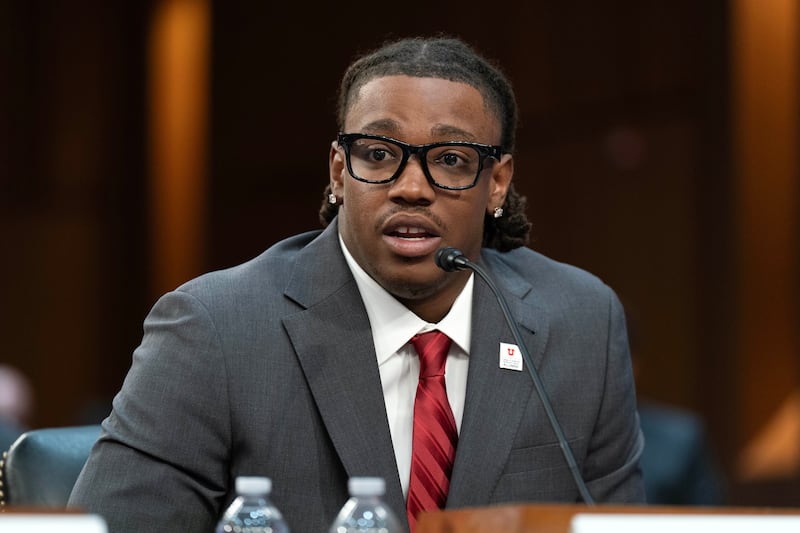
In early June, Utah football player Lance Holtzclaw testified before a Senate committee and, while not explicitly expressing support for the bill, said more transparency was needed and that Congress allowing student-athletes to be involved in the process was critical.
“Decisions about college athletics should not be made solely for student-athletes, but made with student-athletes,” he said.
Sen. Cruz warned that schools not in power conferences, such as Utah State, face slow extinction if the bill is not passed.
“If we don’t act, we will see 30 to 50 competitive football programs in this country and the remainder of the programs go under,” he said.
National college sports expert: ‘Bad bill, I hope it doesn’t become law’
The U.S. Senate is expected to hold a final floor vote early next week, multiple news outlets reported Thursday. The bill is expected to pass by a comfortable margin in the Senate, but could be held up by the House. That body is not scheduled to vote on anything until after the midterm elections in November. So the bill still has a long way to go, as the House appears to be deeply divided over the legislation — far more than the Senate.
At least one national college sports reporter has weighed in, and he believes the bill should be voted down.
Matt Brown of Chicago is the author of the Extra Points newsletter and has strong ties to the Beehive State, often appearing on various sports radio shows and podcasts originating in Utah.
“The Protect College Sports Act is a bad bill, and I hope it doesn’t become law,” Brown wrote recently. “In my professional judgment, this legislation will not do the things its advocates say it will.”
In a lengthy interview with the Deseret News on Tuesday, Brown outlined reasons for his distaste of the bill and three primary concerns:
Capping agent fees at 5% is problematic. Brown says that percentage cap works for professional athletes in the major sports leagues, but for college athletes wanting to get NIL deals for marketing, commercials and sponsorships to take their income beyond the revenue sharing salary caps, finding agents who will take less than 15-25% to work on those deals could be difficult.
“If you don’t make a differentiation between marketing work and contract work — and in college that line gets blurred all the time — what I believe will happen is the actual professional lawyers and agents and people … who are good at it are going to say it’s not worth my time to do complicated work for just 5%,” Brown said.
The bill restricts student-athlete compensation. On the flip side, it does nothing to limit institutions’ spending in other areas, including coaching.
“The only real restriction is on player compensation and I think that’s not really fair,” Brown said. “If you’re really worried about spending being out of control, you change the law. If you’re going to go put a cap on what a quarterback can make, you should do the same thing for (coaches and athletic directors) or the litany of college sports industrial complex vendors and software providers and bus companies that will charge schools as much as they can. … None of that is addressed in the bill. I don’t think that’s fair.”
Not enough input from student-athletes themselves. For instance, the PCSA does not grant or protect the right to unionize. Critics such as Brown say it undermines or suppresses athlete leverage and collective bargaining movements.
“I think it is a little un-American,” Brown said. “I don’t like the precedent of Congress getting together and making rules that impact a certain subset of workers without the input of those workers. … I get that there’s a lot of fans who are like, ‘Man, I just don’t care about the labor rights of somebody making 900 grand. I just don’t want them to transfer four times.’ I get that. But I think this is a sledgehammer being used where maybe a scalpel might be more appropriate.”
What are the positive aspects of the bill?
Brown said the “five for five” eligibility rules hammered out by the NCAA a few months ago will be codified by the PCSA and he sees that as a positive for schools such as BYU, Utah and Utah State that feature a lot of future and returned missionaries.
For instance, BYU reported in August that the 2026 football team includes 64 players who served full-time missions, up from 56 in 2025. Their eligibility clocks will be paused while they are on their missions, which generally last two years for men and 18 months for women.
“There are components of the bill that are going to be a net positive for just about everybody in college sports. Certainly, BYU (and Utah) administrators are going to be thrilled with knowing that there is going to be some predictability and consistency with eligibility rules,” Brown said. “I think that there would be a significant sense of relief about the enforceability of the salary cap, which right now is not enforceable at all. If it is enforced with federal law enforcement rather than the NCAA and the four staffers at the College Sports Commission (CSC), I think that would probably be a net benefit for BYU and Utah, competitively.”
Brown said BYU, and Utah, possibly, will have payrolls for football, men’s basketball and women’s basketball in the upper third of the Big 12. Still, they won’t be within “shouting distance” of Ohio State, Texas, Oregon and others, he believes.
“I don’t think that (gap) changes if this passes. But over time, maybe that gap becomes slightly more manageable for schools like BYU and Utah,” Brown said. “However, there are some meaningful drawbacks that would be bad news for some (top-level) athletes. It would be bad news for BYU fans who care about capitalism, which I grew up thinking was important to that community.”
‘Elite athlete compensation will go down’
Brown said deducing whether the bill will be a net positive for student-athletes overall probably depends on that athlete’s sport and position on the team. Obviously, in BYU’s case, point guard Rob Wright and starting quarterback Bear Bachmeier are going to see some restrictions placed on how much money they can be paid from the school itself through revenue sharing, which will have a cap.
At Utah, the same applies to quarterback Devon Dampier and the aforementioned Holtzclaw, among others.
“If you are the kind of athlete that could command a guaranteed salary of $3 million-plus, and there are maybe five (athletes) in an athletic department who can, this bill is bad news for you because if you limit the number of transfers to one, with exceptions, and you impose a hard cap that can actually be enforced, then elite athlete compensation will go down, and it will go down even though you had no bargaining power or any say in this,” Brown said. “And that is a major part of why schools are pushing for this. They want to drive athlete compensation down.”
On the flip side, rank-and-file athletes, such as cross-country runners and almost everybody on the baseball and softball teams, for instance, could be better off because of the extensions of health insurance for five years after they are done playing and some other benefits written into the bill.
Bottom line: There are going to be winners and losers, just like in real life, Brown said.
“I think if you’re a Power Four institution that is in that bottom third financially, this is much better for you. Like a Purdue,” he said. “If you’re a top 20 athletic program, this is not really good for you. Or if you’re a fan of a school that would like to change conferences in the next three years, this bill probably isn’t good for you.
“I don’t really think that applies to BYU so much. Everything I’ve heard is that they love being in the Big 12. … If you’re a Utah fan who wants to see the Utes in a different conference, I think there’s a lot about this bill that (could cause concern) for you specifically.”
