



The week before the first day of school in Detroit, Mayor Mary Sheffield penned an op-ed for the Detroit Free Press, urging parents to take their children’s attendance in school seriously. With a chronic absentee rate around 60% last year, the city has one of the highest rates of absenteeism in the country.
But in case the mayor’s urging doesn’t work, Detroit schools have another strategy to improve attendance: awarding gift cards for every week students show up.

The program, called “Perfect Attendance Pays,” has drawn the ire of some conservatives who see it as a ploy that coddles children at taxpayer expense. (The district has said that the money for the gift cards, which students in middle and high school can earn, comes from interest earnings on money set aside for capital projects.)
Getting an education is a privilege, the program’s critics say. And the lessons of school aren’t just about math, science, reading and writing, but also about learning to be responsible and punctual, and learning that life involves doing things you might not feel like doing at the time for benefits that come later.
Detroit school officials, however, are happy with the program, which launched in January of 2025, and say it’s paying off in increased attendance.
High school students have to attend every class during the school day for an entire week to qualify. But they can get a $100 Visa gift card for every week they have perfect attendance over 10 weeks, with the possibility of earning $1,000 in rewards.
Speaking to ABC affiliate WXYZ, one mother said of her son, “I’ve never seen him so motivated to go to school.”
The district’s chronic absenteeism rate — defined as missing 18 days of class within a school year — had been 70% before the program launched, WXYZ reported.
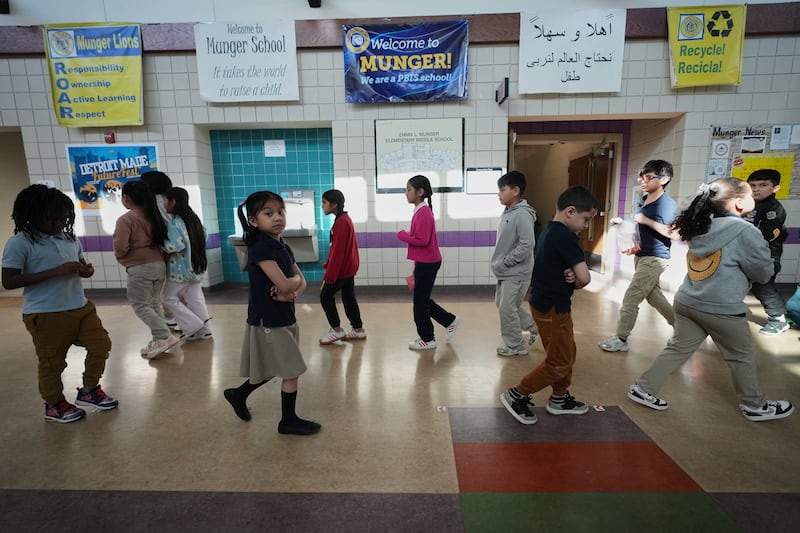
Absenteeism isn’t just a problem for Detroit. Educators have been wringing their hands over the problem since it peaked during the COVID-19 pandemic. And although the number has been coming down, it hasn’t come down enough, Nat Malkus, senior fellow and deputy director of education policies at the American Enterprise Institute, said.
Nationwide, the chronic absenteeism rate before the pandemic was 15%, according to a recent report from the American Enterprise Institute. It peaked at 28.5% in 2022 and has come down every year since then, now hovering at about 23%. But the rate of improvement has slowed, and Malkus fears it won’t drop below 20% anytime soon, if at all.
While some people blame the lingering effects of COVID-19 lockdowns, Malkus says lockdowns are “a minor note in a greater pandemic melody.” That’s because even school districts that never shut down, or did so for a shorter period of time, have also seen a rise in absenteeism, which is an across-the-board phenomenon, affecting districts across the socioeconomic spectrum.
Malkus tracks absenteeism across the country, but cautions that districts have different standards for what counts as an absence. (For example, some may mark a student absent if they miss a half day, while in other districts, students aren’t marked absent unless they are out the whole day.)
Even so, “60% is bad,” Malkus said, adding, “There is no plausible way to improve student outcomes that doesn’t involve getting that number way, way down.”
But does giving students gift cards to do something they’re supposed to do anyway make sense? To some, that smacks of bribery, like paying children to do chores around the house, which many parenting experts say should be an expectation of even young children. Parents magazine reported earlier this year that some parents are now paying their children to read and to exercise.
Iowa’s approach
Iowa has taken a different approach to the attendance problem. Per The 74, a nonprofit news site about education, Iowa cracked down on absenteeism with a three-pronged plan: When a child misses 10% of days in a grading period, parents will be notified; at 15%, the school will work with parents and the student to create a plan on improving attendance; and at 20%, the case will be referred to the county attorney for possible charges.
Iowa’s strategy is, Malkus said, to show “we’re serious about this, we’re not messing around, you have to get your kids to school regularly or it’s going to be really, really inconvenient.”
A blend of a serious approach with consequences, plus support for families, is likely a combination that will lower absentee rates, he said.
Could a Visa gift card be such a support? For some families, maybe.
Detroit doesn’t provide school bus service for high school students, and a principal told WXYZ that one student told her it took him a half-hour to get to school on a bike, and an hour and a half on a city bus. Buying a bike with that gift card, or a good backpack and school supplies, might indeed improve educational outcomes. Buying video games, not so much.
At this point, Detroit’s program is too new and too novel to tell how it will work over time, and whether educational outcomes will be improved, not just attendance. It’s possible that the rewards will motivate only students who were already motivated, and that those with the highest rates of absenteeism will see perfect attendance as out of reach, Malkus said.
At least the city is trying to solve a problem that, left unchecked, will have serious consequences, not just for individual students but for all of society.
“Chronic absenteeism and attendance before the pandemic wasn’t perfect. Fifteen percent of students were chronically absent; that’s not great. It got a lot worse, in part because people loosened up their routines,” Malkus told me.
“And if we get used to that, we should just be used to a less effective school system. The question is, will we allow ourselves to slouch into the future on kids going to school, day in and day out. If school is valuable, then going regularly and getting the most out of it is valuable, too.”