

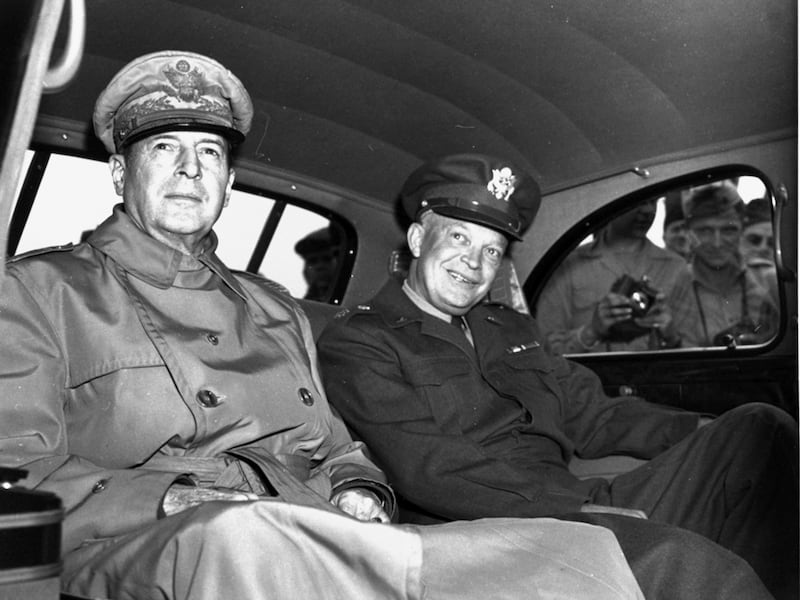

“The formal ceremonies of surrender aboard the Missouri,” wrote General Douglas MacArthur in his Reminiscences, “were fixed for September 2, 1945”—81 years ago. “I had received no instructions as to what to say or what to do. I was on my own.”
Put yourself in MacArthur’s position. What would you have said?
Nearly four years had passed since Japan had crippled the American fleet at Pearl Harbor — a blow that sealed the fate of the Philippines, where MacArthur, as commanding general, U.S. Army Forces in the Far East, was based. The U.S. Navy could no longer maintain supply lines. Short on aircraft, airfields, munitions and men, MacArthur consolidated his troops on the Bataan Peninsula, across Manila Bay from the Philippine capital, and on Corregidor, the island fortress guarding the Bay’s entrance.
In quick succession, Hong Kong surrendered, Singapore fell and the Japanese leapfrogged through Borneo, Malaya and Indonesia. Within a month of attacking Pearl Harbor, they invaded Luzon (the largest of the Philippine Islands, on which Manila is located). By then, Bataan and Corregidor were the only remaining Allied strongholds in all of Southeast Asia.
Outnumbered and out-equipped, MacArthur’s men fought a valiant series of delaying actions, stalling the Japanese advance for weeks, then months. The exhausted soldiers, Americans and Filipinos alike, subsisted on half rations, then less.
Living on the same diet as his men, MacArthur lost 25 pounds. Tokyo Rose announced that he would be captured, transported to the Imperial Plaza in Tokyo, and hanged. He escaped the final Japanese advance only narrowly, and only because President Franklin D. Roosevelt ordered him to. He left in command Major General Jonathan Wainwright, a friend from their days at West Point.
On four small, battle-scarred PT boats, MacArthur and his staff (accompanied by his wife and their young son) made a daring all-night run, breaking through the naval blockade, dodging enemy ships, fighting heavy seas and against all odds reaching Cagayan (on Mindanao, second-largest of the Philippine islands). From there, they took two decrepit B-17s over enemy-held territory to Australia, where they organized the American counteroffensive against Japan.
Wainwright held out as long as possible, but finally succumbed to the inevitable and surrendered Corregidor. There ensued the infamous Bataan Death March. Of the 80,000 prisoners who began the 70-mile ordeal, only 56,000 survived to reach the concentration camps. Thousands were tortured, abused or wantonly killed en route: bayoneted, shot point-blank, run over by trucks, deprived of water until they died of thirst.
Through 1942, 1943, 1944 and 1945, as MacArthur fought his way northward through the Pacific Theater from Australia back to the Philippines, he was never far from Japanese atrocities. Lieutenant Colonel Guillermo Nakar wrote, “Your victorious return is the nightly subject of prayer in every Filipino home”; he was tortured and beheaded. Vice Admiral Fukudome was captured at sea; stopping at nothing to recover him, the Japanese nearly exterminated the helpless civilians of southern Cebu.
“Japanese resistance began to stiffen,” MacArthur recalled. “Every Japanese soldier fought to the death.”
Kamikaze air attacks killed several of his colleagues. But what troubled him most was the fate of the thousands of prisoners of war. He fought his way to the concentration camps. “The men who greeted me were scarcely more than skeletons.”
When MacArthur was finally able to restore civilian, constitutional government to the Philippines, he observed of Manila: “I withdrew our forces and installations from this beautiful city that, open and undefended, its churches, monuments, and cultural centers might, in accordance with the rules of warfare, be spared the violence of military ravage. The enemy would not have it so, and much that I sought to preserve has been unnecessarily destroyed.”
Among the structures pointlessly reduced to ashes was MacArthur’s own penthouse apartment, with its irreplaceable treasures from around the Orient and its incomparable military library.
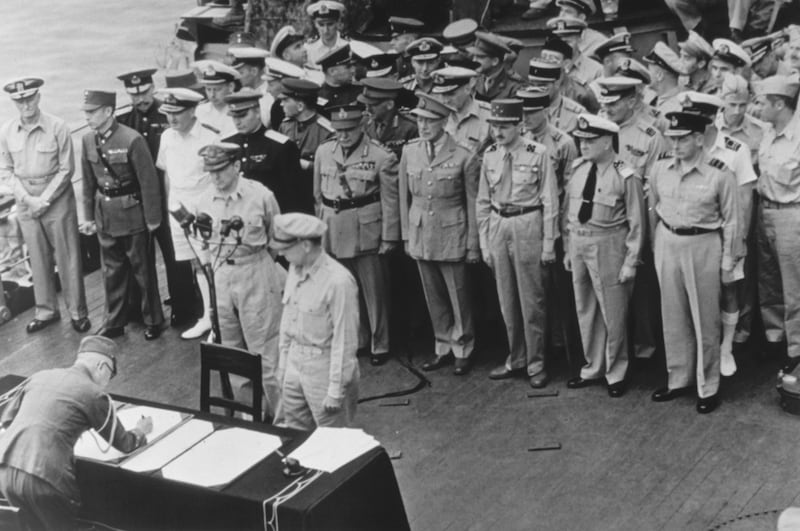
At long last, MacArthur arrived in defeated Japan. After fleeing for his life with his wife and his son, after seeing the suffering of his comrades in arms, after witnessing the brutal occupation of his beloved Philippines, after four long years of war, what did MacArthur say on the deck of the U.S.S. Missouri?
Nothing of vengeance; nothing of reproval; only words of dignity and magnanimity. “It is my earnest hope and indeed the hope of all mankind that from this solemn occasion a better world shall emerge out of the blood and carnage of the past — a world founded upon faith and understanding — a world dedicated to the dignity of man and the fulfillment of his most cherished wish — for freedom, tolerance and justice.”
“As Supreme Commander for the Allied Powers,” he continued, “I announce it my firm purpose, in the tradition of the countries I represent, to proceed in the discharge of my responsibilities with justice and tolerance.”
The Japanese delegates signed the document of surrender. Then MacArthur signed, followed by representatives of other nations. When the last had signed, MacArthur said, “Let us pray that peace be now restored to the world and that God will preserve it always.”
Witnesses reported that at that moment, the low, gray clouds parted and the sun shone brightly through.