

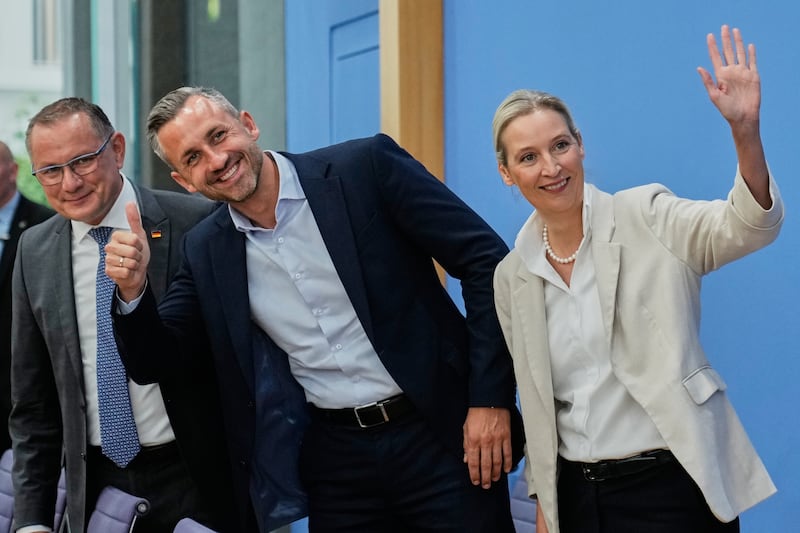

The extreme right-wing political party Alternative for Germany, or AfD for short, has just proved victorious in a state election. The victory was on Sept. 6, the election in Saxony-Anhalt, a small state in eastern Germany. The party won 44% of the vote, but still is three seats short of a majority in the state parliament.
The turnout in this closely-watched election was 78%, a significant increase from 60.3% in the previous election, held in 2021.
The AfD, reflecting inherent emphasis on doctrinal distinctiveness and a strong psychological rigidity, initially absolutely ruled out collaborating with any of the other parties. Since the election, a more pragmatic attitude has become evident. Despite the large plurality, the realities of trying to govern are now being recognized.
Party officials reportedly are exploring possible coalition with the populist reformist Sahra Wagenknecht Alliance (BSW) or even selected individual members of the state legislature from the conservative but mainstream Christian Democratic Union (CDU), a major established party with extensive governing experience, including the current national government led by Friedrich Merz.
This notably is not a typical state government election result, which would normally be largely ignored by international media. Given the history of Germany, most notably the Nazi nightmare from 1933 to 1945, an enormous amount of media is being devoted to the significance of this disturbing event. Considerable attention has been devoted to the AfD since the party was officially established in April 2013, focused on opposition to the euro and skepticism about European integration
Policy positions emphasized in this latest election include tough immigration reform, emphasis on German national culture, support for the traditional family, education reform and hostility to public media.
This nationalist emphasis is hardly unique to German politics, and in reality reflects broad regional political trends evident today across Europe, including the rapidly growing Reform Party in Britain, as well as the political rise in the of Donald Trump to the presidency of the United States.
What is distinctive about Germany, of course, is the modern history of the nation. Once unified by Chancellor Otto von Bismarck, Germany became a potential major military threat to the rest of Europe, and beyond, and also thanks to geography an inherently vulnerable territory. Decisive defeat of France in the Franco-Prussian War of 1870-1871 and the two disastrous World Wars followed.
Well before the end of World War II, Allied leaders began planning a post-war international system centered on a new United Nations. Leaders of Britain, France and the U.S. pursued economic reconstruction and political democracy in West Germany.
Germany today has an established democracy as well as powerful economy, and exercises positive effective diplomatic leadership. One current example is the Kensington Treaty, signed on July 17 last year by Chancellor Friedrich Merz and British Prime Minister Keir Starmer in London. The significant treaty deepens cooperation in defense, migration, trade and other matters.
Merz called for greatly increased cooperation with France, reinforcing a new Anglo-French agreement to coordinate nuclear weapons strategy. He also achieved successful White House visits in June 2025 and also March 2026.
Today diplomacy takes place on a firmly established, reliable foundation of international and regional institutions. UN economic institutions (IMF, World Bank, World Trade Organization) are fully global since the Cold War.
International corporations, global media, nonprofits, widespread travel, economic growth and other factors mitigate against extreme, destructive nationalism.
Germany is integrated in this world, and a positive leader.