

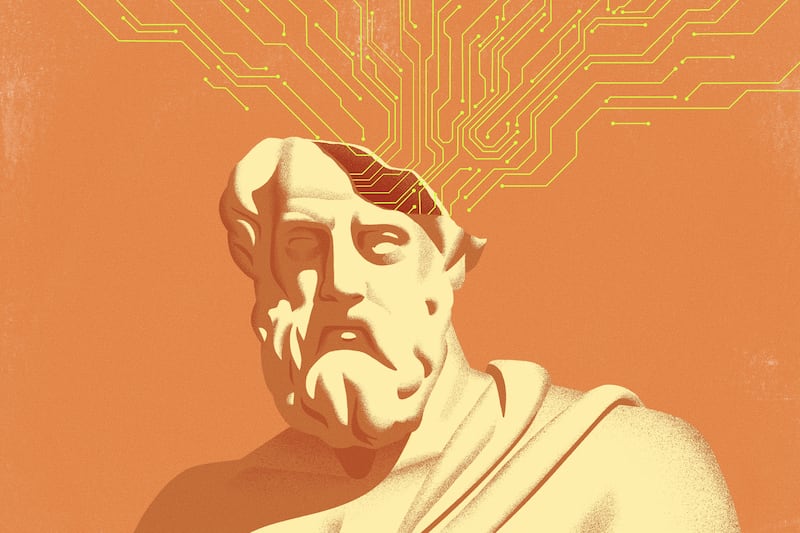

Two writers working more than two millennia apart shared a concern. The first feared that a new technology promising to make his people wiser would wind up doing the opposite, granting them a veneer of wisdom, able to say the right things while understanding little.
The second writer observed that technological advances were offering “improved means to unimproved ends,” and the speed of information transfer didn’t make it any more valuable.
The first writer was Plato. The second was Henry David Thoreau. Neither of them had ever seen a smartphone, but both would grasp today’s Faustian bargain of AI adoption and algorithmic living.
Are you feeling ‘techistential dread’?
The rapid rate of technological advancement can induce a sense of overarching anxiety. Think of it as “techistential dread” — the vertigo of wondering if a new advancement will help or hurt, increase opportunities or threaten human thriving.
A client recently sat in my office after learning that his company would lay off as much as 60% of the workforce, beginning in two months, reportedly due to AI integration.
Shortly after, this individual was tasked with presenting on the benefits of AI adoption. One might imagine being asked to deliver a warm introduction for your own digital executioner.
To engage or not to engage
Over those two months, he encountered weekly mood shifts. Some days he arrived with an air of untroubled levity. On others, he seemed to shoulder the weight of a Herculean labor.
The layoffs never left the equation. The variable that seemed to make an emotional difference was engagement. Some weeks he walked in smiling, eager to talk about meaningful human interactions, challenging training runs and time spent volunteering or playing music with his wife.
By comparison, on the heavy weeks the techistential dread pushed him away from human engagement. More doomscrolling, more ragebait content, more frustration with imperfections in his run training.
Deliberate engagement seemed to be the key. Thoreau based his famous credo on this exact practice of full presence. He celebrated a desire to “live deliberately,” to “front only the essentials,” to avoid resignation, and to “suck the marrow out of life.”
Modern psychology continues to ratify Thoreau’s 19th-century epiphany, identifying engagement as an antidote to burnout and a key component of self-improvement.
How will you use this new tech?
The effect of deliberate engagement on anxiety and related psychological phenomena in the age of AI suggests that AI Doomers are only half right. As AI models convincingly mimic human thought, critics and cynics warn that turning over our thinking to machines will erode our cognitive capacity. And the critics are correct.
Mostly. This worry is nothing new. It’s ancient. In Plato’s Phaedrus the literary Socrates relates a story wherein the Egyptian King Thamus is offered a bevy of gifts from the god Theuth.
Among these is the gift of written language. Thamus is wary, sharing our modern concern that outsourcing memory to the page will lead to a people who “seem to know much, when they are for the most part ignorant and hard to get along with.”
Plato describes the nature of this gift with the word pharmakon, used to describe a drug or elixir that can harm or heal depending on its use. Many commonplace tools might be described this way. A hammer is great when driving nails. Not as great for trimming toenails.
AI and related tech are no different. When used as a means of deliberate engagement, many of these innovations can enrich and lead to personal and professional improvement.
When this same technology leads to unconscious detachment, it does the opposite, fulfilling Plato’s warning.
No panacea
Emerging data in industrial-organizational psychology aligns with both Plato and Thoreau. Two recent studies conducted in a prominent consulting firm followed employees who used generative AI in their work. Two factors determined outcome quality: how and when AI was used.
Those who maintained clear separation between human engagement tasks and rote generative tasks were more likely to experience good workplace outcomes. By contrast, those who attempted to shoehorn AI into all domains or lean on it to navigate complex or abstract managerial tasks did not fare as well.
AI models were great at things like document review or drafting repetitive legal boilerplate. Tasks requiring in-person interaction or understanding human motivation were a poor fit, leading to negative outcomes.
Like my client, the types of engagement that made the largest difference here were relational, areas where technology offers at best an ersatz human connection.
The human factor
Counterfeit human interaction may be the most salient area of concern with passive AI and technology use. Just as we risk degrading our cognitive abilities by signing them over to AI, we risk corroding fundamental modes of human connection when we do the same.
Humans are social creatures. We’re wired for relationships. Husbands and wives, parents and children, friends and neighbors, teammates on the slow-pitch softball team, fellow congregants at church; these have been staples of human existence since the advent of the campfire.
In-person connection requires social friction. For most of humanity’s existence, if you wanted to date someone, you’d risk rejection, face social vetting from mutual friends and you’d hear about it if you behaved badly.
That social friction presents a clear binary: engage wisely and deliberately or live in isolation.
Technology has increasingly removed that friction, often to suboptimal results. The screen offers anonymity, the illusion of infinite choice and the impulse to see if the next online profile might be better than the person sitting across from you.
AI models can also serve as digital companions that become more convincing with each iteration. Research on AI romantic or social partners illustrates a few benefits at the outset of use, followed by a cascade of longer-term risks: over-reliance, manipulation, disruption of real-life relationships, and, for those predisposed to it, a loss of their relationship with reality.
Techistential dread or techno-optimism?
In the end, if we say AI is a tool like any other, how do we know whether we’re using it for the right purposes? There might not be one perfect answer, but asking whether it will increase or decrease your engagement with what you’re doing is a good place to start.
Will you be more or less likely to apply your own experience or creativity to a problem? More or less likely to call a friend and catch up over lunch? More or less likely to ask out that person in your class? Will you engage in more human things or fewer?
Thoreau might have already offered the best framing for testing engagement. Does the proposed use of AI or related digital technology encourage you to live deliberately, avoid resignation, and “suck the marrow out of life,” or is it all an improved means to an unimproved end, a simulacrum or a siren song that tells you everything you want to hear while providing nothing that you need?