

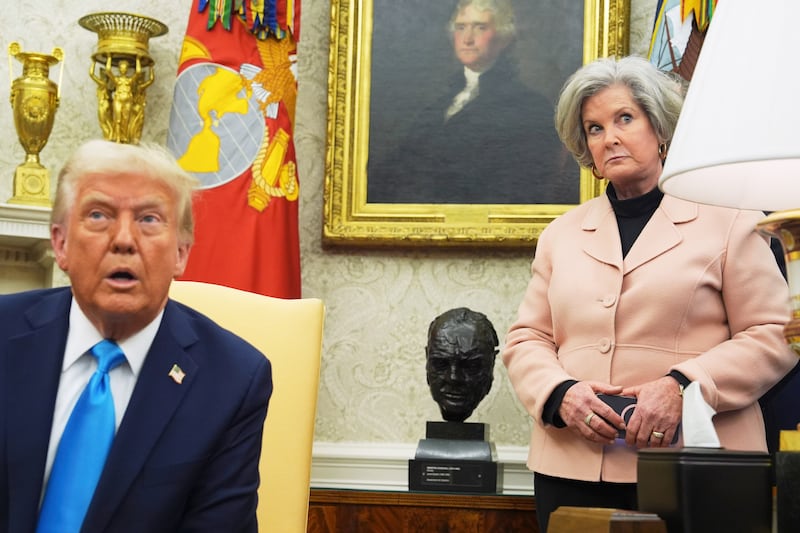

An unusual political figure made headlines this week: a chief of staff.
White House chief of staff Susie Wiles became national news when she candidly weighed in on her colleagues, including President Donald Trump, in a two-part series published Tuesday by Vanity Fair.
The brutal honesty about Trump, Vice President JD Vance and some of the biggest political moves over the year shook Washington, but to a selective group of people, it may not have been entirely groundbreaking.
But several former chiefs of staff say it’s normal to disagree with your boss — encouraged, even.
Your name’s not on the door
Among Wiles’ surprising statements to Whipple include criticism of the way the Department of Government Efficiency shuttered USAID, alleged ketamine use by Elon Musk, questions about Trump’s tariff policies, and what she believes lies behind Vance’s change of heart on Trump.
Peter Loge, the director of George Washington University’s School of Media and Public Affairs, served as the chief of staff to former Rep. Brad Sherman, D-Calif., and served in several other senior advisory positions, including at the U.S. Institute of Peace.
Loge acknowledged that, like Wiles, he didn’t always agree with his boss’ decisions, but as a chief of staff, he said, you are there to make good ideas better and bad ones improved. The difference between him and Wiles, Loge said, is that he didn’t tell Vanity Fair about those disagreements.
“I’ve argued with just about all of my bosses behind closed doors. I have not won all the arguments, and when the door opens, the decision is theirs and my job is to help implement it,” he said.
No matter what went on behind that closed door, the chief of staff must remember that it’s “not your name on the door,” Loge said.
“Good chiefs of staff recognize that their name isn’t on the door,” he said. “Nobody voted for Wiles for president. They voted for Donald Trump, and her job is to make sure that Donald Trump is able to advance the policies that his voters want him to advance.”
“I think it boils down very simply to, she made one mistake and one mistake only, and that one mistake was that she agreed to sit down for 11 interviews. I just think the mistake was that she talked too much, plain and simple.”
— Matt Waldrip, former chief of staff to Sen. Mitt Romney, on White House chief of staff Susie Wiles' decision to be interviewed by Vanity Fair
Matt Waldrip, a former chief of staff to former Utah Sen. Mitt Romney, completely agreed. During his time working for Romney, Waldrip said that the former senator expected his employees to push back on him.
“The worst thing you could have ever done for Mitt Romney is be a yes man and not challenge him,” Waldrip said, noting that they’d often have meetings where both sides of an issue was debated thoroughly.
That tactic not only helped Romney do his homework on many topics, but also “gave him tremendous sympathy and understanding of those that he would be talking to that shared a different viewpoint.”
Waldrip, like Loge, also agreed that as a chief of staff, the job is purely about supporting the person whose name is on the door.
“With that being rule No. 1, remembering that it’s not your name on the door, that’s what makes the article that came out in Vanity Fair all the more interesting because it’s put the focus on her,” Waldrip said of Wiles.
Why did Wiles do it?
Over the course of 11 months, Wiles was interviewed by Chris Whipple, a reporter with expertise in covering White House chiefs of staff dating back to the Nixon administration.
After publishing the profile of Wiles — which includes snippets examining everything from Trump’s “Liberation Day” tariff announcement to recent strikes on Venezuelan drug boats — virtually every high-ranking member of the Trump administration stood firmly united behind the chief of staff. It became clear that amid the fallout, Trump and others were going to back Wiles.
But why she agreed to sit down with Whipple 11 different times and bluntly offer up so much is unknown. To Waldrip and others in political circles, it’s “quite a head scratcher.”
Waldrip said that there are theories out there that Wiles is looking to play some sort of “4-D chess” that is “clearly calculated” since there was no way she would have not expected some of the farfetched comments to make it to publication.
“You can understand why that would be the line of thinking because she is clearly a very bright person. She’s clearly an extraordinarily calculated person, and so I think it would be correct to immediately assume that this was all calculated, that these statements that have come out as part of the article were all very intentional and it was all part of some ploy that she has,” Waldrip said.
There are several flaws in that theory, he said, noting that Wiles likely didn’t know when the Vanity Fair articles were going to be published and what exactly the reporter was going to include over the course of 11 different interviews.
The only other explanation, Waldrip believes, is that no matter if you’re the world’s most calculated person, over the course of those 11 interviews, you’re going to eventually say something you may not have wanted to say.
“To me, I think it boils down very simply to she made one mistake and one mistake only, and that one mistake was that she agreed to sit down for 11 interviews,” Waldrip said. “I just think the mistake was that she talked too much, plain and simple.”
Loge said that the criticism from the piece is interesting because it seems like Wiles is “getting in trouble for talking like a person,” which is “a weird thing to get in trouble for,” he said.
In the Vanity Fair pieces, Whipple notes how comfortable he and Wiles were together, interviewing her over sandwiches in her office and then again another time at her Washington rental home while she was doing laundry.
Waldrip noted how much work goes into being a chief of staff for a senator and believes it’d be “20 times that” in the White House. A chief of staff sifts through “such extraordinary amounts of information, of requests, and of possibilities.”
“For whatever reason, this reporter got her comfortable, got her talking, and letting off a little bit of steam, I think, and sharing some pretty candid thoughts,” Waldrip said. “If you look at her defense, it was that it was taken out of context, that there was so much more that was said than what was included.”
“I’m sure that’s right, but you got to be on your game because you know that all the reporters are looking for is those couple of nuggets that you put into and in 11 hours, you’re going to give some nuggets,” he continued.
The aftermath
Shortly after the Vanity Fair articles were published, Wiles, who has not posted on her X account in over a year, said online that she believes it was a “disingenuously framed hit piece” that lacked significant context.
Other Trump allies and Cabinet members, notably those that Wiles commented on in the articles, came to her defense. They sang her praises and said she’s worked hard in the administration. Trump also doubled down, saying that she’s done a “fantastic” job.
“I’ve argued with just about all of my bosses behind closed doors. I have not won all the arguments, and when the door opens, the decision is theirs and my job is to help implement it.”
— Peter Loge, chief of staff to former California Rep. Brad Sherman
Loge argued that some of her comments aside, Wiles seems like she is performing her duties as chief of staff correctly.
“Every executive, every senior leader needs somebody who can pull them aside and say, ‘Hey, I don’t think this is a good idea,’” Loge said. “Every senior leader needs somebody who will give them honest advice. And it sounds like that’s what Ms. Wiles is doing.”
To Waldrip, the response from other administration officials signals that Wiles has a lot of power.
“The skeptic in me says that (the response) is because there’s tremendous unity and there’s a kumbaya moment … I think people are motivated by two things in politics. They’re motivated by fear and power,” Waldrip said. “And in this case, to me, I see this as tremendous fear and there is nobody who is going to cross her.”