

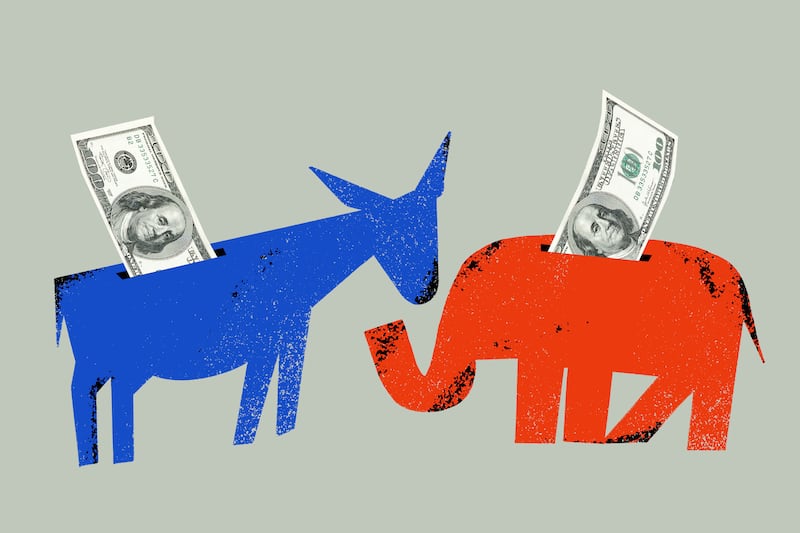

- Registered Democrats outnumber Republicans in all industries except for Christian organizations and construction.
- The sectors with the smallest share of Republican employees are tech development, media and higher education.
- Employees of law firms, fast food and clothing retail also leaned disproportionately toward the Democratic Party.
Construction, extraction and Christian organizations are the only industries in the United States with employees that lean more Republican than Democratic in terms of party registration, according to an analysis of a massive new dataset.
The voter data — compiled by researchers at the Politics at Work initiative, and analyzed by political scientist Ryan Burge — captures the partisanship of 24.5 million workers across more than 534,000 employers in the 13 states that require closed primary elections, including Arizona, Nevada and Oregon.
Burge’s initial analysis confirms public perception surrounding industries like university administration, media production and software development, which lean heavily Democratic, while highlighting politically neutral industries like real estate agents and insurance brokers.
The partisan lean of industries — calculated by subtracting the Republican share of employees by the Democratic share — favors Democrats because Republicans are more likely to be retired, Burge told the Deseret News. But the Republican Party dominated in a few industries.
The Republican workforce
Construction trades were the most Republican-leaning industry, with an overall GOP margin of 11%, Burge found. This margin doubled to 21% among the subset of construction workers employed on oil and gas pipelines, according to Burge.
After construction, religious organizations were the most likely industry to have more Republican employees than Democratic employees by a margin of 7%. But this overall measure of partisanship masks a dramatic degree of variation between religious groups.
Using artificial intelligence to sort through religious organization data, Burge found that individuals employed by Muslim organizations have a partisan lean of 65 percentage points toward the Democratic Party, and employees of Jewish organizations lean 50-points in the same direction.
Employees of Christian organizations, however, have a partisan lean of 15 points in favor of Republicans. Among Christian organizations, employees of nondenominational, Baptist and Pentecostal groups have the greatest pro-GOP lean, while Adventists, Episcopalians and Anglicans lean Democratic.
The Democratic workforce
The industry that leans most toward the Democratic Party by share of its employees’ political registration is higher education. Employees at colleges, universities and professional schools, lean Democratic by 32 percentage points, according to Burge’s analysis.
Close behind faculty and administrators are employees at law firms, who lean Democratic by 27 percentage points; employees at software companies (23 points); public employees in executive and legislative offices (21 points); and employees in general medicine and hospitals (18 points).
Viewed from the other direction, the industries with the smallest share of Republican employees were internet services (26%), clothing retail (27%), media (27%), colleges and universities (28%) and fast-food restaurants, which are tied with public health administration, at 30%.
The most politically neutral employees were real estate agents and insurance brokers, which both had zero partisan lean. Other sectors of employees with similar shares of Republicans and Democrats were engineers, mortgage lenders and car dealers.