



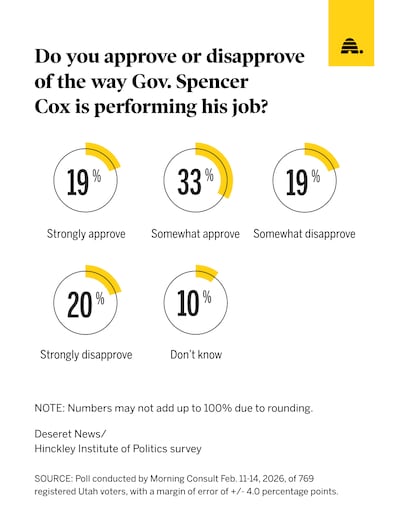
- 52% of Utah voters say they approve of Gov. Spencer Cox's performance in office.
- 44% say they don't know whether they approve of Lt. Gov. Deidre Henderson.
- Two-thirds of Republicans approve of the Legislature. Two-thirds of Democrats disapprove.
Gov. Spencer Cox remains popular but polarizing in the state of Utah even as he gains popularity for his message of depolarization on the national stage, a new Deseret News/Hinckley Institute of Politics poll found.
After a sharp decline in Democratic support between 2023 and 2025, the governor behind “Disagree Better” settled into a steady positive approval rating of 52% over the past year, driven by consistently favorable views among Republicans.
The deepening partisan divide in approval coincided with Cox collaborating more closely with President Donald Trump. This newfound relationship appears to be delivering White House wins for the state of Utah even as it alienates some Utahns.
“It’s difficult to find a balance when your key message is depolarization, but you live entirely in a polarized political environment,” said Jason Perry, the director of the Hinckley Institute of Politics at the University of Utah.
Despite the contentious climate, Cox continues to enjoy a positive net approval rating of 13 percentage points, with 52% of Utah voters saying they approve or strongly approve of his performance and 39% saying they disapprove.
The largest share of Utah voters, making up one-third, “somewhat approve” of the way Cox is performing his job, while 19% “strongly approve,” 19% “somewhat disapprove,” 20% “strongly disapprove” and 10% “don’t know.”
Cox and Trump
The survey has a margin of error of +/- 4 points for the full sample of 769 registered Utah voters. The approval rating for the Republican governor tells a fuller story when broken down by self-identified party affiliation and ideological orientation.
Seven in 10 Utah Republicans approve of Cox’s performance and 23% disapprove. Meanwhile, 28% of Democrats approve and 67% disapprove. Cox also has a net-negative rating among independents, with 38% approving and 46% disapproving.
The poll was conducted by Morning Consult at the exact midpoint of the 2026 legislative session, between Feb. 11-Feb. 14. So far Cox has weighed in publicly on issues of immigration, critical minerals, oil production and Big Tech.
But it also comes as Cox cashes in on his burgeoning friendship with Trump.
Prior to the 2024 election cycle, Cox had resisted associating himself with Trump’s GOP. That changed after the assassination attempt in Butler, Pennsylvania, when Cox sent Trump a private letter of support and pledged his vote.
Since then Cox has balanced his reputation as a national spokesperson for healthy political dialogue — a role that grew dramatically after the assassination of Charlie Kirk in Utah — with his mindset as a team player in the second Trump term.
“Politics has become more and more divided,” Perry told the Deseret News. “Democrats liked (Cox’s) tone for a long time, but eventually it becomes clear based on lots of decisions over several years in office that he is a member of the Republican Party.”
Cox’s partisan turn seems to be paying off. On Saturday, Trump praised Cox as a “very caring Governor” in a post promising to help save the Great Salt Lake. “We are going to make it all happen!” Trump said of his partnership with Cox.
On Monday, top Utah legislators celebrated the recognition from the White House. They said Cox had spent a significant amount of time with Trump over the weekend and Cox confirmed he had requested $1 billion in federal assistance.
“This is not just the environmental left who’s interested in the lake, it’s the MAGA right as well,” Cox said on Monday. “All of us, across the political spectrum, know how important this is. It always helps when you have the president on your side.”
But Cox’s alliance with Trump hasn’t stopped him from giving his candid assessment of the president.
Speaking in Washington, D.C., on Thursday, Cox acknowledged Trump was not trying to unify the country, and pushed back on the administration’s effort to preempt state regulations on prediction markets and artificial intelligence chatbots.
What about the lieutenant governor?
The lieutenant governor’s position in Utah is unique for providing statewide election oversight. Alaska is the only other state with a lieutenant governor who serves as the chief election official responsible for administering elections.
Like other states, the position is also a pipeline to the governor’s office. Around the country more than 1 in 4 governors once served as lieutenant governor. In Utah, Cox and his predecessor, Gary Herbert, were first lieutenant governors.
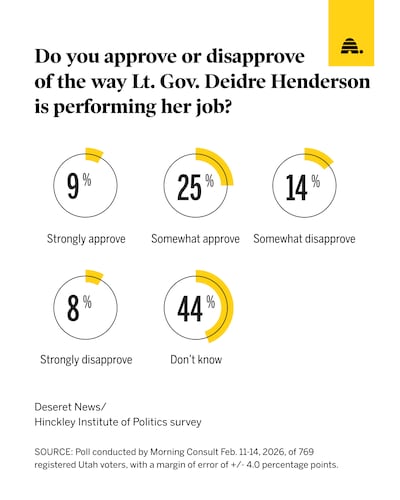
Utah Lt. Gov. Deidre Henderson has not publicly indicated whether she plans to run for governor in 2028. While a large plurality of voters are unsure, Henderson also enjoys a positive net approval rating of 12%, according to the poll.
Among all Utah voters, 34% approve of how Henderson is performing her current job, 22% disapprove and 44% don’t know. Her positive net approval rises to nearly 30% among Republicans, but is slightly negative among Democrats and independents.
During her tenure, Henderson has maintained a skeptical view of Trump, endorsing Nikki Haley in the 2024 presidential primary and refusing to endorse Trump in the general election.
While fulfilling her election duties, Henderson has largely dismissed criticisms of Utah’s election system and boldly criticized the Trump administration for dismissing state election officials.
How popular are Utah lawmakers?
The Utah Legislature also maintains a positive net approval rating of 10 percentage points as lawmakers spend political capital on overturning judicial rulings related to the state’s redistricting law.
“We are grateful for the trust Utahns have placed in us and appreciate the confidence many have in the work being done to keep our state strong and prepared for the future,” President Stuart Adams and Speaker Mike Schultz said.
“Our focus is on putting Utahns first by strengthening education and infrastructure, planning for long-term growth, expanding opportunity for families and businesses, and cutting taxes to keep our state affordable while protecting the Utah way of life.”
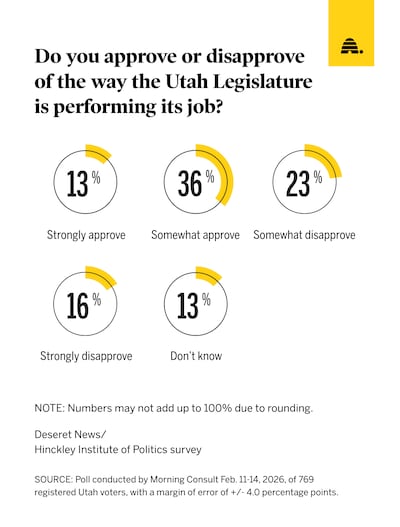
The legislative branch’s performance was viewed positively by 49% of voters, while 39% disapproved and 13% didn’t know. As with the governor, the results mostly mirrored partisan identification.
More than two-thirds of Republicans approve of the Legislature and 21% disapprove. For Democrats, the results are flipped: 27% approve and two-thirds disapprove. Just one-third of independents approve.
“The legislature being a 49% overall approval is a pretty high number,” Perry said. “Legislators are often seen as the institution itself. ... There’s just an awareness factor.”
Messaging from the Republican-controlled Legislature this session has focused heavily on affordability — with proposals to bring down the gas tax and to increase child care — and judicial accountability.
Lawmakers are advancing several policies that would increase court transparency and change the forum to hear statewide constitutional arguments amid ongoing legal battles over culture war and redistricting laws.
“The poll speaks for itself. It is important to be clear that the supermajority does not represent the entire legislature,” said Senate Minority Leader Luz Escamilla and House Minority Leader Angela Romero.
“Headlines often attribute these actions to the legislature as a whole, but voting records clearly show where Democratic lawmakers stand.”