
When Republicans took control of Washington, D.C., in 2025, party leaders touted big plans to enact their agenda through the partisan fast-track procedure known as reconciliation. But skip forward one year, just eight months before that majority will be at stake, no one seems sure if that’s still the plan.
Republicans passed their first reconciliation package in the Big Beautiful Bill last summer, approving massive tax cuts while cutting spending for certain programs the party found wasteful or unnecessary. At the time, House Speaker Mike Johnson, R-La., said they could get at least two more megabills through Congress before the midterm election cycle hit.
Johnson says another reconciliation bill is still in the works — but details of what will be included, how quickly it can pass, or even if it has enough support are still unclear.
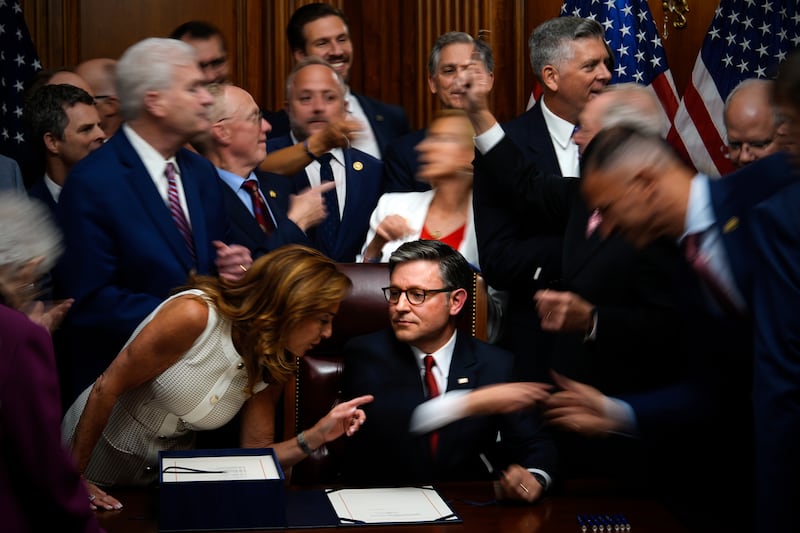
“Let’s be realistic that it will not be as big, but it can be just as beautiful,” Johnson told reporters at the annual House Republican issues conference on Tuesday in Florida.
The top House Republican said they are still “whittling down” policy ideas to be included in the framework, and that “we’re not there yet.”
“Stay tuned,” he said.
But not all members of his conference seem convinced.
Rep. Jason Smith, the chairman of the House Ways and Means Committee that did much of the heavy lifting in the previous reconciliation bill, appeared to brush off the reality of a second package clearing Congress before November.
“If you look at history, it is extremely rare for two partisan reconciliation bills to ever pass in the same Congress,” Smith said. “I would absolutely love a second reconciliation bill. I would love that, but I just don’t think it will ever happen.”
Smith has cast doubt on the likelihood of a second reconciliation bill for months, telling reporters it was his goal to get as many policies in the first package as possible to ensure as many wins as possible. That included Trump’s top campaign promises of no taxes on tips or overtime pay.
But for the rest of the Republican conference, the odds of a second package seems open-ended: If leadership thinks it’s a good idea, sure; if not, then no.
“I have a great deal of respect for Jason Smith, but if he is talking like that, then I need to understand what his reasoning is for that,” Rep. Mike Kennedy, R-Utah, told the Deseret News in an interview. “But reconciliation is certainly a tool in this toolbox that we can use.”
Other Republicans at the issues retreat seemed enthusiastic about a second reconciliation bill, echoing Kennedy’s statement that it’s one of the party’s strongest tools to get their agenda passed in a closely divided Congress.
Appropriations Chairman Tom Cole, R-Okla., said he would be “for a second reconciliation package” but acknowledged the challenges it would pose. One hurdle, he noted, is the lack of time to pass a reconciliation package compared to the previous one — which Republican leaders began crafting one year before they won control of the Senate and White House in 2024.
“Look, it’s an election year, and you run out of runway sometime in late spring to early summer on things that are new,” Cole said. “We don’t have the time we had before.”
Rep. Blake Moore, who supports another reconciliation bill, cited similar concerns, noting the first reconciliation package had a greater sense of urgency thanks to the tax hike deadlines they were working against.
“That was the driving force to getting it, making sure it got done,” Moore told the Deseret News in an interview. “There isn’t that impetus right now on anything because there’s nothing that’s looming that can be catastrophic like that.”
It’s possible that Republicans could add some sort of policy spending to support the Iran war as part of the reconciliation package, all though that is far from certain. But some Republicans say that could be a way to encourage passage.
The question remains whether Republicans will explore a second reconciliation bill — but the biggest question facing the party now is whether there’s enough support to even try.
“The first consensus has to be whether to do it,” House Freedom Caucus Chairman Andy Harris said. “Then I think the consensus will build rapidly to make it a fairly narrowly focused deal with a couple of the issues that are at hand.”