


This article was first published in the On the Hill newsletter. Sign up to receive the newsletter in your inbox on Friday mornings here.
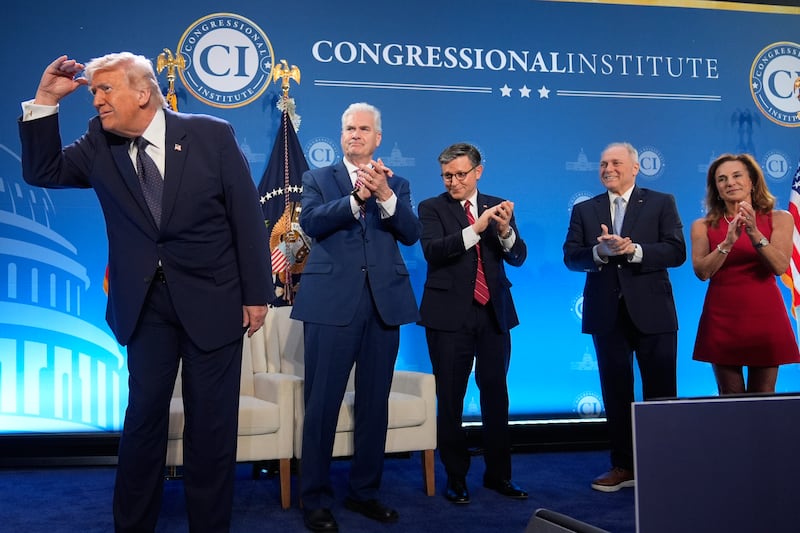
House Republicans huddled at President Donald Trump’s resort in Doral, Florida, for the second year in a row to discuss strategy.
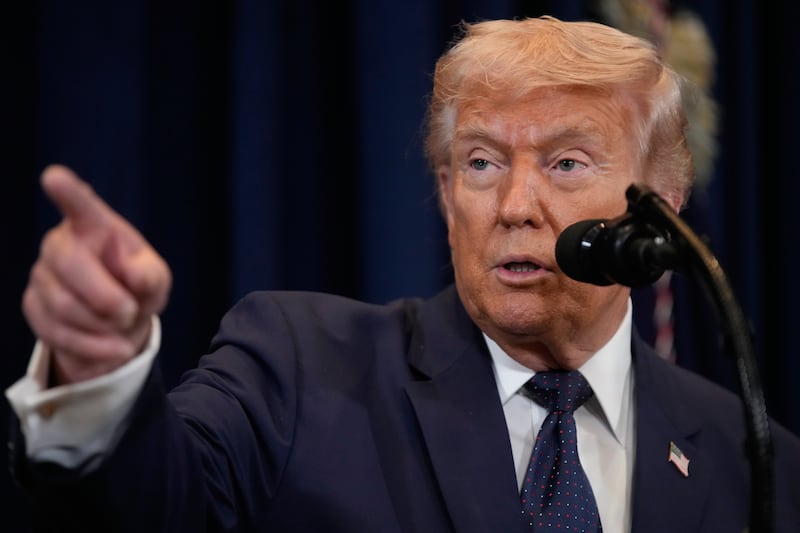
Last year, it was a bit simpler. They had just won their trifecta in Washington, and they had all sorts of possibilities to get their agenda pushed through. That’s what led to the “Big Beautiful Bill” that passed later that summer.
Now, a dose of reality has set in — and Republicans aren’t quite sure what else they should muster through before the midterm elections. Or even, really, if they can get anything else through on a party-line vote.
Take, for example, the possibility of another reconciliation package, the fast-track procedure for getting legislation through that Republicans utilized last year. I reported earlier this week that the party is split on whether to try one, but many of them view it as their only chance to get some of their top agenda priorities through with such tight margins.
“Democrats have made clear they have no interest in governing, and we will never clear the 60 vote threshold in the Senate, which is exactly why the reconciliation process is our only viable path forward,” Texas Rep. August Pfluger, chairman of the Republican Study Committee that has pushed a second framework for another reconciliation bill, told me in a statement. “Speaker Johnson is correct in saying that this bill does not have to be as big to be just as beautiful, and we do not have a guaranteed majority forever. Voters sent us here to deliver, and this is how we get it done.”
Don’t get me wrong: Republicans are united on the fact they’d love to get another reconciliation bill through. They just don’t know if it’s possible — and there isn’t a consensus on what policies would be included.
House Speaker Mike Johnson, R-La., said provisions are still being “whittled down” and there isn’t a finalized blueprint yet. But time is not exactly on their side as we are already in the middle of March in an election year, and the last reconciliation bill realistically took about two years of planning before it got passed.
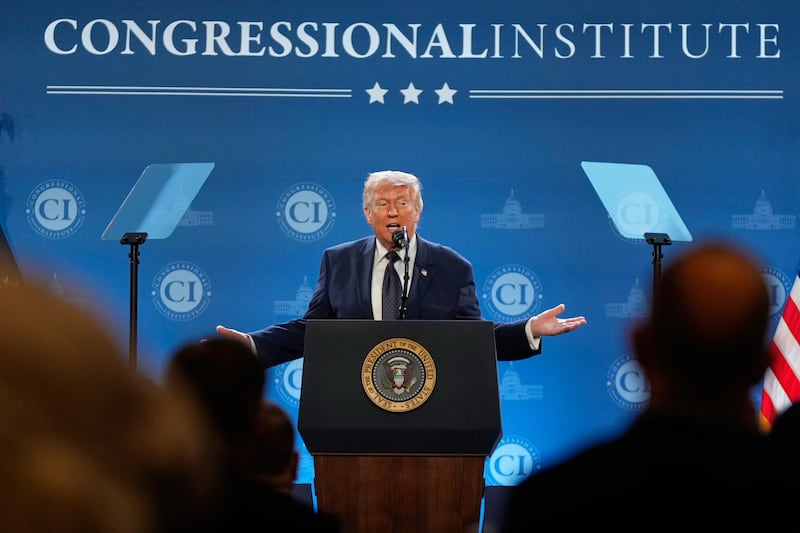
Still, committee chairmen met with rank-and-file members throughout the conference to get a sense of what the party’s priorities are at large. Trump administration officials also sat down with members throughout the week, and the president himself even made an appearance to give remarks on the first night of the conference.
But the big question is still looming: Can Republicans defy history and defend their majority?
History tells us no. Republicans want to tell us yes.
In the midterm cycle following a presidential election, the party in charge of the White House typically loses control of the House. But Republicans think they have a chance to break that precedent.
“History will tell us the party in the majority is supposed to lose seats. History tells us that momentum shifts. But I don’t know about you: history’s been wrong a lot this year,” House GOP Conference Chairwoman Lisa McClain, R-Mich., said on Monday night. “They were wrong when they said that we were not going to elect our current president, Donald Trump. So you know what? I think we are going to defy history again.”
To be sure, it’ll take a lot of effort. Midterm elections usually have lower turnout than presidential years, so voter enthusiasm will be a huge factor.
Trump won’t be on the ballot, which could be a weakness for Republicans who relied on him to help generate big turnout in 2024. But GOP leaders say he is still a major factor that will give them a boost.
“History is going to be different this time,” Johnson told reporters on Tuesday. “We’ve never had a midterm like we’re having right now.”
Other Republicans tell me the historical precedents just simply don’t apply this time around.
“I think our terrain to win midterms is still really strong. We have numerous current House Democrats that are sitting in seats that the Republican candidate for president won” in 2024, Utah Rep. Blake Moore told me on the sidelines of the retreat. “The typical ‘after the president’s first two years, the house always swings the other way,’ it’s a little different this time, because this isn’t President Trump’s first two years. This is his first two years of his second term. And folks know where they are with President Trump for the most part.”
And for the most part, Republicans are hoping to highlight what they consider to be extreme views from their Democratic counterparts as a way to boost their standing — even if they can’t get new major legislation over the finish line before November.
“The split-screen of Republicans are standing for sense and Democrats are standing for nonsensical policies is something that I believe the American people can judge the difference, and that enhances our likelihood that we can win the majority during the midterms,” Utah Rep. Mike Kennedy told me near the end of the retreat. “We’re going to be dedicated between now and the election come November, to make sure that that message is heard and that we actually carry the majority, contrary to the predictions of the doomsayers.”
Stories Driving the Week
- Rescue operation: A large tour group consisting of Utah residents were stranded in the Middle East as airspace began closing down and some airports were damaged due to strikes. It threw Rep. Blake Moore and other members of the Utah delegation into a frenzy to develop an evacuation plan for Utahns who were stuck in the area without a way to get home.
- Secret weapon: As President Donald Trump huddled with House Republicans on Monday evening, he pinpointed one piece of legislation that he said must be passed before the November elections in order to “guarantee” a Republican sweep. That bill, the SAVE America Act, has become Trump’s fixation in recent weeks as he urges Republicans to crack down on voter fraud and enforce identification requirements.
- Debt limit: Utah Sen. John Curtis is leading an effort to decrease the national debt — and he wants Utah to serve as a model to get the federal government back on track.
Is Congress done with legislating?
Another big story you’ve likely seen this week is President Donald Trump urging Republicans to prioritize the passage of the SAVE America Act, the flagship election reform bill led by Utah Sen. Mike Lee.
In essence, the bill would establish proof-of-citizenship and voter ID requirements to vote in federal elections. But now Trump also wants to add unrelated measures such as restrictions on transgender surgeries — and he’s telling Republicans to get it done as quickly as possible.
And by that, he has said he won’t sign anything into law until that is passed. So would that mean Congress is effectively done with its job — considering the fact the SAVE America Act has been stalled in the Senate for over a year?
Well, it depends on who you ask. Some Republicans I talked to at the retreat, including House Speaker Mike Johnson, think this is more so a pressure tactic rather than an actual threat.
“No, and it’s — I’m going to talk to him about that,” Johnson told reporters at a fireside chat on Tuesday. “I understand that he’s trying to emphasize the importance of this priority, how critical it is to not just to him, but to the American people and to all of us. … But I think he wants to send a signal to the Senate in particular, that he’s very serious about this.”
Johnson also pointed out that just because Trump doesn’t sign something, that doesn’t mean it won’t be enacted. A president can leave legislation untouched for 10 days and, without a veto, it’ll automatically become law without his signature.
That would come as a sigh of relief for some lawmakers, especially appropriators who are hoping to get a deal on reopening the Department of Homeland Security — something they’d hope Trump would sign if it reached his desk.
“I think he’s making that point to tell us how important it is to him, and to make that point emphatically, and to send the same message to the Senate — I get that,” House Appropriations Chairman Tom Cole, R-Okla., told me. “But I think in a practical world, you produce what you can when you can. And there’s things that I know he wants. … To me, it’s just, ‘Hey, I want this done PDQ,’ but that doesn’t mean ‘I wouldn’t sign.’ I don’t take that. I take that as a rhetorical flourish, not as a line in the sand. But that’s up to the president.”
We’ll see if the promise from Trump holds up — but of course, Congress will need to pass something in order to test that. Remember: Congress passed fewer than 40 bills that were signed into law last year, one of the lowest outputs during the first year of a presidency in modern history.
That could slow down even more in an election year.
Quick Hits
From the Hill: Trump pick for State Department position drops bid after Curtis opposition sank nomination. … Blake Moore breaks with Trump’s push to add culture-war issues to election bill. … Plaque honoring Jan. 6 law enforcement installed in Capitol after yearslong battle.
From the White House: Jill Biden says it’s time to ‘set the record straight’ in new memoir. … Is ‘MAGA Warrior’ Markwayne Mullin the solution to DHS’s battle with Democrats? …
From the courts: Federal judge rules Kari Lake’s tenure leading Voice of America CEO illegal. … NYPD investigates explosives thrown at protesters near Mamdani’s Gracie Mansion.
What’s next
The House and Senate both return to Washington, D.C., on Monday where negotiations over DHS funding will continue.
As always, feel free to reach out to me by email with story ideas or questions you have for lawmakers. And follow me on X for breaking news and timely developments from the Hill.