


Congressional Democrats sent their latest counteroffer to reopen the Department of Homeland Security, breaking their silence after stalling for 18 days amid negotiations with the White House.
Democratic leaders sent the offer around 11 p.m. on Monday, and White House officials are “currently reviewing” the details, an administration official told the Deseret News. But top Republicans on Capitol Hill said the latest proposal “didn’t change much from where we were.”
“There are things that, in my view, have been significant gives on the part of the White House, but the Democrats seem intent on dragging out this political issue,” Senate Majority Leader John Thune, R-S.D., told reporters on Tuesday.
What the White House is offering in ICE negotiations
Over the last month, Democrats and White House officials have remained tight-lipped on the details of the negotiations. But after the latest round of talks appear to have fallen apart, the White House sent a letter to top Republicans on Tuesday sharing what concessions they have made.
“Throughout this process, the Administration has offered to codify improved operational guidelines to its immigration enforcement operations,“ White House border czar Tom Homan wrote in the letter, which was obtained by the Deseret News. ”These would be layered on top of the updates that were negotiated, agreed to, and passed through the House on a bipartisan basis."
The White House laid out five main concessions offered by the administration, including an expansion of the use of body cameras, with exceptions for undercover operations. The administration also offered to “limit civil immigration enforcement activities at certain sensitive locations” such as hospitals and schools.
Both those proposals were main demands from Democrats.
The White House said it would increase congressional oversight of DHS detention facilities by creating mandatory review and compliance reporting with the inspector general, according to the letter. And the administration agreed to demands from Democrats to enforce use of “visible officer identification for DHS law enforcement” that must be “clearly displayed.”
The administration also committed to adhere to existing law not to deport U.S. citizens “except when the person violates a state or federal law that makes the citizen subject to arrest.”
Those concessions are mostly in line with what Democrats have demanded. However, the minority party is still pushing for other changes, such as judicial warrants for arrests, that the White House has been hesitant to agree to.
How did we get here?
Democrats have been engaging directly with the White House on funding for DHS for the 2026 fiscal year since early February. Congress was on track to pass a spending bill that had been negotiated between both parties, but Democrats scuttled those plans after a pair of deadly shootings by federal immigration officers in Minneapolis in January.
Since then, Democrats have demanded major reforms to how immigration officers can operate, including body cameras and judicial warrants. But as talks drag on, Democrats say the White House isn’t offering enough while Republicans say the minority party is refusing to compromise.
“I was going over last night some of the gives that the White House had made that went above and beyond,” Thune said. “And there’s a lot of stuff in there. I mean, even with respect to body cameras, there was $20 million in the original bill, there’s $100 million in the proposal from the White House to include audits by the Inspector General in reviews for noncompliance.”
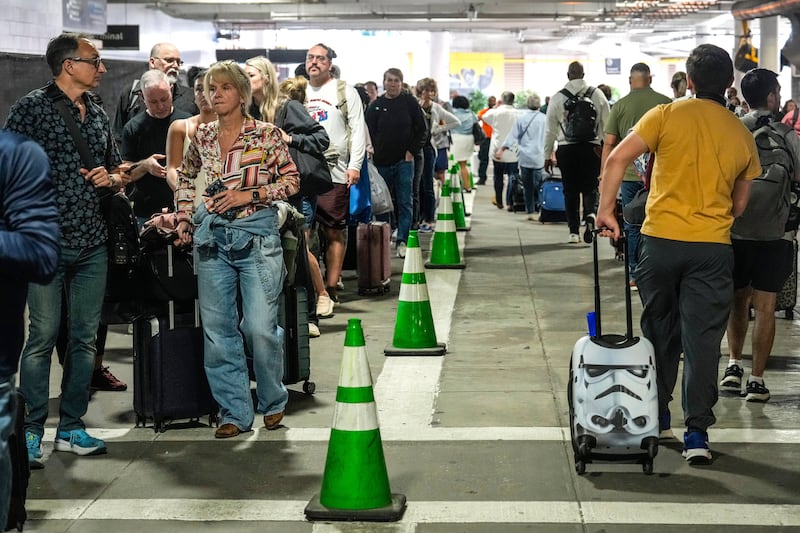
Federal funding for DHS lapsed at midnight on Feb. 14, leaving the department shuttered for over a month. That’s caused challenges for agencies beyond those that deal with immigration, such as the Transportation Security Administration that has dealt with major airline delays due to staffing shortages.
Airline CEOs urge Congress to reopen DHS amid TSA staffer shortages
TSA agents have not been paid since the shutdown began, prompting pushback from Republicans and those who work in the industry.
A group of airline CEOs wrote a letter to Congress earlier this week demanding they fund TSA, citing concerns about staffers missing paychecks.
“That is simply unacceptable. It’s difficult, if not impossible, to put food on the table, put gas in the car and pay rent when you are not getting paid,” the letter reads. “In these times when it’s hard to reach consensus on just about anything, it is significant that the vast majority of Americans want Congress to pay federal aviation workers, keep our National Airspace System secure and ensure travelers and packages can get to their destinations safely.”
Democrats have suggested stripping TSA from the full DHS bill to fund the agency on its own, but Republicans have rejected that idea over concerns it would leave all agencies funded but those that have to do with immigration and border security.
“They want to peel off all the things that they want to fund and not deal with the things that they don’t,” Thune said. “What I’m saying is, we can do this, and we can do it with the reforms — or a lot of the reforms that you’ve been requesting — but we’ve got to have a meaningful conversation where we sit down at the table and actually work these issues out.”
House Minority Leader Hakeem Jeffries, D-N.Y., said on Monday that party leaders “continue to have dialogue” with the White House regarding DHS funding. That comment came hours before Democrats sent a counteroffer for the first time in nearly three weeks.
But Senate Republicans have pushed back on the characterization that negotiations are ongoing, telling reporters late last week that Democrats have been giving radio silence.
“Members need to get in a room, have tough conversations and figure out a pathway for the American citizens and their safety and security should matter more than politics in November,” Alabama Sen. Katie Britt, who is leading negotiations for Senate Republicans, said on Thursday. “Unfortunately, Democrats continue to try to take hostages.”