

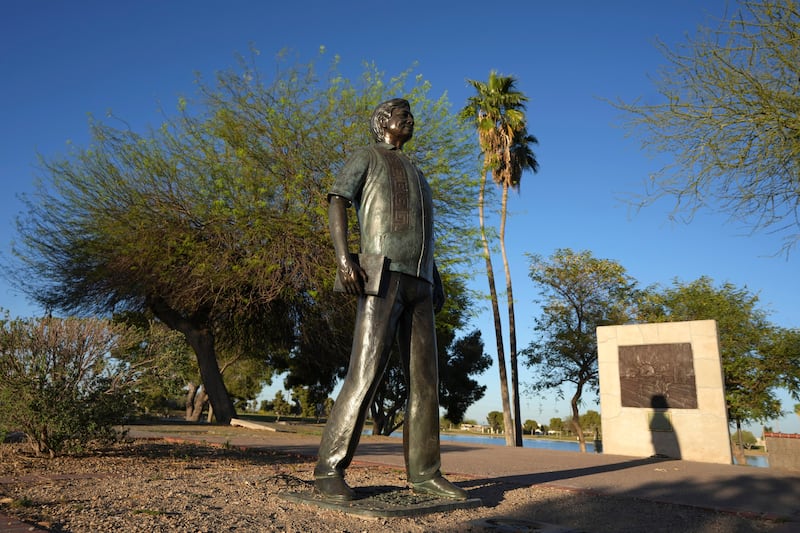

César Chavez Day came and went as cities and states across the country removed Chavez’s name from roads, buildings and holidays.
On Wednesday, Arizona Gov. Katie Hobbs signed a bill to repeal her state’s César Chavez holiday.
Several states — California, Arizona, Colorado, Texas, New Mexico, Michigan, Utah, Wisconsin, Rhode Island and Nebraska — recognize César Chávez Day on March 31, but that changed this year as states canceled, postponed and rebranded events.
“Like so many others, I’m deeply troubled by the recent revelations about César Chávez. After learning the troubling news, I decided not to recognize César Chavez Day this year and have signed legislation to repeal the observance of March 31 as César Chavez Day,” the governor said.
The bill, introduced after The New York Times’ investigative report detailing allegations of Chavez sexually abusing girls and women, passed the Republican-controlled state Legislature with bipartisan support.
“While I know signing this bill won’t erase the pain, my thoughts are with the victims and everyone affected. I’m working with community leaders to find meaningful ways to honor and celebrate our farmworker community and their continued contributions to the state of Arizona,” Hobbs added.
What did the Times report find?
Chavez grew in prominence in the 1960s for advocating for farmworkers at the same time African Americans were fighting for their civil rights. Chavez, the co-founder of the United Farm Workers Union, negotiated for better wages and working conditions by creating pressure through marches and boycotts.
Although much of his activist work took place in California, he often returned to his home state of Arizona for many labor protests, including the 24-day fast in Phoenix in 1972. In 1993, his travel to a protest in Yuma, Arizona, a stone’s throw away from his birthplace, San Luis, a border town, became his last. At the time, he was defending UFW against a multimillion-dollar lawsuit filed by a major lettuce producer.
The Times’ report found that Chavez allegedly sexually abused Dolores Huerta, with whom he co-founded UFW. Two minors were also his alleged victims at the height of his popularity. In the report, those women, now in their 60s, recounted their stories about yearslong abuse that began when they were 12 and 13.
Chavez shared eight children with his wife, but the Times’ report found he also fathered four more children with other women.
The latest allegations tainted celebrations everywhere, even his birthplace, San Luis, where all related public events were canceled.
What happens to Chavez’s legacy in advocacy for farmers?
UFW said the allegations in the report were news to the organization.
“The allegations about abusive behavior by César Chavez go against everything that we stand for,” the organization said in a statement, adding that they are taking the investigative report seriously.
“Recognizing how serious the allegations are, the UFW Foundation has canceled all César Chavez Day activities this month,” UFW said.
“For nearly 20 years, the UFW Foundation has worked to advocate, organize, and provide direct services that protect and serve farmworkers and immigrants — many of whom are women, and many of whom have shared their painful stories with us. We know this is difficult and painful, and the healing and safety of survivors is of utmost importance to us,” the statement added.
Now, despite the more than three-decade legacy, Americans who grew up idolizing Chavez must now reconcile with the fact that the same man accused of sexual abuse also coalesced thousands of people to help farmworkers.
The reports also leave a bigger question: What happens to the movement Chavez led to help farmworkers?
Geraldo Cadava, a professor of history and Latino studies at Northwestern University, told PBS that historians already view the UFW as part of a “broader social movement.”
“I think what placing Dolores Huerta at the forefront of the movement now does, on the one hand, is acknowledge women’s contributions and the idea that women have always been part of the union and were central to its successes,” he said.
Many places previously named after Chavez are being changed to Huerta. But Cadava warned against replacing one idol with another.
“I would only caution against simply replacing Chavez with Huerta and lionizing her, coming to lionize her in the same way that we lionized César Chavez,” he said, “because to replace one hero with another hero could also stunt the movement in some ways.”