

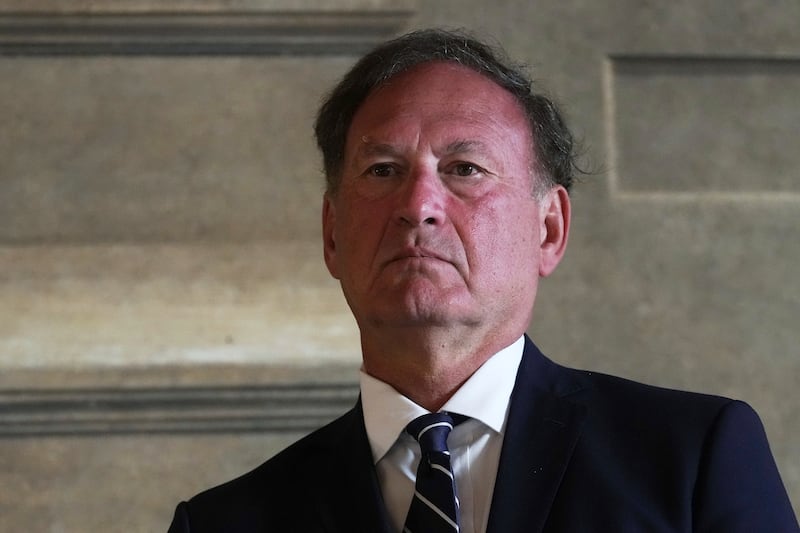

The biggest story this week out of the Supreme Court isn’t about a landmark decision or fiery oral arguments. It’s instead about the possibility of retirement of a longtime justice: Samuel Alito.
After President Donald Trump was reelected, questions have loomed about whether the court’s more conservative older justices would retire, leaving an open spot for the president to appoint someone like-minded. This has put a spotlight on the possible retirements of 76-year-old Alito or 77-year-old Justice Clarence Thomas, which would allow Trump to make an additional pick after appointing three justices during his first term.
Alito hasn’t made any sort of retirement announcement yet, but rumors swirl it could happen at the end of the court’s current term, which wraps up around late June or early July.
However, with the 2026 midterm elections around the corner, this brings up a partisan battle that’s already about a decade old.
Court sees years of partisan drama
A month after Justice Antonin Scalia died in February 2016, former President Barack Obama nominated Merrick Garland to the Supreme Court. As it was the final year of Obama’s presidency, Senate Majority Leader Mitch McConnell said he would consider any appointment to be null and void and the new justice would have to be chosen by whoever won the general election that fall, which turned out to be Trump.
Senate Democrats pushed back on McConnell and said there was plenty of time before the November election to confirm a new justice. Republicans refused and Garland’s nomination expired in January 2017.
Trump then assumed office and nominated Justice Neil Gorsuch. Just over a year later, Trump nominated Justice Brett Kavanaugh after Anthony Kennedy retired from the court.
Then, after Justice Ruth Bader Ginsburg died in September 2020, Trump nominated Amy Coney Barrett to succeed her. Barrett’s nomination was supported by Republicans who wanted to quickly confirm her ahead of the 2020 presidential election.
Many Democrats were upset that her nomination was moved forward just four months before Trump’s first term was set to end after the McConnell-Garland fight from just a few years earlier. She was confirmed to the Supreme Court just eight days before the 2020 election.
Justice Stephen Breyer retired from the Supreme Court in June 2022, leaving former President Joe Biden to appoint Ketanji Brown Jackson. She became the first Black woman to serve on the high court after Sens. Mitt Romney, Lisa Murkowski and Susan Collins joined all Democrats in voting her forward.
In the four years since, the court’s makeup has remained stable even as the retirement rumors have not faded.
So … Alito? Thomas?
Earlier this week, Senate Majority Leader John Thune said that Republicans would quickly fill a Supreme Court vacancy if one opens up before the midterm elections this fall.
“That’s a contingency I think around here you always have to be prepared for,” he told reporters Tuesday. “And if that were to happen, yes, we would be prepared to confirm.”
It’s been floated that should Alito or Thomas retire, Trump has been eyeing Texas Sen. Ted Cruz as a replacement. The president previously joked that Cruz would get unanimous consent from his fellow senators because “they want to get him out of there.” Utah Sen. Mike Lee has also been floated for the position.
Last month, attendees gathered for a formal dinner honoring Alito’s 20th year serving on the Supreme Court. An unspoken topic of the night was whether he’d serve a 21st, The New York Times reported.
Thomas, the court’s oldest sitting justice, has ruled out retiring in recent years and indicated that he intends to serve for a history-breaking amount of time. Should he stay working through spring 2028, he would be the longest-serving justice in the Supreme Court’s history after starting in 1991.
That’s put the spotlight on Alito.
Even as speculation mounts, some experts say that a retirement won’t happen. Ilya Shapiro, a senior fellow at the Manhattan Institute, told the Deseret News last summer that both Alito and Thomas are enjoying their comfortable positions on the court.
“They’ve never had more influence, more power, so why would they leave at the top of their game?” Shapiro said.
Shapiro noted that there’s plenty of time before the 2028 general election for a retirement to take place.
“If it looks like the Republican brand is really low and there’s much more likely than not a Democrat that wins the White House in 2028, at that point I could see Thomas retiring … in June ’28,” he said.
“We would have another election year confirmation battle,” Shapiro said.
Lifetime appointments or term limits?
Over the past decade or so, it appears that Supreme Court nominations have become more attuned to the political calendar, with both parties anticipating the right time for retirements.
After Ginsburg died at 87 while still serving on the court, some in the Democratic Party criticized her for not retiring and allowing Obama the chance to nominate someone to replace her.
Alito allies have indicated that the conservative justice is well aware of the political calendar and would prefer to have a Republican president choose his successor. Still, they are unsure about his plans, the Times reported.
Stephen Spaulding, a Supreme Court expert at the Brennan Center for Justice, compiled an online thread this week detailing how “it doesn’t have to be this way.”
The retirement season frenzy is beginning as the court nears the end of its 2026 term, but Spaulding argues that the Alito rumors show “the system needs reform.”
Spaulding said Congress could stop justices from “strategic, calculated retirements” by enacting term limits for justices and putting a cap on how many Supreme Court appointments a president can make in a single term.
He highlighted how if Alito, Thomas or 71-year-old Chief Justice John Roberts were to retire, Trump would be on his way to appoint his fourth, fifth and even sixth justice to the court. Biden made one appointment, Obama and former President George W. Bush made two each, and former President Jimmy Carter did not make any.
Spaulding argued that justices timing their departure undermines trust Americans have in the high court. He pointed to the reintroduced bill by Rep. Hank Johnson, D-Ga., that would cap justices at 18 years of service on the court.
“Enough is enough. We can get things back on track in a way that would give presidents an equal impact on the court, while bringing in new voices and viewpoints to the bench,” Spaulding said. “Congress has the power to make this the law, and it should.”
Ilya Shapiro, during an interview with the Deseret News on Thursday, said while term limits may be popular with the public, it would take an amendment to the Constitution to institute them, and the logistics of an 18-year cap are complicated.
“What would you do with the current court? Are they grandfathered in? Are the five of them who served longer than 18 years instantly retired? What happens with the Senate that doesn’t confirm someone every two years?” he asked.
Shapiro noted that the Alito retirement rumors have intensified because Republicans’ chance of political success in the midterm elections are in limbo. While unlikely, should Democrats flip the Senate in November, it would make it way more difficult for Trump to push through a conservative-leaning justice.
He noted that the most recent example of a divided White House and Senate confirming a justice was Thomas in 1991. Today’s political environment is “very different” than it was in the ’90s, Shapiro said.
We are now at a point in time where “the parties are more ideologically sorted and polarized than they’ve been since the start of the Civil War,” he said, adding that changing the Constitution to create term limits won’t fix the polarization.
So, in Shapiro’s point of view, it’s still up in the air, but he still doesn’t think a retirement announcement is coming any time soon.
“Unless you hear something from a justice or maybe his wife, I would discount it,” he said. “It’s just rumors based on rumors based on speculation.”