

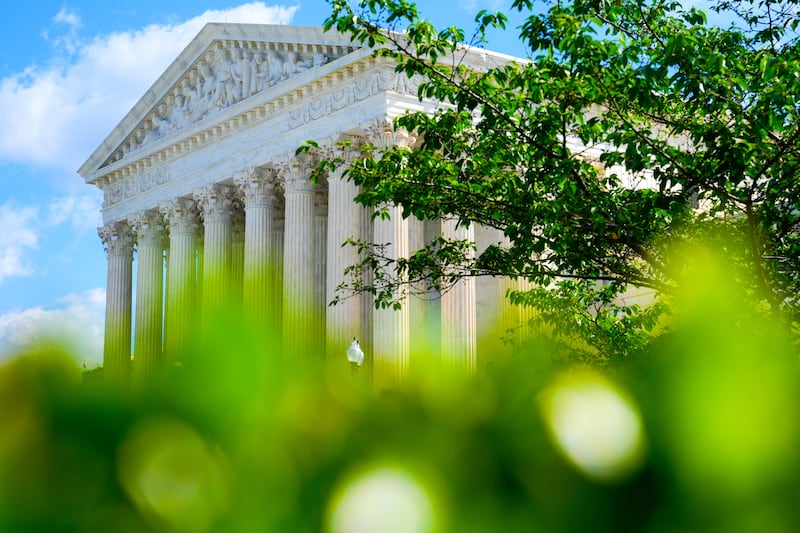

The Supreme Court on Wednesday will consider the rights of lawful permanent residents who have been accused of committing a crime that could put them at risk of being removed from the United States.
The case is focused on Muk Choi Lau, a Chinese national who became a lawful U.S. resident in 2007. He was arrested in 2012 and charged under a New Jersey law that said he allegedly sold $300,000 worth of knock-off shorts.
While Lau was awaiting trial, he left the U.S. but upon his return he was deemed an “applicant for admission” by the Department of Homeland Security which sought his removal from the United States.
Green card holders typically have been able to leave the U.S. for short periods and then return without their immigration status being impacted.
According to the Immigration and Nationality Act, they shouldn’t be regarded as seeking admission to the U.S. upon their return and should be regarded as someone that has the right to enter the country. However, there are exceptions if the individual has committed a dishonest or immoral crime.
Officers determined Lau’s pending trial meant he was subject to that exception and he was paroled, temporarily allowed entrance to the country while he was facing prosecution.
He later pleaded guilty to the counterfeiting charge and was sentenced to two years of probation. Then, DHS moved forward with removing him from the country. Lau tried to argue that counterfeiting wasn’t an immoral crime that was grounds for his removal and he had been wrongly classified as someone seeking admission to the country, not a lawful permanent resident.
Additionally, migrants who have been admitted to the U.S. can be deported if they’re convicted of an immoral crime within five years of their initial admission to the country. However, in Lau’s case, five years and 10 months had passed between his crime and admission, meaning he likely could have avoided deportation had the immigration officer at the John F. Kennedy airport upon his return admitted him, SCOTUSBlog reported.
An immigration judge ultimately decided that Lau was inadmissible. He brought it to the Board of Immigration Appeals, which affirmed the judge’s ruling. Then, Lau brought the case to the U.S. Court of Appeals for the 2nd Circuit, which disagreed with the other rulings and thought Lau was wrongly classified.
The five year and 10 month timeline is proving to be a major topic for the justices, as the appeals court judges note that it was unclear when DHS must prove that the disqualifying crime is committed to deem an individual ineligible for entry into the country.
Solicitor General D. John Sauer brought the case to the Supreme Court, asking the justices to overturn the appeals court decision. They will determine whether immigration officials need clear evidence that Lau committed a crime at the JFK airport upon his return or later during removal proceedings.
Lau argues that the government has ignored its textual limitations.
The justices will hear from Sauer and Shay Dvoretzky, Lau’s attorney, on Wednesday. The case, originally named Bondi v. Lau, is now Blanche v. Lau, after former Attorney General Pam Bondi left the Trump administration and Todd Blanche became acting attorney general.