

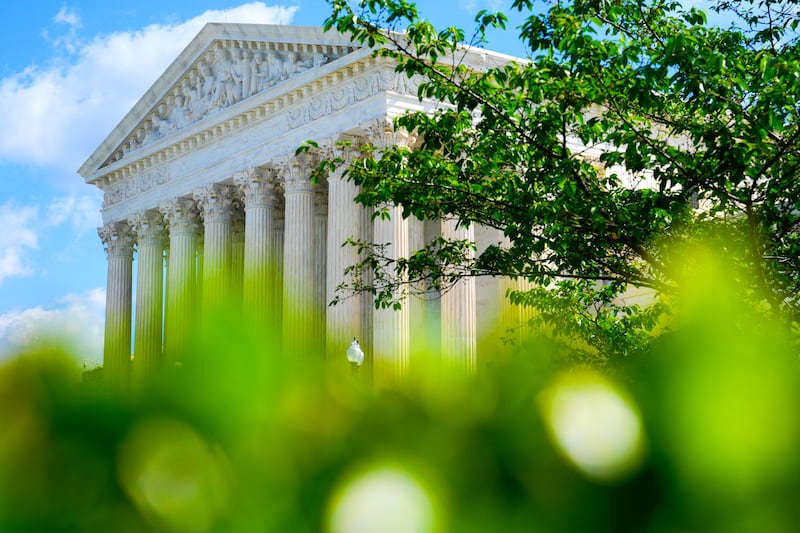

The Supreme Court on Wednesday heard oral arguments in a case centered around whether the government can deport someone who has a green card but committed a crime, appearing skeptical of the government’s argument to change admissibility standards for those who travel out of the country.
Arguments were at some points tense, particularly between Justice Sonia Sotomayor and Sopan Joshi, the assistant to the U.S. solicitor general, who argued on behalf of the government.
The court’s more liberal justices appeared skeptical of Joshi’s argument, which is that the government was correct in attempting to deport Muk Choi Lau, a Chinese national who became a lawful U.S. resident in 2007.
The court’s conservative justices also questioned some of the government’s arguments, including Justices Clarence Thomas, Neil Gorsuch and Amy Coney Barrett. But Justice Samuel Alito seemed frustrated by some of the liberal justices’ questioning and said one of their hypotheticals was a “conspiracy theory.”
Lau was arrested in 2012 and charged under a New Jersey law that said he allegedly sold $300,000 worth of counterfeit shorts. While awaiting trial, Lau left the U.S., but upon his return he was deemed an “applicant for admission” by the Department of Homeland Security at John F. Kennedy International Airport instead of a lawful permanent resident, who can typically leave the U.S. for short periods and return without their immigration status changing.
Under the Immigration and Nationality Act, the individual generally has the ability to return to the U.S., but there are exceptions if the person has committed a dishonest or immoral crime. Lau was put on parole as he awaited his trial.
He later pleaded guilty to the counterfeiting charge and was sentenced to two years of probation. However, the department moved forward with his removal from the country, leading to the ensuing legal battle that was before the justices Wednesday.
One of the main questions before the Supreme Court was the timing of Lau’s crime and when DHS began its proceedings. Migrants who have been admitted to the United States can be deported if they are convicted of a crime deemed immoral if it happens within five years of their initial admission to the country. In Lau’s case, five years and 10 months had passed between his conviction and admission, meaning he could have avoided deportation had the officers at the airport admitted his return to the country.
Lower court judges noted that it was unclear when DHS must prove that the disqualifying crime is committed to deem someone ineligible to be granted reentry. The justices will determine if immigration officials at the airport needed clear evidence that Lau committed a crime or later during the deportation proceedings.
Shay Dvoretzky, Lau’s attorney, noted during oral arguments that the government has changed its language about when exactly the government must prove that Lau was admissible.
He questioned the level of confidence that an immigration officer has that the individual should not be admitted based on the existing guidance for a green card holder.
“What information does the officer have before them? And how does that suffice? Does that satisfy the level of confidence required to conclude that this returning (legal permanent resident), who has a statutory right to the country, should nonetheless be stripped of that right?” he questioned.
Barrett and Justice Brett Kavanaugh pressed Dvoretzky about the exceptions to admission into the country, like a conviction. Dvoretzky noted that Lau had not yet been convicted of a crime at the time the immigration officer would not admit him to the country and argued that the officer likened a pending charge ahead of a trial to a conviction.
Sotomayor and Justice Ketanji Brown Jackson pressed Joshi on the possibility that an anti-immigration government might crack down on legal permanent residents reentering the country in an effort to remove non-U.S. born individuals from the country.
Under the Immigration and Nationality Act, a green card holder is guaranteed reentry to the U.S. and not regarded as someone seeking admission to the country, unless one of six exceptions apply: they have abandoned or relinquished their legal permanent resident status; they have been gone from the U.S. for more than 180 days; they engaged in illegal activity outside of the U.S.; they departed the country during removal proceedings; they committed certain criminal offenses; and they are attempting to enter without proper admission.
Sotomayor questioned Joshi about if the government can determine someone fits into one of those six exemptions “for any reason the government can think of” and begins to “willy-nilly” parole green card holders that they no longer want in the country. Sotomayor and Joshi went back and forth on the matter and several others as she suggested that the government didn’t have enough proof to determine Lau had committed an immoral crime.
During her closing questioning, Jackson expressed emotion about the case’s facts and the government’s argument. She said she didn’t understand why a border officer “suddenly has so much power to deprive a person” who has a green card reentry into the United States when he had not been convicted yet. Like Sotomayor, Jackson expressed concern about an anti-immigrant government going after green card holders upon their return to the U.S.
“They take this person’s green card, which then makes it much, much harder for this person to actually live and work and continue in their life here in the United States, perhaps so much so that this person self-deports because it’s really, really difficult without a green card to operate in this country,” she said. “So you could imagine a world in which a government that really is not interested in immigration and having immigrants living here and working could use this kind of thing to inappropriately parole people rather than admit them so that it depresses immigration.”
Joshi pushed back on the hypothetical, saying DHS would have to be filled with “monsters” for that to happen. He also said the Immigration Nationality Act shouldn’t be interpreted on the assumption that the “entire executive branch is operating on bad faith.”
While the justices appeared skeptical about the arguments presented by the government, how they will rule is unknown, particularly as the court’s more conservative justices stick together and immigration-related cases are generally voted along 6-3 partisan lines. A decision in the case is expected to be handed down by late June or early July.