

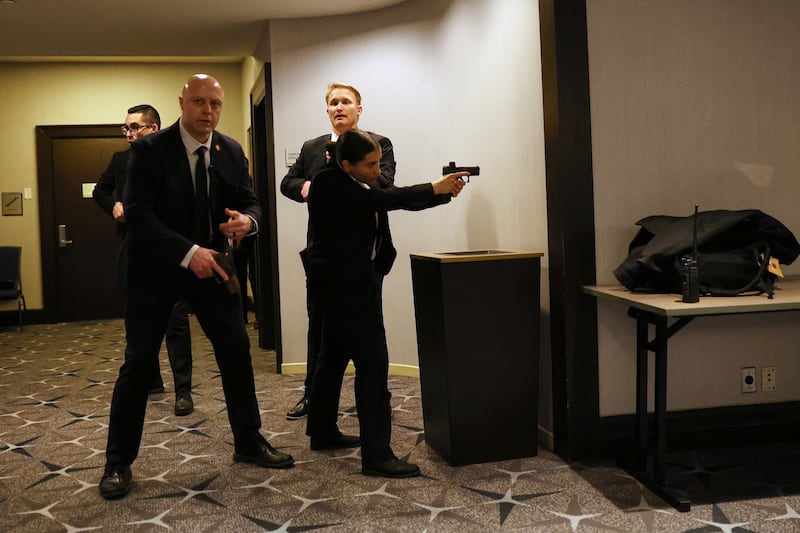

The shooting at the White House Correspondents’ Association dinner on Saturday evening has left a curtain of uncertainty over Washington, D.C., all while intensifying debates that have already left lawmakers on Capitol Hill in a gridlock for the last few months.
Lawmakers will return to the Capitol on Monday with a busy week ahead while also grappling with the attack over the weekend that several members were present for. Many legislators are using the incident — during which President Donald Trump and members of his Cabinet were evacuated just minutes after the dinner began when shots were fired on the floor above — to pressure their colleagues to reopen the Department of Homeland Security.
Others are using the moment to push for other legislation addressing security concerns for future events. Meanwhile, Congress is expected to hear from King Charles III this week, which will heighten law enforcement presence on Capitol Hill after the events of this weekend.
Here’s a list of everything Congress is expected to work on this week, and how the shooting over the weekend has increased the tension on Capitol Hill.
Department of Homeland Security funding
At the center of debate this week is sure to be continued funding talks for the Department of Homeland Security, which has now been closed for 72 days without a certain end date in sight.
Utah Sen. Mike Lee responded to the shooting over the weekend, calling for Congress to reconvene “immediately” and vote on legislation to reopen the department. The Utah senator even reiterated threats to “nuke the filibuster” if legislation gets stalled in the Senate.
The House is set to vote this week on advancing the Senate-passed budget resolution to fund immigration enforcement for the next three years in addition to another bill that funds the rest of the department through the end of September. The latter bill already passed the Senate last month.
But the two-track process has hit some roadblocks due to scrutiny from conservatives in the House, raising questions about whether those lawmakers will push to expand the scope of the funding package.
For example, Rep. Chip Roy, R-Texas, has suggested lawmakers should attach funding for Trump’s ballroom construction — a controversial project the president began last fall that lawmakers have insisted requires congressional approval. Shortly after the shooting on Saturday, Trump used the moment to push for the completion of the White House ballroom to be used as a secure venue for future events.
“Any consideration of DHS reconciliation instructions this week & beyond should provide for construction of a secure ballroom on White House grounds — in addition to other concerns being addressed regarding ICE/CBP, SAVE America, Transgender & Abortion funding, (a third reconciliation bill), & more,” Roy wrote in a post on X.
But the race to fund DHS is expected to ramp up this week after Secretary Markwayne Mullin warned the administration would no longer have the funds to continue paying department employees. That will likely be used as a pressure point by Republicans, who have lamented that the Secret Service agents and TSA workers who secured the ballroom after the shooting on Saturday are at risk of not being paid after this week.
King Charles III comes to Washington
King Charles III is set to address both chambers of Congress this week, marking the first time the British monarch has done so since 1991.
The address comes amid a flurry of looming deadlines on Capitol Hill, and it will likely feature increased security measures after the shooting over the weekend. Despite the attack at the White House correspondents’ dinner, the king and queen still plan to make the trip with the itinerary mostly untouched.
The king will arrive in Washington on Monday to meet with the president and first lady, and he will give his address on Tuesday afternoon. The four-day trip is one of the most high-profile political visits this year — now taking on new meaning with the security concerns over the weekend.
The speech coincides with the 250th anniversary of the United States’ independence later this summer.
Other key deadlines this week
In the background, lawmakers will be working overtime to advance must-pass legislation.
Aside from the self-imposed DHS funding deadline this week when the department is expected to run out of money to pay its employees, Congress has another legislative due date coming this week.
Congress must pass some sort of extension of key government spy powers before the current surveillance law expires on Thursday — a yearslong fight finally coming to a head on Capitol Hill. The House is expected to vote on a three-year extension for Section 702 of the Foreign Intelligence Surveillance Act as early as Tuesday, although its chances of success are not yet solidified.
The House released the latest deal last week that reauthorizes the spy powers for three years while attaching minimal penalties for agencies or officials who abuse the law. It does not include new warrant requirements, which was a major demand from conservatives in the House.
Section 702 specifically allows intelligence agencies, particularly the National Security Agency, to collect communications of foreign targets located outside the United States without needing a traditional warrant. Congress first enacted that authority in 2008.
But Section 702 has periodical expiration dates, meaning Congress must routinely reauthorize the spying powers. Under the latest iteration, the section was set to expire on April 20, but lawmakers passed the temporary 10-day extension last week, letting the program last until April 30.
If the program were to go dark, intelligence agencies would lose their authority to collect foreign intelligence, which officials say would cause a major intelligence gap.