

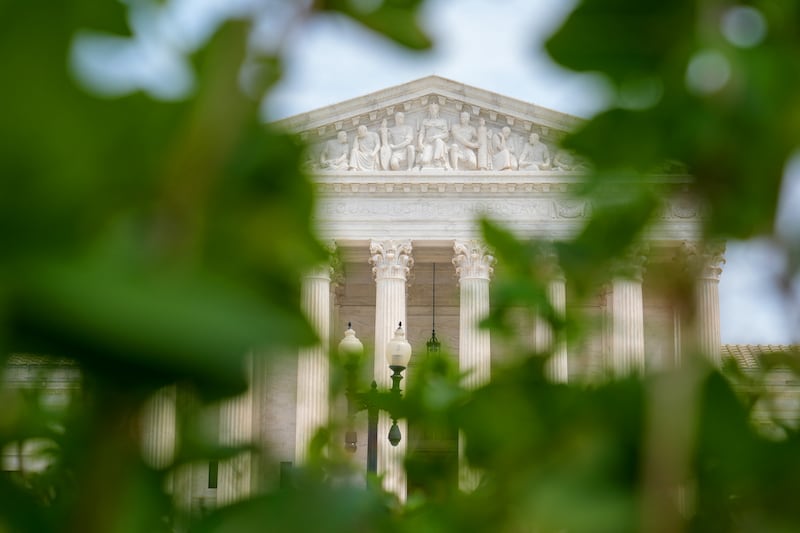

The Supreme Court’s oral arguments have concluded for this term and the justices are entering their May writing period, where they will draft up decisions and dissents, while preparing for the release of several major rulings.
There are many high-profile cases yet to be decided. The court, despite delivering President Donald Trump some wins, has also pushed back on some of the president’s key agenda items, including tariffs.
Decisions are expected to be in before July Fourth, when the justices take a several month break.
It’s unclear if the court will get a breather before starting its next term in October, particularly as the Trump administration kept them busy last summer through an unprecedented use of the emergency docket.
The biggest news out of the court last week was the landmark decision in Louisiana v. Callais, which deemed it was unconstitutional for states to draw congressional maps to favor a certain race. It was a decision that was both celebrated and criticized, and is already having an impact in several states ahead of the 2026 midterm elections.
Here are some other big decisions to be on the lookout for:
Trump v. Barbara
One of the biggest cases before the justices is Trump’s effort to end birthright citizenship.
On the first day back in office, Trump signed an executive order challenging the long-standing interpretation of the Constitution that almost all children born in the United States are granted citizenship, referred to as birthright citizenship. It’s a key issue for the president, who made history by being the first sitting president to attend an oral argument session.
Trump’s order revoking birthright citizenship for children born to parents in the country temporarily or illegally sparked concern among expecting mothers, immigration advocates and constitutionalists. It also was unclear what the order would mean for those who were already granted citizenship under the long-standing interpretation.
The Constitution states “All persons born or naturalized in the United States, and subject to the jurisdiction thereof, are citizens of the United States and of the State wherein they reside.”
The ruling will come down to how the justices interpret the clause “subject to the jurisdiction thereof.” U.S. Solicitor General D. John Sauer argues that the administration believes it means lawful, permanent allegiance to the U.S. and children born to temporary visitors or immigrants illegally in the country would not qualify since their parents are not domiciled residents.
If they sided with the administration, the justices would have to overturn a 127-year-old precedent in the case United States v. Wong Kim Ark, which confirmed and clarified the 14th Amendment in 1898.
Questions from the justices about the Wong case in regard to the administration’s argument narrowing the ruling showed they were skeptical of making changes.
Little v. Hecox and West Virginia v. B.P.J.
The court appeared ready to uphold state bans on transgender athletes playing on women’s and girls sports teams.
In recent years, several states have banned transgender students from playing on girls athletic teams at public schools. It’s become a flashpoint issue across the country and is frequently raised by Trump. The two cases stem from lower court rulings that said a student’s rights are violated if they’re banned from playing on teams.
Chief Justice John Roberts appeared skeptical of the arguments from Kathleen Hartnett, who represented Lindsay Hecox. Justice Brett Kavanaugh argued that the growth of women’s sports in the last 50 years has been “inspiring” but said allowing transgender athletes to play on girls and women’s teams will reverse that success.
In the West Virginia case, Becky Pepper Jackson pointed to Title IX to challenge the state when it enacted the ban. West Virginia Solicitor General Michael Williams argued that Title IX was created to advance educational opportunity for girls and for the court to rule against state bans would deny girls those opportunities.
Josh Block of the American Civil Liberties Union said Pepper-Jackson doesn’t have a physiological advantage despite being a transgender athlete. Block argued that all Pepper-Jackson needs to establish in the case is differential treatment on the basis of sex.
The case has become a partisan battle and gained national attention. Education Secretary Linda McMahon and activist and former collegiate swimmer Riley Gaines protested outside the court during oral arguments.
Landor v. Louisiana
This religious liberty case before the justices hinges on if an individual can sue for damages if they are in prison at the time of their rights being violated.
Landor was serving a five-month prison sentence and with just weeks left to go in his term, his dreadlocks were forcibly cut. As a devout Rastafarian, Landor had grown out his dreadlocks for nearly 20 years in accordance with his faith.
While the justices have often supported religious liberty in the recent past, they appeared skeptical of Landor’s case. A majority of the justices appeared to agree that the text of the law does not allow Landor to sue for money damages.
It centers on two federal laws, both designed to protect religious liberties. The Religious Freedom Restoration Act and the Religious Land Use and Institutionalized Persons Act (RLUIPA).
Landor’s team argued lower courts were wrong to dismiss his case and to say he had no grounds to sue the Louisiana prison officials who shaved his head. Zachary Tripp, his attorney, acknowledged that everyone, including the state of Louisiana, has admitted that Landor was treated unfairly. They also pointed to a 2020 ruling in Tanzin v. Tanvir, where Muslim men placed on the FBI’s No Fly List were able to receive monetary damages.
However, the justices questioned him on RLUIPA’s spending clause, which stipulates that Congress can put conditions on federal funds going to states. Congress has mandated that states follow the law and not violate inmates’ religious rights as a condition for accepting federal funding. But lower courts deemed that state officials, or the individual prison guard in this case, aren’t direct recipients of that federal money and cannot be required to provide monetary damages.
Benjamin Aguiñaga, the solicitor general of Louisiana, admitted that there are “valid concerns” that Congress hasn’t explicitly outlined damages, but said it should be up to Congress to create the law to make it clear, and is not the responsibility of the court.
National Republican Senatorial Committee v. FEC
The court heard arguments in a campaign finance case initiated by Vice President JD Vance when he was a senator. The ruling in the case could have major implications for fundraising ahead of the 2026 midterm elections.
It centers around whether party committees can openly coordinate spending with political campaigns. As it stands, there are limits on how much political parties can spend when they coordinate directly with candidates.
Donors can currently give less to individual candidates than they can to party committees like the National Republican Senatorial Committee and the National Republican Congressional Committee.
Vance filed a challenge saying the spending limits infringe on candidates’ First Amendment rights. The justices will have to determine if they will uphold or overturn a lower court ruling that went against the vice president’s argument.
The court has long debated what restrictions can be placed on campaign spending while simultaneously upholding the Constitution’s free speech protections. In 2001, the justices upheld the same restrictions that are being challenged in this case.
When the Trump administration took over last year, the Federal Election Commission agreed with Vance’s argument so the justices appointed Roman Martinez, a former clerk for Roberts, to argue the case. Martinez argued the justices should throw the case out since it isn’t clear Vance is going to run for president in 2028 or at a later date. Vance only has legal standing in the matter if he plans to run for office again.
The Democratic National Committee filed a motion to intervene and leaned heavily on precedent, saying if the court overturns the lower court decision, it will “fundamentally reshape the campaign finance regime.” The DNC argued that it is concerning that the Trump administration is “abdicating its duty to defend the law” by joining Vance’s challenge.
However, solicitor general Sauer argued on behalf of the FEC that political parties have to guess what their candidates believe on issues and contribution limits are capping party spending at a “tiny fraction” of how much is spent in modern campaigns.
The court seemed skeptical of siding with Republicans and Vance, questioning the NRSC attorney more extensively than the DNC’s. Justice Sonia Sotomayor acknowledged that every time the court interferes in a similar matter, like the 2010 landmark Citizens United ruling, they end up amplifying the voices of corporations and special interest groups and diminishing the power of political parties.
“Our tinkering does more harm than it does good,” she said.
Trump v. Lisa Cook and Trump v. Slaughter
The Supreme Court heard two cases related to Trump’s ability to remove federal officials.
In Trump v. Lisa Cook, Trump fired a member of the Federal Reserve Board of Governors from her position, accusing her of making fraudulent statements in a 2021 mortgage agreement.
Cook took the matter to court and lower courts paused the Fed governor’s firing. She was appointed to the Fed board by former President Joe Biden in 2022.
The justices will have to decide whether to remove Cook or allow her to stay in her position in the independent agency within the federal government. The court could also wind up sending the case back to lower courts for further examination.
Many justices appeared skeptical of the Trump administration’s position that it is “impossible” that Cook, a top decision-maker of monetary policy, intended to honor her two separate mortgage loan agreements.
The president accused Cook of declaring both a home in Michigan and an Atlanta condo as her primary residence. Cook has repeatedly denied the allegations, saying they were “unprecedented and illegal” and said the condo was a vacation rental.
Should the court side with Trump, Cook’s firing would be the first of its kind in the Fed board’s history. However, the justices seemed skeptical of the administration’s argument, with Kavanaugh and Justice Amy Coney Barrett pressing the solicitor general about why the administration wasn’t open to further judicial review as well as the future implications if the court sided with Trump.
In Trump v. Slaughter, the case hinges on a president’s power to remove federal officials. Last March, Trump fired FTC Commissioner Rebecca Slaughter, saying her service was “inconsistent” with his administration’s priorities. Slaughter sued, saying her firing was without statutory cause.
The FTC, an independent federal agency, was established by the Federal Trade Commission Act, where commissioners are nominated by the president, confirmed by the Senate and serve seven-year terms. Under the act, a president’s ability to remove a commissioner is limited to “inefficiency, neglect of duty, or malfeasance in office.”
This matter has already been examined by the court. In a 1935 ruling in Humphrey’s Executor v. United States, the justices ruled that the Constitution does not give the president the same removal power over every federal officer. Some federal roles are fully under control of the president but others can be protected from political firing.
That ruling came after President Franklin D. Roosevelt dismissed William Humphrey as an FTC commissioner.
Sauer argued that the case is centered on returning dominant line of authority back to the president and independent agencies like the FTC are not under the same level of accountability to Americans as elected officials like the president.
Slaughter’s attorney argued that if the justices side with Trump, 100 years of precedent is invalid. If that’s the case, “all three branches of government have been wrong from the start,” Amit Agarwal argued.
It’s a closely watched case for this term and experts say the justices appeared to be persuaded by the administration’s argument about political accountability.
Big cases already decided
The court has already handed down several big decisions.
The justices in February struck down Trump’s sweeping tariff agenda, handing the president a significant blow to his economic agenda for his second term.
In the 6-3 decision, the justices said Trump’s unilaterally imposed “reciprocal” tariffs on nearly every country exceeded his power as president. They held that the Constitution gives Congress the power to impose taxes and tariffs, not the president.
Kavanaugh joined Justices Clarence Thomas and Samuel Alito in a dissent, saying Trump’s tariffs were lawful. The court’s three liberal justices were joined by Roberts, Barrett and Justice Neil Gorsuch in the majority opinion saying the president was wrong in issuing tariffs.
Trump said the ruling was “deeply disappointing” and criticized the conservatives who joined the liberals in overturning the tariffs. He suggested that he would be pursuing tariffs using a different legal justification.
The president has defended his use of the tariffs by declaring a national emergency under the International Emergency Economic Powers Act (IEEPA) and said under IEEPA, he can impose tariffs to manage trade imbalances.
Most recently, the court made waves ahead of the 2026 midterm elections by ruling that a Louisiana congressional map was unconstitutionally racially gerrymandered.
The court struck down the map that would have added a second majority-Black district. While the justices didn’t explicitly strike down Section 2 of the Voting Rights Act, the ruling will have implications for voters in Louisiana and nationwide.
The justices, in a 6-3 decision along ideological lines, narrowed the Voting Rights Act precedent on race-based redistricting. Justice Elena Kagan read her dissent from the bench.
Some celebrated the court’s ruling, including Utah Sen. Mike Lee who noted that the ruling confirms that the government can’t “treat you differently based on your race.”
Kagan, in her dissent, argued that the ruling will reduce minority voters’ power in the electoral process, particularly in places that see residential segregation, but Utah Rep. Burgess Owens said it was condescending to assume that Black Americans can’t compete without lines being redrawn.
The decision could impact the 2026 midterms amid an unusual mid-decade national redistricting spree. Immediately following the ruling, several states began to take action to redraw their congressional maps, including Louisiana, Florida and Tennessee.