


On the eve of America’s 250th birthday, patriotism in the United States is on the decline. It’s a symptom of a broader problem the United States is facing in 2026 and will not easily be reversed.
New Deseret News and the Hinckley Institute of Politics’ surveys of Utahns and voters nationwide, conducted by Morning Consult, find that there are very real partisan, gender and age differences around feelings of patriotism.
This comes ahead of a historic summer, as events and activities will take place in Washington, D.C., across the country and in Utah to honor the nation’s 250th birthday.
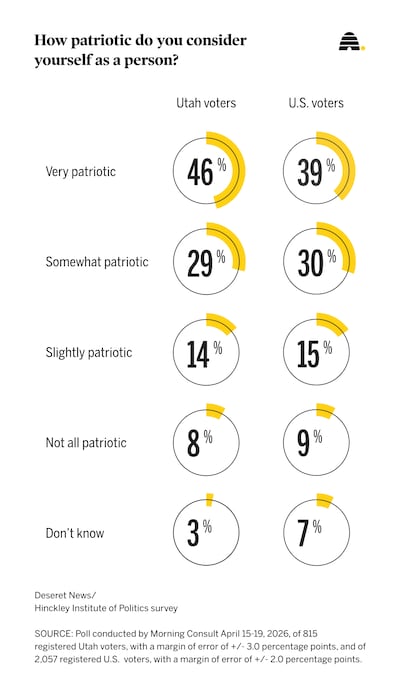
The survey found that Utahns are more likely than the general American public to say that they are either somewhat or very patriotic, with 75% of Utah respondents choosing those options. Nationally, that number is 69%.
Still, experts say that number is low. Matthew Wilson, an associate professor at Southern Methodist University, said it’s an “unfortunate development” that’s happened relatively recently.
Utah Democrats least likely of all to be patriotic
The findings also found that Republicans are more likely to say they’re patriotic than independent voters or Democrats.
In Utah, 90% of Republican voters say they’re patriotic and nationally it’s 82%. In Utah, just 49% of Democrats — the lowest of any group in the survey data — say they’re patriotic. That number jumps at the national level to 61% of Democrats.
“Traditionally, we assumed that patriotism, love of and pride in the country, was a constant that cut across party lines, that Republicans and Democrats might have different visions of what America should be and how the country should move forward, but that they were united and consistent in their love for and pride in the country,” Wilson said. “And unfortunately, that is less true than it used to be.”
Wilson noted that when Republicans accuse Democrats of being less patriotic, the data show that they’re “not wrong.” But, patriotism is not solely related to who controls Washington, he argued.
The MAGA and patriotism pipeline
President Donald Trump has not only embraced patriotism in his campaigns and administrations, but has tried to portray patriotism and love of America as “largely synonymous with support for Donald Trump and the MAGA movement,” Wilson said.
To that extent, Trump has seen more support among male voters, which Wilson notes could be why more men in Utah and nationwide say they are patriotic than women. To the extent that women tend to be skeptical or not approve of Trump’s messaging, it “may bleed over” into skepticism about American patriotism generally.
The survey found that among men, 81% in Utah and 75% nationally say they are either somewhat or very patriotic. This drops among women to 70% in Utah and 64% nationally.
Hinckley Institute Director Jason Perry noted that the partisan gap, in addition to gender and age differences, shows that “people’s relationship with national identity” is being shaped more by politics than it used to be. He said it was “striking” that the same patterns continued to show up across multiple surveys.
The age gap
The survey found that in both Utah and nationwide, the younger generations are less likely to say they’re patriotic.
In Utah, among respondents ages 18-34, 57% say they are very or somewhat patriotic. Nationally, it’s nearly equal at 56%.
For people ages 35-44, those saying they’re patriotic jumps to 71% in Utah and 61% nationally. For those 45-64, in Utah, 86% say they’re patriotic and 67% of the general population says the same. The oldest generation was the most likely to say they are somewhat or very patriotic with 92% of Utahns and 86% nationwide.
Wilson noted that the decline in patriotism seen among younger generations could be attributed to multiple things. Younger people are more likely to be “disillusioned” with the extreme political polarization they have been raised in, but changes in the country’s education system have also likely impacted the way younger Americans view their country — and their love or disdain for it.
“Older generations, certainly the Silent Generation, baby boomers, even Gen X, when they came up through the educational system, the predominant message in schools was America-positive. That is, there was an optimistic and laudatory narrative of America that dominated history and government instruction and that was an intentional part of political socialization in the school system was to cultivate patriotism,” Wilson said. “I think in the school system, as millennials and Gen Z have experienced it, that is much less the case.”
Wilson argued that there have been significant changes in curriculum that have put more emphasis on the problematic, unfortunate aspects about America’s history and systems and their shortcomings. Younger Americans haven’t been socialized with the same sort of positive messaging as their parents or grandparents and Wilson said he thinks it shows up in the data, including in the Deseret News-Hinckley Institute surveys.
Part of the battle and tension around America’s messaging, both in schools and at museums, comes from the desire to paint the country in a positive light while still being factual, truthful and not shying away from some dark or difficult topics, Wilson said.
Latter-day Saints’ unique relationship with patriotism
Wilson highlighted the unique relationship between patriotism and The Church of Jesus Christ of Latter-day Saints.
The survey found that 88% of Utah Latter-day Saints considered themselves patriotic.
Leaders in the church teach that America’s founding documents are divinely inspired, including the Declaration of Independence and the U.S. Constitution.
Church President Joseph Smith in 1839 said the Constitution is a “glorious standard” and was “founded in the wisdom of God.” He said that the love of liberty inspired him and civil and religious liberty were “diffused into my soul by my grandfathers.
Utah Gov. Spencer Cox has spoken about how his faith informs his public service. He said the country needs to look beyond politics to solve the nation’s problems and believes there needs to be a “religious revival.”
Wilson said that for members of the church, the founding of America was not just historical, but theological. Church leaders and the Book of Mormon teach that God would raise up a free nation where his church could be restored. It’s why religious freedom and patriotism are core tenets of the faith, he said.
“There’s a kind of core LDS belief in the divinely guided nature of the American founding and so patriotism is kind of woven, in some ways, into Mormon religious DNA,” he said. “More than any other religion, it is completely interwoven with American patriotism.”
Perry agreed. Utahns are more likely than the rest of the country to say they’re patriotic and faith plays an “important role” in that.
“It speaks to Utah’s strong traditions of service, volunteerism, and community life,” Perry said.
Patriotic acts past and present
The survey asked individuals about how they have expressed patriotism, including by voting, standing for the national anthem, saying the Pledge of Allegiance, flying an American flag, protesting and more.
While Utahns were more likely to say they have engaged in several patriotic activities, including 41% to the nation’s 17% that have participated in service, there are several issues where the two surveys line up.
For example, 79% of Utahns say they expressed patriotism by voting while nationally 72% say the same. Additionally, 17% of Utahns say they have made political statements online and 16% of the general public say the same.
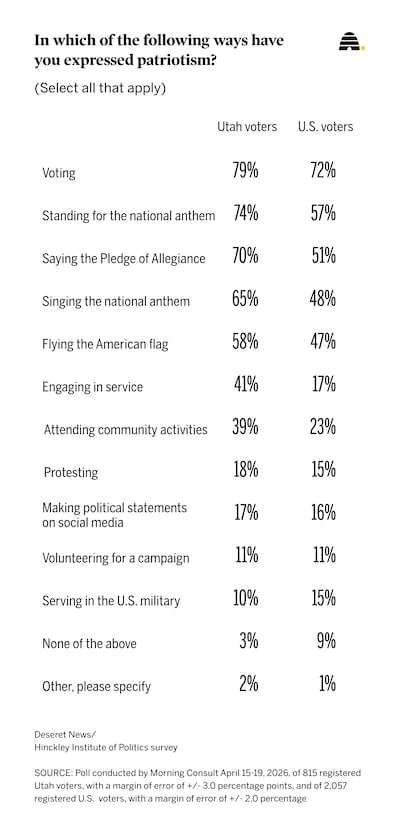
Perry argued that an “encouraging” finding from the data shows that Americans still broadly agree on what patriotic behavior is.
“Voting, military service, and civic participation continue to receive strong support across political lines,” he said. “Even when people disagree about the meaning of patriotism, there is still considerable agreement around the civic values behind it.”
Is there a fix to falling levels of patriotism?
Wilson highlighted how over the last several decades, Americans have changed the way they identify with political parties. The polarization seen in the nation today is part of a phenomenon that is fueling the decline of patriotism.
“There are partisan gaps opening up in almost everything,” he said. “This deep division between people on the left and people on the right shows up in things from what television shows they watch, what cars they buy, what fast food or coffee places they patronize and it has shown up in whether and how they express their affection for and pride in the country.”
Wilson said he thinks the decline in Americans who say they are patriotic is a “symptom of broader social polarization.”
So, is there anything that can be done? Wilson said there’s not an easy or quick fix.
“I do think that some correction of the highly critical America narratives that have pervaded education, that’s a part of restoring this balance, but a general decrease in social and political polarization would help as well,” he said.
For patriotism to evade being “partisan coded,” it will likely take work of an intentional, bipartisan years-long project to change the way patriotism is viewed and acted upon in the country.