



- Utah Gov. Spencer Cox hosted Operation Gigawatt Summit on Friday in Utah.
- Park City gathering tackled future energy challenges, opportunities.
- Nuclear energy and critical minerals were among key discussion items.
How will energy — in varied and rich abundance — be delivered for the next generation of growth?
That was the heady question tackled Friday by Utah Gov. Spencer Cox, several Trump administration officials, members of Utah’s congressional delegation, local lawmakers and a massive hall filled with policymakers, builders, academics and industry leaders all gathered under one big roof in Park City.
Friday’s Operation GigaWatt Summit was staged, according to sponsors, to help author a “national playbook” for long-term energy abundance in a national environment of strength and prosperity.
“I’m so grateful,” said event host Cox in his welcome remarks, “to be in a room of builders. People with ambition and ethical behavior. People who care about this country and want to make it better — not just for yourselves, but for your neighbors and the generations that will come after us.”
The daylong gathering at Park City’s Grand Hyatt Deer Valley Hotel, included panel discussions and speeches from Cox, U.S. Energy Secretary Chris Wright, U.S. Nuclear Regulatory Commission Chairman Ho K. Nieh, Environmental Protection Agency Administrator Lee Zeldin, and Ohio gubernatorial candidate Vivek Ramaswamy.

The day’s far-ranging discussion points included accelerating deployment of nuclear energy and emerging technologies across the country, modernizing grids, critical minerals, building infrastructure to accommodate growth — and championing policies to support such building.
Beware of scarcity mindsets
During his opening keynote address, Cox signaled that Friday’s energy conference would be anchored in optimism and hope. He warned against detrimental “scarcity mindset.”
“We live in an age of miracles,” he said. “It feels like every single day, I see a headline and read a story about some incredible breakthrough that can transform our lives.”
The governor said the country requires a return to both ambition and virtue.

“We need both of those things,” said Cox. “The only thing worse than a scarcity of energy is a scarcity of ambition. And for too long, our country has been telling people that ambition is bad. That you shouldn’t be trying to do well to get ahead. That’s not who we are. That’s not what made us a country.”
But such ambition, added Cox, must be paired with virtue.
“We need to combine those two things,” he said. “The pursuit of excellence in ambition and the pursuit of excellence in virtue. And we can do that because we’ve done it before.
“That’s what made this the greatest country in the history of the world.”
Calls to close nuclear reactor ‘strategic gap’ with China
In his discussion with Nieh, Cox said the country is experiencing something of a nuclear power renaissance.

The commissioner pointed to the bipartisan ADVANCE Act which, he said, “really laid the groundwork and set the direction for more predictable and efficient regulation.”
That was followed by President Donald Trump’s executive order last year to reform the Nuclear Regulatory Committee.
“That executive order, in my view, took the path of incremental change that the NRC was on — and elevated it to the most consequential moment for the NRC in 50 years.”
Today, added Nieh, there’s unprecedented support for nuclear energy rights and security. “The conditions could not be more ideal for the United States to lead the world in nuclear energy.”
So what’s different today, Nieh asked, than in decades past? “We’re working smarter, not harder,” he answered.
The commissioner noted a “strategic gap” in nuclear reactors existing between the United States and China.

“That is a strategic gap that America wants to close,” he said. “There are countries now, including our allies, that are making decisions on reactor technology markets. If America can’t deliver, they’re going to buy foreign reactors and accept the geopolitical leverage that they carry with them.”
Nieh said he’s enthused by the shift in mindset and attitude toward nuclear energy.
He called for “big scale” commercial projects while saluting the industry’s forward-thinking efforts.
“Nuclear is going to be part of the next 250 years for America,” he said. “And what I’d like to let (others) know is that there is a new NRC. We are not going to be an impediment to the deployment of nuclear power in the United States.
This “new NRC,” Nieh added, enables the safe use of nuclear technologies and moving forward.
Energy Secretary Wright: ‘We’re going to quadruple our nuclear capacity’

In his discussion with Cox, Wright spoke of energy being the key to human flourishing. The progress of civilization — and people’s quality of life — is intimately tied to their respective energy systems
“Energy is this catalyst to just change societies,” he said, adding that a “life quality” as fundamental as human longevity is linked to a person’s access to energy.
Cox asserted that the country is moving beyond the scarcity mindset “that has really dominated the last 30 years.”
Responded Wright: “We’re going to put the nonsense of the last couple of generations behind us and just move forward — lean in, be optimistic and believe in our futures ... there’s never been a better time to be alive.”
Wright spoke of the Trump administration’s efforts to advance energy resources — calling them “very bold goals.”
“We’re going to quadruple our nuclear capacity in the next 25 years,” he said.
Cox continued his discussion by asking Wright about energy and affordability.
“The states that lean in, demand growth, build new tech, and (more efficiently) use existing infrastructure — those are the states that are going to stop the rise in electricity prices and energy and push them down,” said Wright.
“The states that stay in the ‘non-abundance’ and the scarcity/fear-mongering mode, they’re going to continue, sadly, to see rising electricity prices.
“And hopefully that’s going to become so politically unpopular, that even they are going to have to move towards abundance.”
It’s critical, Wright added, to re-embrace the country’s historic founding ideas when approaching energy’s future.
“We’re going to embrace an agenda that best enables life, liberty, and the pursuit of happiness,” he said.
“Let the marketplace and people decide that. The government should not be deciding that; controlling the economy and making decisions for you. Let the American people be free and pursue life, liberty and the pursuit of happiness.”
Vivek Ramaswamy: Choosing ‘winning over whining’

A biotech entrepreneur and Republican candidate for governor of Ohio, Ramaswamy focused his lunchtime keynote on the future of nuclear energy.
Such a future doubles as a national opportunity, he said. “I view it as an ascension to the future of American life.”
Major changes in the Energy Department and the NRC are removing manmade obstacles, he said. “One of the things that I ran on for U.S. president, and President Trump ran on, was liberating U.S. energy, including nuclear energy.”
Natural obstacles — such as uranium enrichment capacity — are trickier to hurdle.
“If we are to be able to meet the artificial intelligence demand through the production of energy, including through nuclear energy, we have to look at whether or not we have enough capacity to produce enough enriched uranium, particularly for nuclear reactors,” he said.
“And that’s going to be something that we work on as a country.”
Thankfully, he added, the Energy Department is “laser focused” on that issue.
Reactors will also have to be financially sustainable, added Ramaswamy.
And then there’s the variable of public acceptance. “This is where I think leaders both at the state and federal level can and must make a difference,” said Ramaswamy.
And what about convincing the public of the importance of adopting nuclear energy?
“Well, the good news is it’s already slowly happening,” said Ramaswamy. “Recent polling over the last couple of years show it has dramatically changed relative to where it was even 10 or 20 years ago.
“And the public, I think, is open to the idea — backed by facts — that nuclear reactors are, as measured by data, the safest form of energy production that has ever been known to mankind.”
Meanwhile, he said, the future must be grounded in truth. Legitimate safety objections should always be taken into account.
“So long as we are grounded in the facts and we are actually addressing the objections — not steamrolling them, but addressing them on the merits — then I think we are on the side of truth when we stand for the expansion of nuclear energy in the United States.”
The results, he added, will be lower energy costs across the country.
On the 250th anniversary of the Declaration of Independence, he concluded, Americans have an opportunity that the nation’s founding father embodied: Choosing expansion over restriction. Winning over whining. And victory over victimhood.
“And I believe that our embrace of nuclear energy in the last 18 months is hopefully a leading indicator of what is possible as America leads the world — not only in the era of artificial intelligence, not only in quantum computing — but empowering all of the sectors of the future.
“And it starts with the production of energy — including nuclear energy.”
Championing civilian nuclear power
Trump’s chief science and technology adviser, Michael Kratsios, wrapped up the day’s events by noting it’s been a year since the president signed a series of executive orders on nuclear energy.
“President Trump made the most transformational decision for civil nuclear power since President Eisenhower announced ‘Atoms for Peace’ in 1953.”
That heralded the first heyday of American nuclear energy, said Kratsios. Within two decades, the country had 30 nuclear power plants in operation and 5,500 under construction.
“Americans looked forward to a future of nuclear trains, planes, and flying automobiles,” he said.
“That momentum, unfortunately, did not last. Prior to President Trump’s policies, we weren’t testing new reactors. We were shutting perfectly good ones down. We were totally dependent on other countries for our fuel.”
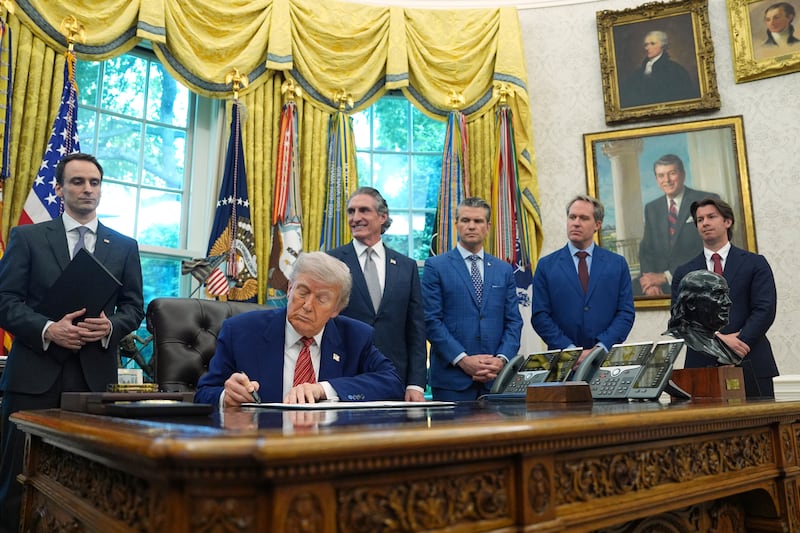
All that’s changed, said Kratsios.
“The reforms and actions these orders call for are not merely an evolution in American energy infrastructure,” he said. “They are bringing about a revolution for American power. The successes of the last year will be foundations for a century of innovation.
“One year ago tomorrow was a starting shot and a renewed race to a brighter future. Old inertia has been reversed. This industry now has new momentum.”
Kratsios added more domestic uranium was produced last year than the previous six years combined.
“More than $2.5 billion has been invested in domestic uranium enrichment alone. And we’re making progress in American nuclear exports and increased nuclear cooperation with our partners, including backing for American construction reactors to allied countries.”
Nuclear energy, he noted, is no longer viewed primarily as a liability to be managed — “but once again is a powerful tool for enhancing our national security.”
Kratsios asserted that civilian nuclear power is key to rebuilding the nation’s industrial base — including drone technology and rocket ships.
“President Trump’s vision for adding nuclear power to the grid includes restarting shutdown reactors and increasing power production by the country’s existing fleet.”
Today’s civilian nuclear program, he concluded, “will give ourselves, give our children and our children’s children the energy necessary to sustain and build this great nation for the next 250 years.”
EPA chief Zeldin: Protecting environments, while growing economies

Gov. Cox’s busy day also included a discussion with EPA leader Zeldin about that latter’s approach as a key steward of the nation’s natural resources.
“It is not a binary choice where you have to choose to either protect the environment or grow the economy,” Zeldin said. “We can, should and must choose both. That is absolutely an option for us — and we’re proving it.”
Voters in the most recent presidential election signaled their support for agencies “applying common sense and heeding economic demands,” he said. And that includes how the EPA operates.
Cox spoke of Trump’s interest in restoring the Great Salt Lake. “We know we can accomplish that. These are the types of ‘dream big’, ‘believe big’ and ‘do big’ projects that are making a difference in our country.”
The governor asked Zeldin about his vision for the EPA — and for the country in a year when Americans are celebrating the nation’s 250th birthday.
“I hope that what’s most enduring is that we have people who are running an agency like the EPA who can just follow the law,” he answered.
“Don’t try to get creative in claiming other laws to impose that will of that unelected head of a bureaucracy to slow things down and make things more difficult, and torture companies and make it harder for you all to survive and thrive and prosper.
“Hopefully, a very simple approach that we’re taking to this job ends up being the most enduring piece of it for a very long time to come.”
Critical minerals = mission critical
Given Cox’s well-established commitment to maximizing critical mineral opportunities in Utah, it’s no surprise the issue found a spot in Friday’s energy event.
A “power session” that included U.S. Sen. John Curtis, R-Utah, and Utah Senate President Stuart Adams focused on the “mission critical” mineral essential for American energy dominance.

“Nothing gets built without minerals,” said Adams.
Policy makers can issue permits and industry leaders can provide financing. But without critical minerals such as magnesium, uranium, potash, copper and lithium, little can be done.
“Critical minerals are not just another issue,” said Adams. “They are the foundation underneath every major strategic objective America has. In many ways, they are the foundation for the free world.
“If the future of artificial intelligence depends on energy, the future of energy depends on critical minerals.”
But the United States, he added, is “dangerously dependent on a single adversarial nation.”
“The countries that control the next century will not just be the ones that innovate, they will be the ones that have the resources to build — to build energy, to build infrastructure, to build supply chains and secure the minerals required to sustain them.
“America needs more critical minerals.”
Curtis referenced the 1970s and 1980s when “an outside country held us hostage for energy.” The U.S. then made a commitment to be energy, not knowing entirely how to do it.
“We are in that exact same position, and we’ve allowed ourselves to get there, with critical minerals,” he said.
It’s become a national security issue, he added. Adversaries are not only mining most of the world’s critical minerals, they are also doing most of the mineral processing.
Curtis also utilized the session to tout nuclear energy.

“There is no way we can get to our energy future without hundreds of nuclear capabilities around the country, perhaps even thousands,” he said. “And if we’re dependent upon China and Russia, that shuts down everything.
“That’s what keeps me up.
Friday’s “power sessions” also included deep dive examinations into Utah’s nuclear playbook, the future’s energy workforce and a discussion on scaling the modern energy grid featuring Utah House Speaker Mike Schultz.
University of Utah President Taylor Randall also moderated a discussion on geothermal energy.