



At the Operation Gigawatt Summit Friday in Park City, Utah, energy and artificial intelligence industry leaders said that AI is the next space race and the United States is already behind.
And this time around, America’s biggest competitor in the race isn’t Russia, but China, and they’re already miles ahead on energy production.
“China understands that whoever can produce power the fastest and the cheapest will own the future of AI,” said Sal Churi of Trust Ventures.
However, energy production in the U.S. has flatlined over the past several years, even as AI data centers are built around the country, including in Utah.
“By 2030,” Churi continued, “if the AI data centers continue to build out on pace, we will use 100% of current American energy generation to power data centers.”
In order to increase our energy supply, the U.S. will need to increase building projects significantly and quickly, according to the panelists speaking about “powering the AI boom.” To increase energy production, industry experts said the U.S. will need to increase energy using all sources available — including solar, nuclear, gas and coal.
In addition, the U.S. will need updated infrastructure to meet AI’s high demands.
The key to winning the AI race, industry leaders said, is ramping up our energy supply and engaging the community in the process.

Community response to data centers and energy projects
Up to this point, the race to build AI infrastructure has been met by protest and backlash.
“We have seen growing opposition on both sides to the development of data centers,” said Seth Cohen from the U.S. Department of Energy.
“One of the things we’re seeing,” Cohen continued, “is a misunderstanding of the technology and also a failure to effectively communicate the core benefits of this technology.”
The panelists stressed the amount of misinformation that is being spread and how it’s slowing critical building projects down.
“I think a lot of the ‘facts’ that people put out there are just not right,” said Ernie Rogers of CoreWeave.
“One, for instance, is water usage,” Rogers continued. “In a closed-loop system, it just doesn’t use that much water.”

The panelists stressed that in order to win the AI race, having the community on board is essential and industries are working hard to improve public perception of these projects.
“Community engagement is critical and the industry just does a terrible job of getting that AI bid out there,” said Rogers.
The panelists compared the public’s perception of data centers to nuclear energy late last century. They believe that the benefits of AI infrastructure far outweigh the costs.
“Embodied AI is going to reduce the cost of everything we touch. We think it can reshape entire industries,” said Churi.
“An abundant deflation for consumers,” Churi continued, “is in the crosshairs right now.”
The path to getting back in front
Throughout the summit, industry leaders stressed that the way to win the race is through building more energy production and updating old infrastructure.
“There is no single industry that can solve this issue,” said Churi.
The energy industry has the capital, technology, and resources, he said, but strict regulations and permitting processes slow the effort.
“We need certainty and we need speed … [and] policymakers willing to recognize that strategic infrastructure is a new space race,” he said.
Utah has the opportunity to become a leader for energy production in the United States, state and industry leaders said.

“My vision is Utah and the West being the heart of energy for the rest of the nation,” Utah Congressman Mike Kennedy said.
“We want to make sure,” continued Kennedy, “that Utahns can continue to afford energy, afford power, afford to have kids, while also being an energy exporter.”
Kennedy boosted nuclear power generation as a necessity, while praising the billboards in Utah that say a banana emits more radiation than a nuclear power plant.
“If we’re going to move something forward, we’re going to need to treat (the community) as coequals and bring them with us,” said Kennedy.
Chasing down China
According to political leaders and energy industry leaders, our biggest adversary in this new AI race is China.
“While the U.S. debates permitting timelines and tax reduction, China is aggressively executing a national industrial policy,” said Churi “They have 10 times the energy generation capacity than they had 25 years ago.”
The U.S. in that same time period, he continued, is flat on energy production.
“Last month, China installed more battery capacity than the U.S. did in the entire year,” said Churi.
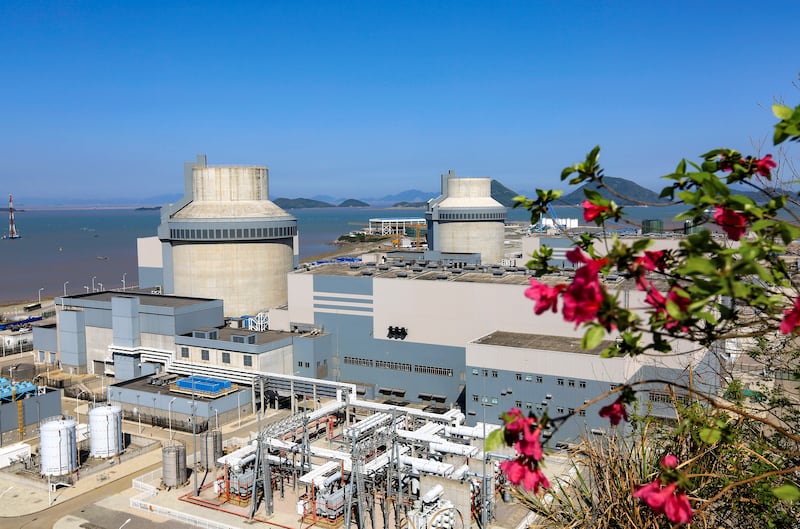
Kennedy said China is already moving forward on nuclear, quantum computing, and energy production on the moon.
“China’s forging ahead,” continued Kennedy. “And they don’t care about environmental concerns, they don’t care about the population, they don’t care about freedom and liberty and the people being engaged.”
Despite the gloomy outlook, the panelists mentioned that many people had fears about the Soviets’ efficient centralized approach to the space race. Despite the odds, the U.S. was ultimately able to band together and win the race, they said.