

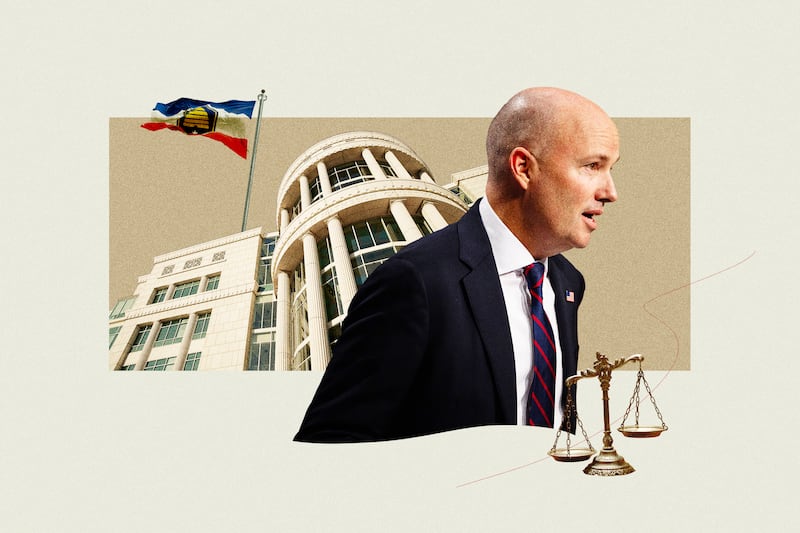

- Utah Gov. Spencer Cox is interviewing candidates to fill vacancies in the state Supreme Court.
- Cox is set to have appointed at least seven members to the court during his two terms, including to replace the chief justice.
- In 2023, lawmakers gave Cox more influence over the commission that recommends nominees.
By the end of his second term in office, Gov. Spencer Cox will have transformed the Utah Supreme Court, potentially more than any of his predecessors in the executive branch.
Working with lawmakers, Cox has approved changes to the way justices are nominated, expanded the bench by two members and required greater transparency from courts.
Cox interviewed nominees for vacancies created by the new laws last week, and will interview more this week as he prepares to fill seats left open by Chief Justice Matthew Durrant and Justice Diana Hagen.

Durrant announced his retirement on Friday, culminating a sequence of legislative updates and personnel turnover that have overhauled the court over the course of a few months.
The upheaval comes as lawmakers have focused their frustrations on the judiciary, with threats of an investigation into alleged misconduct leading to Hagen’s resignation in May.
Soon, Cox will have nominated six members of the seven-person body, leaving a lasting legacy on the high court, which is responsible for interpreting the state Constitution.
Underlying Cox’s impact on the court is a debate over how to maintain trust in the judicial branch during a politically fraught moment.
The Republican-led Legislature believes credibility must be reestablished, after several controversial rulings, through procedural reforms to help judges reflect Utah values.

Some in the legal community view this as politicizing a merit-based process, and call for a return to judicial independence with oversight mostly from other judges.
While every judge in the state was nominated by a GOP governor, a combination of unique timing and new policy has given Cox the power to remake the landscape of Utah’s courts.
Upstream from outcomes
Supporters and critics point to a 2023 law, SB129, as the start of an accelerated push to reshape the composition of courts by tweaking how attorneys get nominated to them.
The law removed restrictions on who Cox could put on the state’s 10 judicial nominating commissions tasked with vetting judicial nominees.
It removed requirements for commissions to have no more than four members from the same party, no more than four lawyers, and two recommended by the Utah State Bar.

This change was made because of the assumption that the seven-member commissions tended to lean more liberal than the public overall, leading to a biased nominee pool being forwarded to the governor.
Defense attorney Greg Skordas said he did not see any evidence of this. But the law does provide Cox more direct influence over the kinds of judges who are appointed.
“I think it’s huge,” Skordas told the Deseret News about the change. “It gives the governor much more authority and leeway to select justices than he’s ever had in history.”
The lawmaker behind SB129, Senate Majority Leader Kirk Cullimore, said Utah’s old commission model simply obfuscated political biases, instead of overcoming them.
This is supported by a 2017 nationwide study finding that nominating commissions led to judiciaries that were more ideologically skewed to the left compared to the population.
His goal, Cullimore told the Deseret News, was not to insert partisanship into the process, but to ensure that commissions focus on merit, not likeminded philosophies.
“Establishing trust in government is critically important,” Cullimore said. “I saw what I believed was the undermining of that trust over decades of the office that was in place.”
Will changes make Utah’s court more or less partisan?

Republicans have found themselves increasingly at odds with the GOP-appointed Supreme Court in recent years.
In 2024, justices upheld a pause on Utah’s elective abortion ban. The court also overturned longstanding precedent that allowed the Legislature to amend any law passed by ballot initiative.
Lawmakers reacted by making initiatives harder to get on the ballot, letting the governor pick who will be chief justice and creating a new district court to consider challenges to the Legislature.
In April, the state Republican Party launched a campaign to oust two Cox-appointed justices, Jill Pohlman and Hagen — who resigned earlier this month — during an upcoming retention election.
Put together, these actions to remove partisan balance show a desire to orient courts toward certain outcomes, Co-Equal Utah President Tenielle Brown told the Deseret News.
“This is really them playing a long game,” Brown said. “Not only do they want to select the referees in the game, they want to be able to select the people who select referees.”
Utah Bar president Kim Cordova is not so pessimistic. While she thinks SB129 weakened a good process, she told the Deseret News that Utah exemplifies merit-based judicial selection.
The purpose behind reforms was to prevent, not encourage, judicial activism, by creating a more open nomination process, House Rules Chair Jordan Teuscher told the Deseret News.

“The biggest concerns that we’ve had is where decisions have strayed far from the plain text of the language or seemed to be coming from some sort of political bent,” Teuscher said.
Senate Judiciary Chair Todd Weiler, who like Cullimore and Teuscher is an attorney, told the Deseret News opposition to reform is often driven by those seeking liberal outcomes.
One thing Weiler expects to stay the same is that even with additional input, Cox will continue to be surprised by the decisions handed down by the high court he has remade.
