



- Defending Our Values PAC spent $880,000 to support Rep. Celeste Maloy.
- Think Big PAC has spent $450,000 to support former Rep. Ben McAdams.
- Both PACs are funded by founders of biggest AI companies in Silicon Valley.
The political battle over the future of artificial intelligence arrived in Utah this month, with the nation’s top two AI super PACs dropping more than $1.3 million on Beehive State congressional primaries.
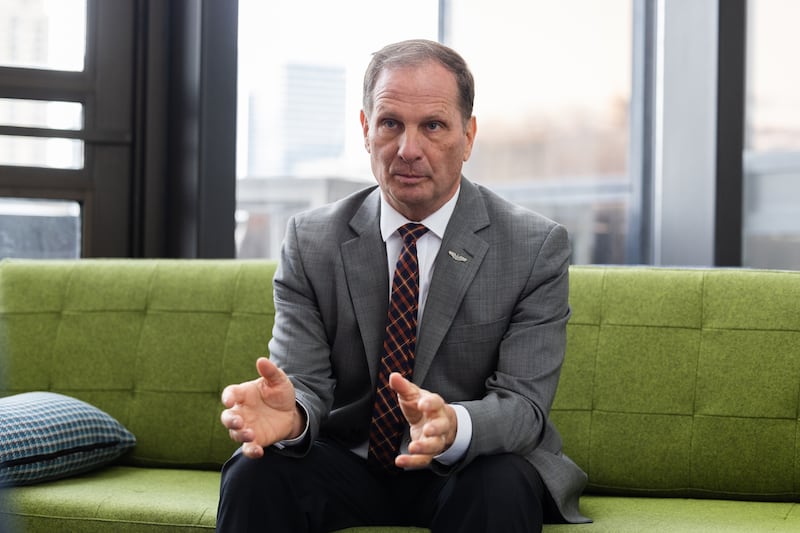
Defending Our Values, a committee run by former Utah Rep. Chris Stewart, spent nearly $880,000 last week on ads to support Republican Rep. Celeste Maloy in her 3rd District primary race against former state lawmaker Phil Lyman.
The group is funded by Public First, a nonprofit created by Stewart, a Republican, and former Oklahoma Rep. Brad Carson, a Democrat, to support candidates who will pursue legislative safeguards for new AI models.
“We think that there should be reasonable guidelines for AI development,” Stewart told the Deseret News. “Just the same thing that most Americans are worried about.”
In February, Anthropic — an AI developer valued at just under $1 trillion — announced a $20 million donation to Public First to elect lawmakers balancing AI innovation with child safety and transparency regulations.
Anthropic competitor OpenAI does not donate to political committees. But co-founder Greg Brockman has joined Silicon Valley investors in donating $100 million to the anti-regulatory campaign of the Leading the Future PAC.
Leading the Future operates a network of PACs, including Think Big — which reserved $450,000 of TV ads this week to support former Rep. Ben McAdams, who is running against three other candidates in the 1st District Democratic primary.
Utah is fertile ground for the AI policy stand-off pitting techno-optimists against regulatory realists.
Utah’s Legislature has led out on model bills coupling AI consumer protection with liability mitigation, even as a massive data center has sparked concern around the impact of AI infrastructure on energy and the environment.
Lyman, a Republican, and 1st District Democratic contender Nate Blouin have gone all-in on framing the election around connections to Big Tech. June primaries will give voters a chance to signal where they stand on the quickly evolving politics of AI.
Why did Chris Stewart start his group?

In an interview with the Deseret News, Stewart said his decision to jump in the middle of America’s AI regulation debate was motivated by his work in Congress on the high-profile House Intelligence Committee.
No one understands the importance of beating China in a global AI arms race more than him, Stewart said. But the committee’s role in approving Project Maven to integrate AI into military intelligence showed him the risks.
“It comes down to three things: privacy, protecting children and testing models before they’re released so that we know what potential threats they have,” he said.
Since Public First was announced in November, it has spent millions of dollars in races across the country to support half a dozen candidates, like Nebraska Sen. Pete Ricketts and Texas candidate Carlos De La Cruz.
Aside from the $1.5 million spent on De La Cruz, Maloy has received the most independent expenditures in her favor. While candidates cannot legally coordinate with campaigns on support, Maloy has a special connection to Stewart.
Maloy worked as Stewart’s chief legal counsel in his congressional office in Washington, D.C., before running to replace him in Utah’s 2nd District when Stewart resigned in 2023 to spend more time with his ailing wife.

Maloy was interviewed like any other candidate about her stance on AI legislation before the PAC endorsed her, Stewart said. The sizable amount spent to support her ranks eighth in the nation for AI-related spending.
“Our campaign cannot coordinate with any outside groups, and we are focused on what we can control, communicating directly with voters about my conservative record,” Maloy said in a statement.
AI as a hot-button issue
Maloy has been active on the issue of AI regulation.
She served as a broker between Utah lawmakers and the White House this year as leaders sought to communicate the state’s approach after the administration quashed an attempt to require risk disclosures for new AI models.
Stewart was “disappointed” by the move from President Donald Trump’s office to prevent state-level regulations, but he has been encouraged by recent executive actions requesting early federal access to test new AI models.
Meanwhile, Maloy’s opponent has tried to frame the endorsement by Defending Our Values as proof she is complicit in Anthropic’s effort to influence the regulations that will shape the industry moving forward.
In a statement to the Deseret News, Lyman said Maloy should have mentioned the PAC when stating her support for AI data centers during a debate last week. Defending Our Values is neutral on AI data centers.
“Celeste stood in that debate last week and told Utahns she should be in Congress making decisions about AI,” Lyman said. “You don’t need to coordinate with someone to know they’re buying your steak dinner.”
Blouin has also framed his race as an attempt by billionaires to buy a congressional seat in Utah.

While McAdams has disclosed he owns stock in a large scale AI data center under construction in Delta, Blouin has called for a moratorium on new AI infrastructure. Both oppose the Box Elder County “Stratos Project.”
But Stewart is convinced there is a middle way, where candidates can prioritize innovation and regulation.
The bipartisan nature of Public First, paired with a Republican and Democratic PAC, relies on surveys showing 80% of voters say the government should put guardrails on AI development, even if it slows it down.
Utah primaries reveal just how much AI juggernauts are willing to pay to elect lawmakers who feel the same way.
“This is an 80/20 issue — and it’s not particularly partisan," Stewart said of regulating the growth of AI. “The whole purpose is to advocate for these types of guidance from the federal government.”