


To ensure “election integrity” is maintained in the upcoming midterms this November, President Donald Trump is taking his plea to the U.S. Supreme Court.
On Monday, the Trump administration filed a request with the higher court asking the justices to bar lower-court rulings prohibiting the president’s March 31 executive order on voting in federal elections from being administered, while they review the government’s request.
The order, titled “Ensuring Citizenship Verification and Integrity in Federal Elections,” would create new, overlapping responsibilities for the Department of Homeland Security and the U.S. Postal Service. DHS would compile a list for each state of U.S. citizens who will be at least 18 by Election Day. USPS would then establish state-specific lists of mail-in and absentee voters and, under rules called for by the order, would only transmit ballots from voters enrolled on those lists.
More than 20 states and the District of Columbia, led by California, challenged the order in federal court. They argued that it’s the states’ rights under the Constitution to determine who is eligible to vote in elections.
U.S. District Judge Indira Talwani sided with the states on June 25, and prohibited the federal government from implementing the order ahead of the Nov. 3 election.
“The States alone determine voter-eligibility requirements, subject only to the outer limits of the Constitution,” the Massachusetts judge ruled, adding, “This injunction does not bar the federal government from providing assistance with verifying the citizenship or eligibility of any voter if the assistance is provided at the request of any State and within the framework provided by Congress.”
Talwani refused the Trump administration’s request for a pause on her injunction, causing the defendants to then request a pause from the U.S. Court of Appeals for the 1st Circuit.
The appeals court ultimately refused to pause the lower court’s injunction:
“Were the EO (executive order) to take effect for the elections taking place in September and November, it would sow confusion and threaten disenfranchisement of many eligible voters. And given that the Government ‘make(s) no argument that (its) actions were legal on the merits,’ and ‘there is generally no public interest in the perpetuation of unlawful (government) action,’ the public interest does not favor a stay.”
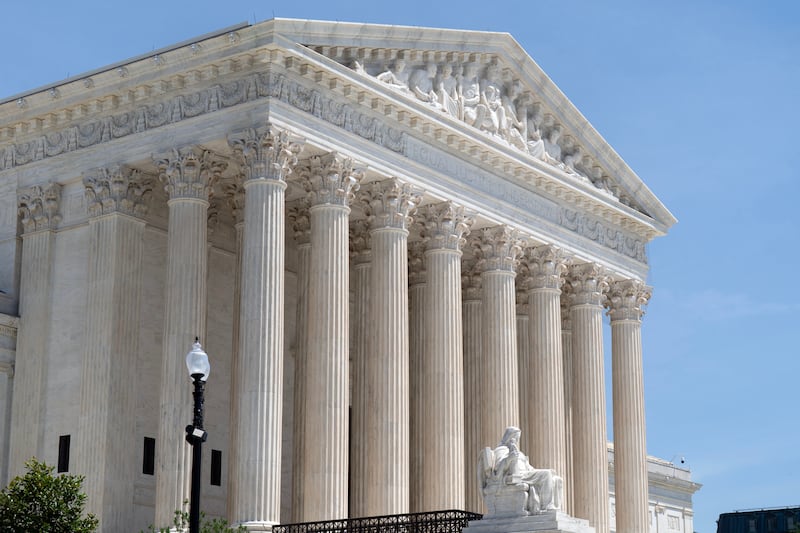
In the federal government’s last attempt to lift the lower court injunction while the underlying appeal continues in the 1st Circuit, U.S. Solicitor General D. John Sauer filed to the Supreme Court.
The filing does not ask the Supreme Court to issue a ruling on the constitutionality of Trump’s election executive order right now; instead, it asks the justices to determine what rules should be in effect while that litigation continues.
“A stay — along with an immediate administrative stay — is also warranted because the injunction below imposes irreparable harm on the government,” Sauer argued. “Absent a stay, the government will be unable to obtain appellate relief from an order that bars implementation of a presidential policy that seeks to ensure voter integrity in the upcoming November 2026 election. Accordingly, both the irreparable harm factor and the public interest favor the government.”
On Tuesday, 12 states, headed by Alabama, sided with the Trump administration’s request to temporarily pause the 1st Circuit’s order while litigation continues.