

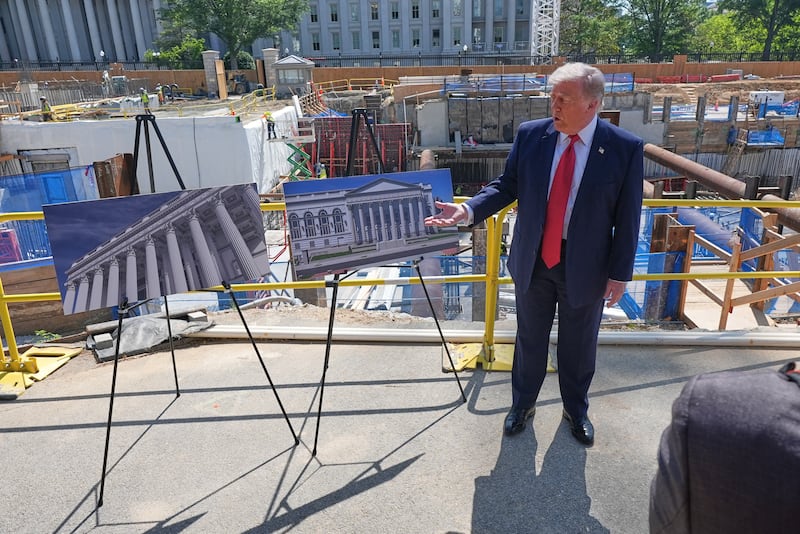

The federal appeals court for the District of Columbia ruled Friday that President Donald Trump must cease construction on the 90,000-square-foot White House ballroom project.
“The President has no — and claims no — constitutionally assigned authority over that property, which is designed and maintained for the use of all Presidents, current and future, and for the American people,” the court ruled.
In the dissenting opinion, Justice Neomi Rao, who was nominated by Trump, said the court had “no jurisdiction” and that improvements made to the Executive Residence are “likely within the President’s authority,” adding that the decision was “an abuse of discretion.”
Trump posted a lengthy comment on Truth Social following the ruling, which he said he will be “immediately appealing” to the Supreme Court.
“This unjust decision must be overturned by the Supreme Court in its entirety,” Trump said.
The battle over ballroom construction has been going on for months
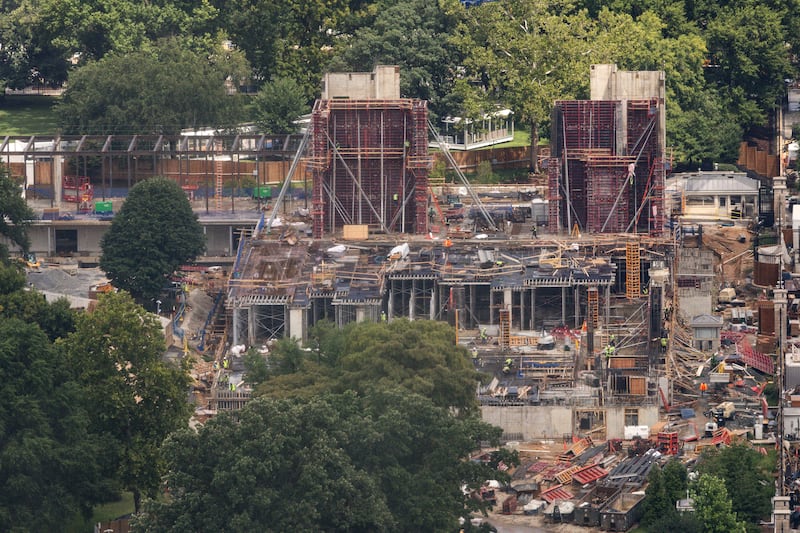
The East Wing of the White House was bulldozed in October 2025 to construct a “much-needed and exquisite addition,” the White House said when announcing the project.
A few months later, the National Trust for Historic Preservation filed a lawsuit to halt construction on the ballroom, an action that Carol Quillen, president and CEO of the National Trust, said it was “compelled” to do as the “organization charged with protecting places where our history happened.”
Court documents from the Friday ruling said the ballroom would “inflict permanent and irreversible harm to the historic, architectural, and aesthetic interests of the National Trust’s members, as well as the design of President’s Park, the White House, and the surrounding area.”
Rao, in her dissent, said, “The government’s interest in the security of the White House far outweighs any alleged harm to the Trust.”
“The government’s serious and substantiated security interest in completing the ballroom plainly trump what the Trust has placed on the other side of the scale — the aesthetic preferences of one individual who walks by the White House about once a month,” Rao wrote. “The minimal harm cannot justify a preliminary injunction that threatened the security and safety of the President of the United States.”
In a press release following the ruling Friday, the National Trust said it was “pleased” with the court’s decision.
“The White House, a global landmark that symbolizes American identity and the ideals of democracy, belongs to the American people,” the release said. “The National Trust for Historic Preservation and its partners are proud to defend this irreplaceable monument on behalf of all Americans.”
The court ruling said “whether or not a massive ballroom should be constructed is for Congress to decide and is not a matter for Executive self-help.”
The decision “does not even necessarily mean that the Defendants may not ultimately construct the ballroom,” the court added, but rules the project cannot be executed without “securing Congress’s authorization, as the Constitution and laws require.”
Trump argues the project is necessary for national security
Trump and Rao both argued that the ballroom is necessary for national security purposes.
The project includes construction of bomb shelters, medical facilities and heavily-secured bunkers, Trump said in an online post, adding that the ruling “severely jeopardizes the lives and welfare of the people who work, and will be working” at the White House.
Rao mentioned national security in her dissent, saying the case “is not about tearing down the White House and building a skyscraper or razing the Statue of Liberty.”
“The equitable balance is between the asserted aesthetic harm to a single passerby and the safety and security of the President as well as his family, staff, and guests at the White House,” Rao continued.
Decisions about changes to the physical design of the White House require congressional approval “even where those changes are said to serve security interests,” the ruling said.
The effect of the decision is stayed for 14 days, allowing defendants to seek an appeal to the Supreme Court, which Trump said he plans to do.