

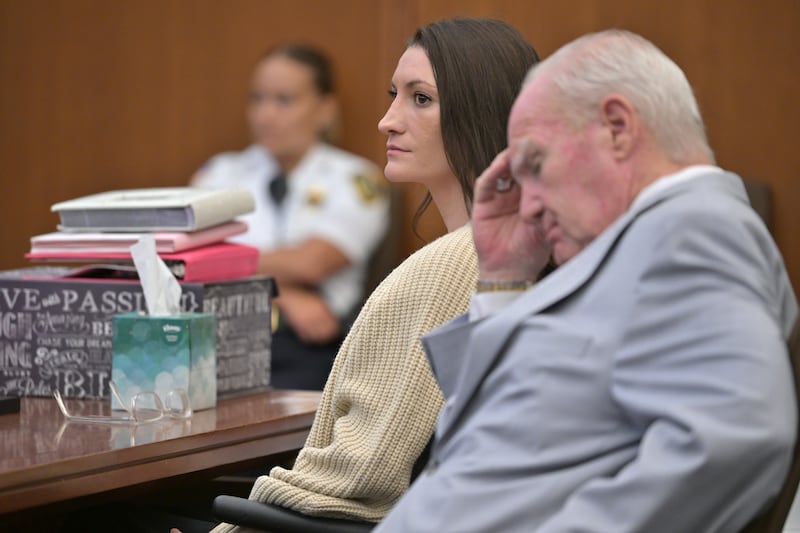

The judge in the Lindsay Clancy trial recently impounded the jury members’ names.
The order was extended indefinitely because, according to Plymouth Superior Court Judge William Sullivan, there is a “risk of immediate and irreparable injury should the list be made available to the public at this time,” the filing said, CBS News reported.
However, the order does not prohibit jurors from publicly speaking out themselves, and a few have.
After the Massachusetts case ended in a mistrial due to a hung jury, three female jurors spoke to the media about what they said occurred behind closed doors in the deliberation room.
Clancy, who admitted to killing her three children, ended in a mistrial on Sept. 4 after a hung jury ended 11-1 in Clancy’s favor of not finding her guilty by reason of lack of criminal responsibility. Plymouth County District Attorney Timothy Cruz has not publicly decided whether to retry her.
In a separate interview, one juror, Paula Devin, told CBS News’ Gayle King that the holdout juror was a Black man, and the only person of color on the jury.
“Whoa,” King said. “I have to sit with that for just a second.”
Holdout juror is identified
More information about the holdout juror seemed to come out each time an interview with fellow jurors was released online.
And though the man has not spoken publicly, YouTuber Ray Marcel, who hosts a show called “Fugitive TV,” said on Wednesday that he has been in constant contact with the holdout juror and that he would be speaking out soon.
“If you agree with him or not, guilty or not guilty, his name shouldn’t have been put out there like that, and no juror should be, you know, put to the forefront like that because it’s their civic duty to do that, and they should be protected,” Marcel told NewsNation’s Chris Cuomo.
“When I had my conversation with him, he said that based off all the evidence that he’s seen, everything that he heard, he felt that she was guilty,” Marcel added. “He felt that she was sane when she did it, and that’s exactly what he told me.”
He also said that the juror and another woman believed Clancy was guilty, but in the end, and he apparently didn’t know why, the female juror changed her mind.
In the interview with NBC Boston, Roni Carlson, the jury foreperson said the holdout juror “admitted he had reasonable doubt,” but added that he said he’s “still not going to say that she’s not guilty by reason of insanity.”
Marcel said the holdout juror denied that:
“He said from day one that he always felt that she was guilty, and he never displayed or said anything about reasonable doubt.”
The New York Post interviewed the juror’s brother, who said his family had no idea his brother was even on the jury, yet their lives have been turned upside down.
“My family cannot leave the house,” the brother said. “They are leaving notes at my mother’s house. They won’t leave us alone and we don’t know anything.”
His brother added that though the holdout juror is a devout Catholic, “I don’t think religion had anything to do with it. ... He looked at the case, and he made the call,” the brother said. “For me, that’s how I would do it. I would just listen to the case with all the evidence, and go from there.”
Will this affect juries in the future?
Before news outlets like NBC Boston released the juror’s name, they conducted background checks and reported what they found — including domestic violence disputes from 2021 that he was never convicted of and an active restraining order that expired during the trial — while withholding his identity.
“I don’t know if they tried to give the full story, or they just didn’t have the full story. But it wasn’t the full story,” Marcel said during his Tuesday show.
Katherine Loftus, a Boston attorney who has closely followed the Clancy case, told CBS News that this level of attention directed at jurors could undermine the importance of jury service as a civic duty.
If put on a high-profile case, “Your entire life is going to be subjected to scrutiny,” she said.
“I think that’s going to have a chilling effect for jurors moving forward,” Loftus added.
After speaking with the holdout juror, Marcel shared a similar concern.
“Now, in the future, people are going to be scared to even serve on a jury, and if they do, they’re going to be scared to maybe give in to pressure because they don’t want to be that one person that votes either guilty or not guilty,” he said.
He continued, “Is this how we’re supposed to treat our jurors, no matter if you agree with them or you disagree with them?”