


- A larger share of U.S. voters believe Republican candidates are generally corrupt, driven by more independent voters.
- Voters most worry about corruption involving covering up wrongdoing, misusing taxpayer money and taking bribes.
- Voters define political morality as being honest, standing up for what's right and not using office for personal gain.
Firmly conservative Fort Worth resident Mike Sturgill found himself in a dilemma this midterm election cycle.
A lifelong Republican committed to fiscal restraint and a strong defense, he has wrestled with the scandal-ridden candidacy of Texas Attorney General Ken Paxton.
Increasingly, Sturgill considers character an essential component of good governance. He voted for President Donald Trump in 2024 but chafes at his ragebait style.
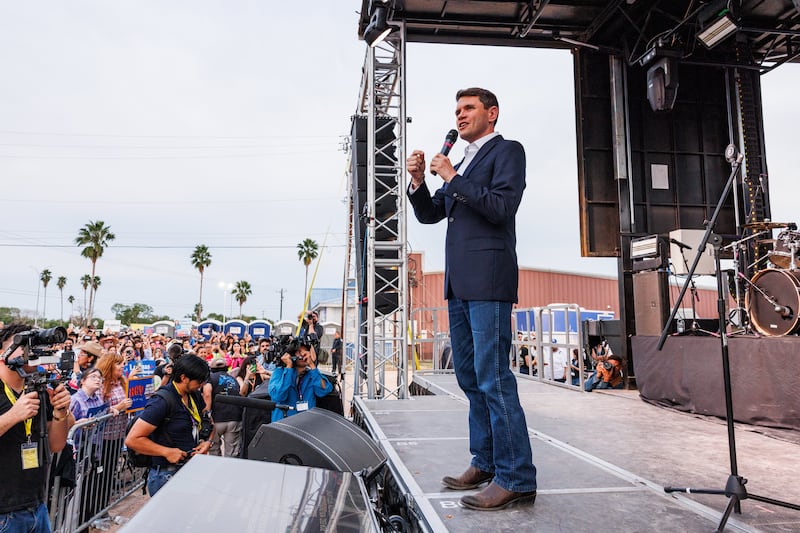
But Sturgill cannot stomach a vote for Democratic nominee James Talarico, with his progressive track record on transgender ideology, abortion and immigration.
In the state’s high-stakes Senate race, which concludes on Tuesday, Sturgill may simply withhold his vote entirely.
“Do I vote for somebody who I think will vote and do things that I probably agree with but is a terrible human being?” Sturgill told the Deseret News. “I think most people are having that same kind of challenge.”
A dozen polls conducted this month put Texas into the “toss-up” category, showing Talarico tied or slightly ahead.
The matchup between Paxton and Talarico has elevated personality over policy in a year when voters are putting self-dealing in government atop their list of anxieties.
Multiple polls, including Deseret News’ September poll, place corruption alongside issues like high prices as the most serious concern for voters ahead of Election Day.
This can mean very different things for different voters: A polarized political environment has filtered perceptions of corruption through red and blue lenses, according to the latest Deseret News-Hinckley Institute of Politics survey.
Which party is most corrupt?
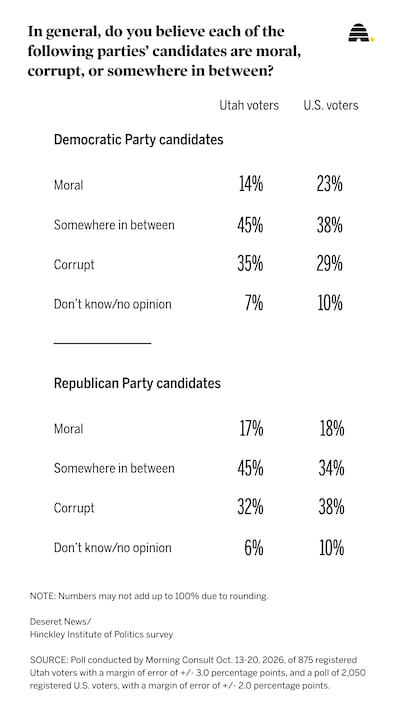
More voters in the U.S. view Republican candidates as corrupt. Responses are almost entirely determined by party affiliation, making independents the deciding factor.
While 29% of American voters believe candidates of the Democratic Party are generally corrupt, 38% believe the same, in general, of Republican candidates, the poll found.
Nearly two-thirds of Democratic voters believe that GOP office-seekers are corrupt, compared to 42% of independents and 9% of self-identified Republicans.
A much smaller share of independent voters — just over one quarter — believe that Democratic candidates, in general, are corrupt. Most independents see Democrats as usually being “somewhere between” moral and corrupt.
Utah voters avoided labeling candidates moral or corrupt: 45% said candidates on both sides fell in the middle.
Republicans nationwide had a more complicated view of their own party’s candidates than Democrats did of theirs.
Whereas 49% of Democrats believe Democratic nominees are generally moral, 36% of Republicans think so of their party’s picks. Nearly half of Republicans say their candidates are somewhere between moral and corrupt.
The poll was conducted online by Morning Consult among 2,050 registered voters from Oct. 13 to 19.
It is not so clear how this translates into votes because the graft of political figures ranges from private conflicts of interest to statewide fraud, said Chuck DeVore, chief national initiatives officer at Texas Public Policy Foundation.
For example, over the past two years, former New Jersey Democratic Sen. Bob Menendez was sentenced to 11 years in prison for bribery, and federal prosecutors uncovered an estimated $9 billion in welfare fraud schemes under the oversight of Minnesota Democratic Gov. Tim Walz.
These criminal findings have been followed by apparently legal but well-timed deals by Trump, his sons and their business associates, making the president more than $2 billion in profits his second term, largely from cryptocurrency, but also mining and social media ventures.
In Texas, voters are likely to come back to their ideological homes despite the allegations against Paxton, DeVore said.
“They’re voting for people who they think are going to vote in ways that reflect their philosophy,” he told the Deseret News. “A lot of voters look at it like, ‘I’m not hiring someone to be a babysitter; I’m hiring someone to vote in the U.S. Senate.’ So what’s the record of these individuals running?”
Paxton’s skeletons
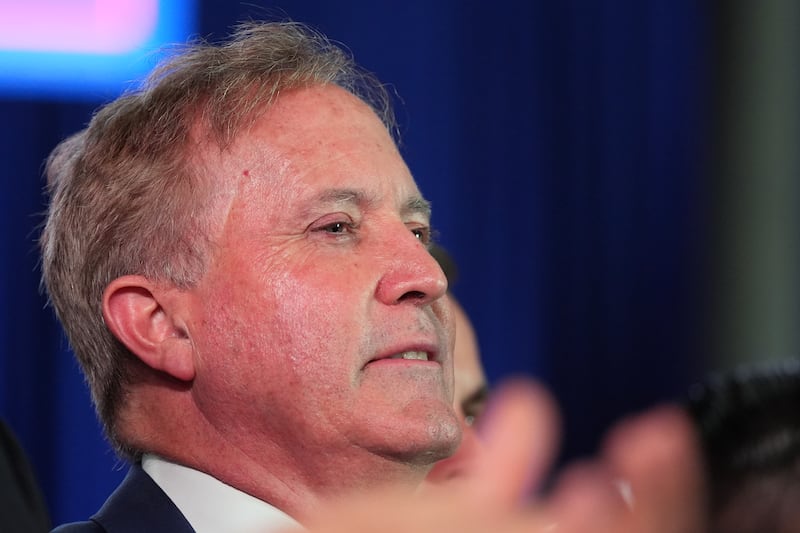
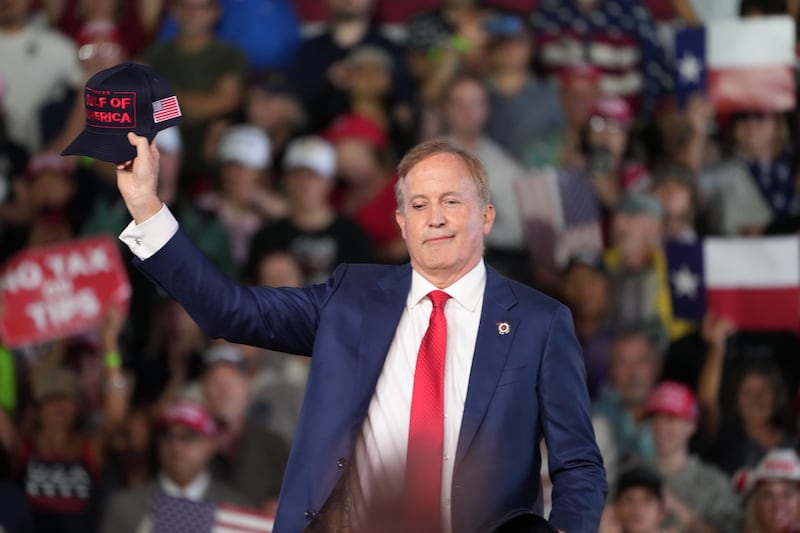
As attorney general, Paxton sued the Biden administration more than 100 times, notching major court wins to restart the border wall, overturn lax immigration rules, restrict porn access for minors and oppose vaccine mandates.
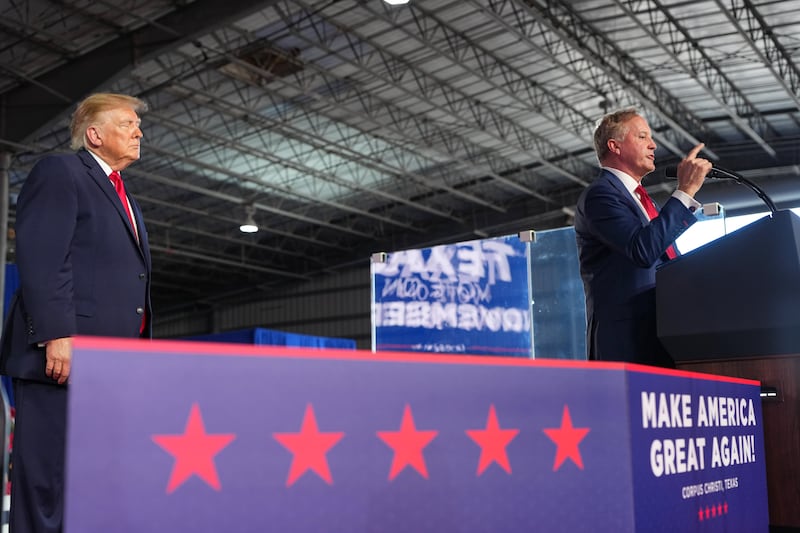
His tenure has also been marked by serious controversy: In 2023, the GOP-led Texas state House impeached Paxton for abusing his office to help a wealthy donor. He was acquitted by the state Senate after denying any wrongdoing.
He had previously been indicted for securities-fraud, for which he entered into a plea deal last year. Also in 2025, Paxton’s wife filed for divorce after 38 years of marriage, alleging he had committed adultery with other women.
For Jim Jack, a GOP volunteer in Williamson County, Paxton’s aggressive pursuit of Trump’s political priorities marks him out as a quality candidate, regardless of the negative press.
“I see Paxton doing a lot of good things for Texas, just in general; I never really looked at his personhood too much,” Jack told the Deseret News. “I have got to agree with Trump on what I think of him as an attorney general.”
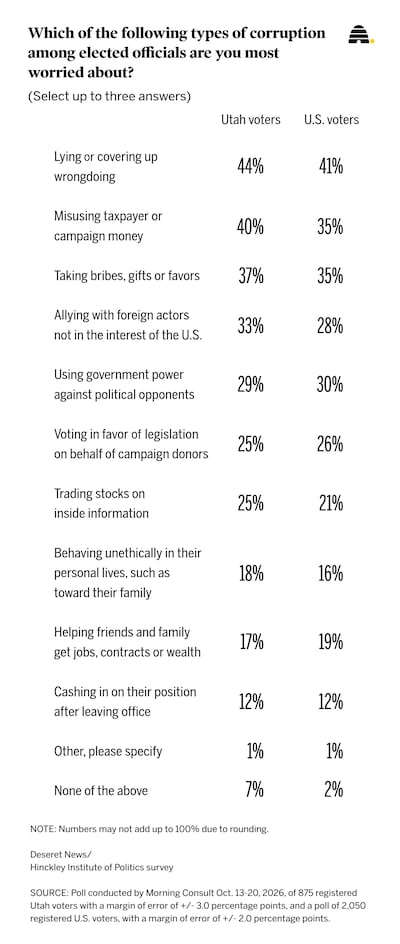
The types of corruption that most worry voters are covering up wrongdoing (41%), misusing taxpayer money (35%) and taking bribes (35%), the Deseret News-Hinckley poll found. The least worrying are cashing in on positions after leaving office (12%) and behaving unethically toward family (16%).
Perceived corruption was the deal breaker for Jon Seldon, an Austin voter with an independent streak that includes votes for George W. Bush, Barack Obama, Mitt Romney, Bill Clinton, Joe Biden and Kamala Harris.
If incumbent GOP Sen. John Cornyn had defeated Paxton, there is a good chance Seldon would have supported him, he said. But Paxton’s candidacy has pushed Seldon away from the GOP and into the arms of Talarico, potentially creating an opening in a state Trump won by 13 percentage points.
“People don’t like him, and that’s why I think Talarico has a shot,” Seldon said. “He comes across as a cleaner candidate.”
Attempts to frame Talarico as “extreme” by quoting his past statements about gender are not working like they once did in a red state like Texas, Seldon told the Deseret News, because Talarico, with his baby-faced, Bible-thumping image, seems “normal” in comparison to Paxton with all his “baggage.”
Talarico’s pitch
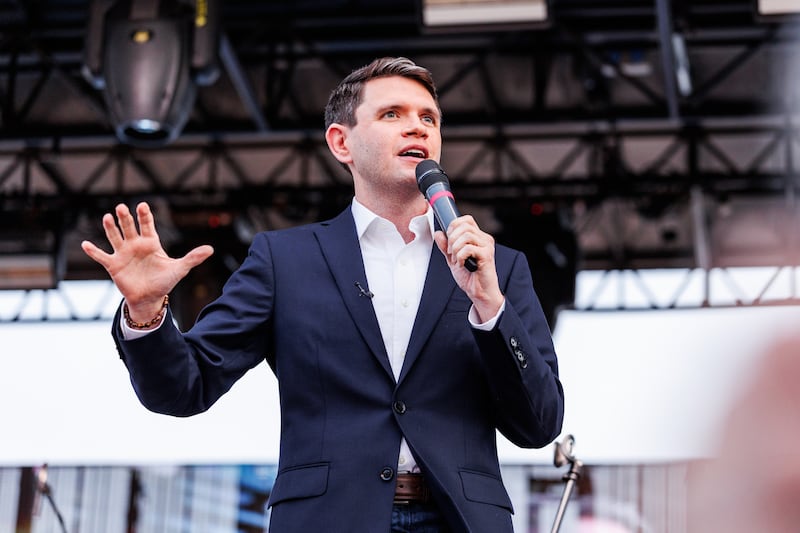
But Republicans have been keen to point out that Talarico, despite his centrist rebranding, has baggage of his own.
In the years leading up to and following 2020, Talarico was part of a far-left shift on social issues in the Democratic Party, declaring that “God is nonbinary,” there are “six” biological sexes, advocating for transgender participation in sports and supporting child gender-transition treatments.
More recently, Talarico has applied his seminarian background to hot-button issues like in defense of abortion access. While in the Legislature he opposed criminal enhancements for human smuggling and pushed for bans on some firearms.
The Democrat has pivoted on some social issues, retracting some past comments on gender, even as he has delivered a moderate message on affordability and ethics in politics.
Talarico has won over others, like Texas Democrat Ginger Bingham, appealing to religion to justify more welfare and a more compassionate approach to immigration enforcement.
“He’s also showing the things that you should get with a Christian,” Bingham told the Deseret News. “He’s showing the empathy and the support of you’re supposed to welcome the migrant, take care of the widows, take care of the poor.”
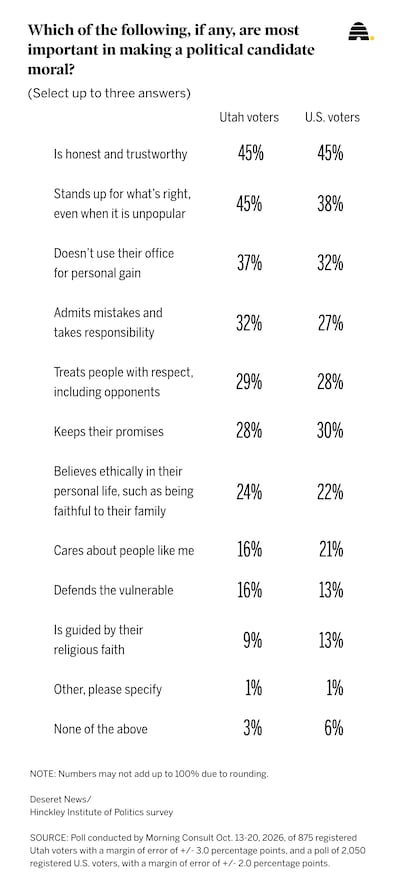
U.S. voters characterize morality in politics as being honest (45%), standing up for what’s right (38%) and not using an office for personal gain (32%), the Deseret News-Hinckley Institute poll found. Voters are least likely to say defending the vulnerable (13%) and being guided by religion (13%).
As a one-time “Romney” Republican who leans Democratic, Nancy Fisher said she is voting for Talarico because Republicans in Congress have failed to act as a check on Trump. While she had her qualms with Cornyn, she said her vote might have been different without Paxton at the top of the ticket.
“Ken Paxton is a crook,” she told the Deseret News. “I’m just looking for someone who has higher morals at this time.”
Another Cornyn voter has come around to Paxton. Joel Treanor, a Dallas resident, said while Paxton may not be the “prettiest candidate,” his background as an experienced “fighter” who champions limited government is what counts.
There is probably “a little truth” to the allegations brought against Paxton, Treanor said, but at least Paxton has remained constant as controversy erupted around him. Meanwhile, Talarico has morphed under political pressure to hide his “radical” reading of the Bible, according to Treanor.
“I gotta take the lesser of both evils if you really just want to know the truth,” he told the Deseret News.