

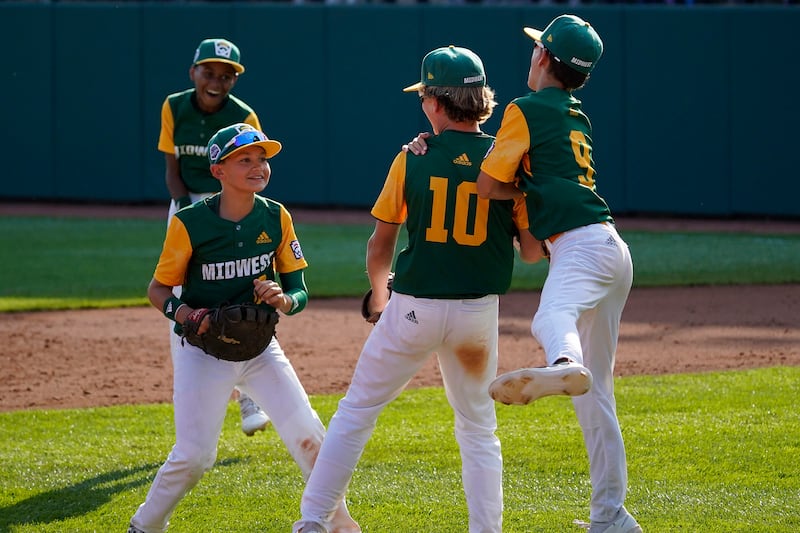

The Little League World Series and its broadcast partner, ESPN, are facing accusations of racial insensitivity after a group of white teammates was shown on camera Sunday sticking pieces of cotton to a Black teammate’s hair.
ESPN cameras caught the moment on film while broadcasting the MLB Little League Classic between the Boston Red Sox and Baltimore Orioles.
“That’s just Little Leaguers being Little Leaguers right there,” one of the commentators said.
A video from the broadcast started making the rounds on social media Sunday night. People questioned why the boys’ activities were shown on national television and whether the Black player was OK.
How did the Little League World Series respond to the video?
In a statement released Monday, tournament leaders said they talked to the team involved, which is from Davenport, Iowa, and represents the Midwest region, and felt confident that the Black player was not being singled out for mistreatment due to his race.
“We have spoken with the player’s mother and the coaches, who have assured us that there was no ill-intent behind the action shown during the broadcast,” the statement from the Little League World Series said.
Although it wasn’t shown on camera, multiple players had the cotton from inside the free stuffed animals that were handed out at the game stuck to their head, according to the statement.
“After speaking with the team, as well as reviewing photos, multiple players on the Midwest Region team were taking part in this while enjoying the game, As only one player appeared on the broadcast, Little League International understands that the actions shown could be perceived as racially insensitive,” it said.
Did the Little League World Series struggle with racial discrimination in the past?
The Little League World Series has prohibited racial discrimination since its founding 75 years ago, but it has faced several race-related challenges over the years, just like other sports leagues, as Chris Lamb, chairman of the partner of journalism and public relations at Indiana University-Purdue University Indianapolis, noted in a recent article for Andscape.
“In 1955, Little League Baseball found itself in a civil war when white teams in South Carolina, Florida, and Texas refused to take the field against Black teams” in order to protest the Supreme Court’s recent decision mandating an end to school segregation, Lamb wrote.
The article highlighted the efforts of sports editor Sam Lacy, who attend the Little League World Series in the 1950s in order to show that the young white players were happy to play against Black teams; it was their parents who caused the problem.
“If things were left to children, Lacy said, there would be no color line,” Lamb wrote.