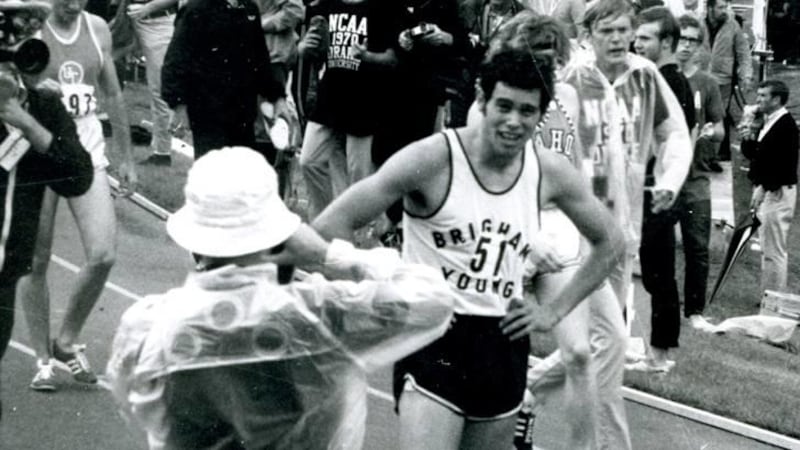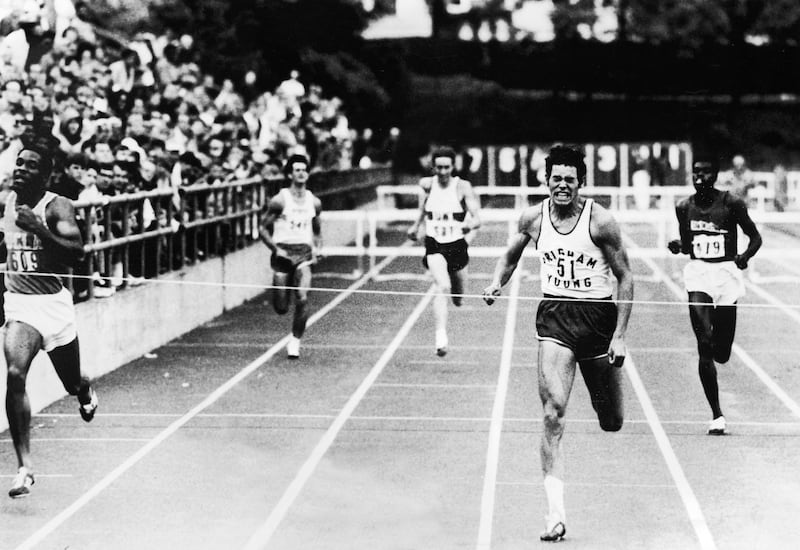

Ralph Mann is one of the greatest athletes ever to wear a BYU uniform, although many of the school’s fans probably have never heard of him or have forgotten him. A 400-meter hurdler, he ranked No. 1 in the world three times and No. 2 four times from 1969-75, claimed three NCAA championships and four U.S. championships, set a world record and won a silver medal in the 1972 Olympic Games.
And those might not be his finest accomplishments.
Armed with an undergrad degree from BYU in mechanical engineering and a doctorate from Washington State in biomechanics, he used science to teach elite athletes proper biomechanics — optimal athletic movements.
One of them was Sydney Levrone. She was a prodigy, making the Olympic team at the age of 16, but track aficionados recognized immediately that, as good as she was, she could be much better if she fixed her flawed hurdle technique. She met Mann in 2018 when she was 18. He took video of her hurdle movements and analyzed them.
When asked about it by New York Magazine, Mann said, “Sydney had problems. She couldn’t hurdle with her opposite leg. With her primary leg, she was mediocre at best. And her training wasn’t to the point where she could handle the last three hurdles. The problem with this is that no athlete likes to work on their weaknesses. What convinced her is that she hates to lose.”
Levrone went on to become the greatest female hurdler/long sprinter in history, setting a next-generation world record and winning two Olympic gold medals in the 400-meter hurdles.
When Mann died of pancreatic cancer on Jan. 2 at the age of 75, Levrone was among several world-class athletes to post a tribute to the man.
“Truly will be missed,” she noted on Instagram, accompanied by a photo of Mann in his athletic prime.
After a disappointing bronze-medal performance in the 2021 Olympics, U.S. sprinter Noah Lyles also sought help from Mann. As Lyles tells it, “He came by, looked at it (his sprint technique), and said, ‘That’s trash.’ He’s very blunt, and I’m a blunt person so I can take it. Still, it was like, ‘Okayyy. That hit differently.’”
Working closely with Mann, Lyles improved dramatically — especially in the drive phase of the sprint (the first 20-30 meters) — and became a sensational 100- and 200-meter sprinter, winning the gold medal in the former at last summer’s Olympics.
Lyles also posted a tribute to Mann with a photo of the two of them together on the track.
“I know Ralph because he is the crazy scientist that helped me and my coach turn me into the athlete I am today. He brought a new way of thinking to my starting blocks that helped me to become a great 60m runner and 100m Olympic Champion. I will forever be grateful for the love and support he showed me and for sharing his craft. I will forever remember you . RIP Ralph and THANK YOU.”
As Maleehah Shakeel put it more esoterically in Essentially Sports, “Mann’s coaching focused on getting Lyles to adjust his hips, reduce foot turnover, and minimize contact time during the first few steps.”
Michael Johnson, the legendary four-time Olympic champion and former world record holder at 200 and 400 meters, also posted a tribute: “Ralph Mann had a positive influence on the careers of many athletes and coaches. It was his work that helped my coach …”
Mann, a tenured professor at the University of Kentucky, wrote a 300-page textbook on the mechanics of sprinting and hurdling, as well as dozens of articles. He brought the science of biomechanics to USA Track and Field, working closely with elite sprinters and hurdlers to evaluate and improve performance.
His work was not limited to track and field. He co-wrote another book for golfers, “Swing Like a Pro: The Breakthrough Scientific Method of Perfecting Your Golf Swing.”
Mann is considered a pioneer in sports performance analysis. PJ Vazel, a professor of biomechanics at the University of Kentucky, noted that Mann “developed a patent for overlaying actual and optimal movement videos.”
“Ralph Mann is a true legend of BYU track and field,” said BYU head coach Ed Eyestone. " … Ralph excelled as a fierce competitor. He helped establish BYU as a power in track and field and made his name synonymous with greatness for our athletes for over 50 years. Dr. Mann has continued to positively impact our sport by being one of the world’s leading researchers and clinicians in sprint and hurdle mechanics and has generously shared his knowledge with generations of coaches and athletes. Our sport is better because of his contributions as an athlete and scientist.”
During five decades as an athlete and then a scientist, Mann left an indelible mark on the sport.