



In the beginning — of the 20th century, at least — college football created bowl games.
While the first bowl game occurred in 1902, it took a while for BYU to establish a tradition of bowling, with its first appearance coming in the 1974 Fiesta Bowl.
The Cougars lost their first four bowl games. In fact, it required “a miracle” for them to win their first one.
Today, BYU ranks among the top 25 of Division I programs with the most bowl appearances — 40 — and it has posted an overall record of 18-21-1.
BYU’s 50-year bowl tradition continues on Dec. 27, when the Cougars face Georgia Tech in the Pop-Tarts Bowl in Orlando for No. 41.
While Notre Dame turned down the opportunity to face BYU in the Pop-Tarts Bowl earlier this month, BYU turned down the opportunity to play in the Fiesta Bowl in 1977, albeit for a much different reason.
How much have times changed? The payout per team for the 1974 Fiesta Bowl was $202,000. In last year’s Alamo Bowl, featuring BYU and Colorado, each team received roughly $4.9 million.
The Cougars have compiled a colorful and controversial bowl history, filled with amazing, last-second comebacks; iconic plays; unforgettable performances; and heart-wrenching losses. They’ve played in all corners of the country, from Miami to Detroit to Dallas to Honolulu.
BYU has competed in 22 different bowl games, including the de facto national championship game (1984), a game immortalized as “The Miracle Bowl” (1980) and one on New Year’s Day (1997).
But there may be moments, trends, ironies or performances that many BYU fans don’t know about — or have forgotten.
Here’s a look at BYU’s wild, 50-year bowl history, in somewhat chronological order:
Bowling 101: At the Fiesta Bowl (1974)
Six weeks into the ‘74 season, nobody could have guessed BYU would end up going to a bowl game. Back then, there were only 11 bowl games. (Today, there are 41 bowl games and 11 College Football Playoff games.)
Besides the fact the Cougars had never been to a bowl game before, they started the season with a miserable 0-3-1 record. They didn’t earn their first win until Oct. 12.
To begin the season, both Hawaii and Utah State defeated BYU without scoring a touchdown (the Cougars lost 15-13 and 9-6, respectively, on a flurry of field goals). Iowa State then pummeled BYU, 34-7. The Cougars’ first Western Athletic Conference game of the season, against Colorado State, was a bizarre affair that ended in a 33-33 tie.
Coach LaVell Edwards called those weeks “the low point of my coaching career.” But it was also the turning point of his coaching career.
The Cougars defeated Wyoming the following week, 38-7, and then went on to win their next six games. They won the WAC title and were invited to the Fiesta Bowl, which automatically took the league champion (it was played on the home field of then-WAC member Arizona State in Tempe).
After playing football for 52 years, BYU finally earned a trip to a bowl game.

“It was one of the major early accomplishments we had,” Edwards said. “We had won a championship when I was an assistant (in 1965), but we had never gone to a bowl game. It was an exciting period of time. As a boy growing up, I remember listening to bowl games on the radio. So for us to go to a bowl was very special.”
BYU fans gobbled up the allotment of 8,333 tickets for the game.
Quarterback Gary Sheide suffered a dislocated shoulder in the first quarter after leading the Cougars to an early 6-0 lead. He was sidelined for the rest of the game. BYU fell to Oklahoma State, 16-6.
That’s how the Cougars’ bowl tradition kicked off.
The coach and pony connection (1979, 1980)
Two of the three men that became well-known ESPN “College GameDay” broadcasters were not only quite familiar with BYU on the field, but they also played prominent roles in BYU bowl history in back-to-back years — Lee Corso (aka “The Coach”) and Craig James (aka “The Pony”).
Both games occurred around the time of ESPN’s birth. It was a fledgling local cable network headquartered in Bristol, Connecticut, that began broadcasting on Sept. 7, 1979, just months before Indiana’s coach, Corso, faced BYU in the ‘79 Holiday Bowl.
The next year, James was a running back at Southern Methodist, which squared off against the Cougars in the Holiday Bowl.
As it turned out, Corso won a game against BYU he should have lost, and James lost a game against BYU he should have won.
In ‘79, the 11-0 Cougars were undefeated and ranked No. 9 in the nation — their highest ranking at the time. Indiana, from the Big Ten, was 8-3. BYU’s offense, led by quarterback Marc Wilson, led the nation in scoring. The Cougars put up 37 points on the scoreboard at Jack Murphy Stadium that night, but that wasn’t enough.
With seven seconds remaining in the contest, with BYU trailing by one point, kicker Brent Johnson uncharacteristically missed the potential game-winning field goal from 27 yards (Johnson did convert three field goals earlier in the game, including a 40-yarder), leaving the Hoosiers the winners and spoiling BYU’s would-be perfect season.
The final score: Indiana 38, BYU 37.
“We were very lucky,” Corso recalled. “Marc Wilson had an incredible game. He threw for something like 900 yards against us. Our guys had never been so exhausted. And then they have a guy who had never missed a field goal in his life and misses a chip shot. We were very, very fortunate.”
Corso has gotten a lot of mileage out of that win over the years, having referred to it numerous times on the air.
Then, in 1980, the Cougars entered their showdown with SMU (dubbed “The Mormons vs. The Methodists”) with an 11-game winning streak. But the only streaking they saw for most of that game came courtesy of the Pony Express — Craig James and Eric Dickerson — racing into the end zone for touchdowns. James was named the co-offensive MVP, along with BYU’s Jim McMahon. James rushed for 225 yards and two TDs.
The Cougars, who trailed 45-25 with four minutes remaining, capped a miraculous comeback with a Hail Mary pass with no time remaining as one Catholic, McMahon, connected with another Catholic, Clay Brown, for a 41-yard touchdown pass in the end zone, with multiple SMU defenders draped around him, to lift the Mormons over the Methodists.
Edwards liked to point out, though, that the game-winning extra point was nailed by Kurt Gunther, a Latter-day Saint returned missionary.
For BYU fans, the game is simply known as “The Miracle Bowl.” Perhaps it required some divine intervention to secure the Cougars’ first bowl victory.
Years later, James still had strong emotions about that bitter loss to BYU.
“They were very lucky to beat us,” he said. “We dominated that game for 57 minutes and then we just let up. If we would have played them again the next day, we would have kicked their fannies.”
Added James, “That whole week after the game, that’s all anybody around the country would talk about, the Holiday Bowl. It was the most exciting game I’ve ever been a part of.”
No longer oh-for-OSU (1974, 1976, 1982, 1985, 1993, 2009)
Six times, BYU has met OSU in a bowl game. The initial result? Five losses.
The Cougars’ first two bowl matchups were losses to Oklahoma State. BYU has played, and lost to, Ohio State three times in bowls (the 1982 Holiday Bowl, 1985 Citrus Bowl and 1993 Holiday Bowl). The Buckeyes are the only opponent that Edwards’ teams faced at least three times without winning at least once.
BYU finally broke that streak against OSU teams in 2009 with a resounding 44-20 victory over Oregon State in the Las Vegas Bowl.

Tangerine tangent (1976)
Former BYU athletic director Glen Tuckett said the 1976 Tangerine Bowl in Orlando is the one bowl he remembers most because “we had to work at it to get to it.”
In 1976, BYU and Wyoming had tied for the WAC crown, but the Cowboys earned the right to go to the Fiesta Bowl.
“I was the new director of athletics, and I wasn’t smart enough to know you could fail,” he once recalled. “We had to be invited and we had to do a lot of politicking. (Tangerine Bowl officials) found out how many members of the LDS Church we had down there and how many alumni were down there.
“I told them, ‘Traditionally, we draw a lot of fans to bowl games.’ I didn’t tell them we had only been once before. We had a fireside at the ballpark before the game and got a lot of support from fans there. The bowl people were tickled that we went.”

So was Oklahoma State, which won the game, 49-21.
One of the few BYU highlights of the night was a kickoff returned 102 yards for a touchdown by Dave Lowry.
Never on Sunday — Bowling for yen (1977)
Before the 1977 season kicked off, BYU made it clear that if it won the WAC championship, it would not play in the Fiesta Bowl, which was scheduled for Christmas Day in Tempe, Ariz.
That year, Christmas fell on a Sunday. BYU does not play on Sunday, because it is owned and operated by The Church of Jesus Christ of Latter-day Saints.
Sure enough, the Cougars won the WAC in 1977. The Cougars snubbed the Fiesta Bowl for religious reasons (years later, in 1996, the Fiesta Bowl returned the favor by snubbing the 13-1 Cougars for Bowl Alliance reasons).
With the 1977 Fiesta Bowl out of the question, BYU had no bowl to play in. So BYU AD Glen Tuckett told the Cougars to “go east, young men.” To the Far East, that is, on a goodwill trip that was planned before the season.
BYU played in two games in Japan against Japanese all-star teams at the end of the ‘77 season in an Oriental Extravaganza called the Silk Bowl, which was an exhibition contest.
“It was a great experience for the team, a great trip for the kids,” Tuckett remembered. “You don’t get to go to Tokyo very often.”
And what was the quality of Japanese football?
“They know the game pretty well, but they were just overmatched,” Edwards said. “They were competitive little guys. The night before the game I remember thinking, ‘This would really be big if we lose.’”
They didn’t, of course.
The Cougars must have been a big hit in Japan. The following year, BYU defeated UNLV 28-24 in its regular-season finale, played in Yokohama.
Beating BYU, by George (1978, 1987)
When George Welsh coached the Naval Academy to victory over BYU in the inaugural Holiday Bowl in 1978, it was a special experience for him in more ways than one.
That day, Dec. 22, happened to be his wedding anniversary.
Ironically, nine years later, to the day, on Dec. 22, 1987, Welsh, who was then the coach at the University of Virginia, met BYU in the All-America Bowl in Birmingham, Alabama, and won again.

More ironic still is that in those palindromic years, ‘78 and ‘87, Welsh beat BYU both times: 23-16 in 1978; and the almost identical score of 22-16 in 1987.
Who knows if Mrs. Welsh enjoyed those two anniversaries?
Years later, though, the Cougars exacted a measure of revenge against Mr. Welsh.
In 2000, in Edwards’ final season at the helm, the Cougars rallied from a 21-point halftime deficit to claim a 38-35 victory over Virginia and Welsh, who also retired at the end of the season.
So close, yet so far (1979, 1985, 1989, 1991, 1992, 1993)
Six times in bowl games between 1979-1993, BYU played well enough to win and probably should have won.
In 1979, the loss came after the aforementioned missed field goal that cost the Cougars a victory. In 1985, Robbie Bosco threw a pass that was intercepted and returned for a touchdown — Ohio State’s only TD of the game. The Buckeyes picked off two more passes in the end zone that day on their way to a 10-7 win.

In the 1989 Holiday Bowl against Penn State, a number of bizarre plays occurred, like a 2-point conversion attempt that was returned 102 yards for a score and a 53-yard fumble return for a touchdown late in the game in a 50-39 Nittany Lions’ victory.
“That was the screwiest game I’ve ever been involved in, and we’ve had our share,” Edwards said afterward. “Don’t ask me about any turning points because I wouldn’t be able to tell you.”
In the Holiday Bowl, favored Iowa halted BYU’s potential game-winning drive to preserve a 13-13 tie. BYU missed an extra point attempt in the second quarter.
In the 1992 Aloha Bowl in Honolulu, Christmas Day in paradise began wonderfully for the Cougars against Kansas. Before you could say Mele Kalikimaka, freshman Hema Heimuli returned the opening kickoff 94 yards for a touchdown.
But Jayhawk defensive lineman Dana Stubblefield spent the afternoon chasing fourth-string QB Tom Young, who was making his first, and only, career start for BYU as a result of injuries to the other quarterbacks on the roster. (Later, Tom’s brother, Steve, and Stubblefield were teammates with the San Francisco 49ers and won a Super Bowl.) The Cougars also shot themselves in the foot by missing an extra point and two field goals before falling 23-20.
In 1993, the 6-5 Cougars were coming off their worst season in 20 years. The top-10 ranked Ohio Buckeyes weren’t happy one bit about being relegated to the Holiday Bowl, feeling they deserved to be in the Rose Bowl.
The Cougars actually outplayed the Buckeyes for much of the game, but BYU squandered opportunities as OSU won, 28-21. Three times in the second half, BYU drove into the Buckeyes’ red zone without scoring.
Ty’s foes and woes (1988, 1989, 1990, 1991)
The legend of Ty Detmer may have begun in earnest during the 1988 Freedom Bowl in Anaheim, when, as a redshirt freshman, he came off the bench to rally the Cougars to a win over Colorado, a team that would play for the national title the following two seasons. The Buffs won it all in 1990, at least in the final AP poll.
It was the only bowl game Detmer won in his illustrious career. Placekicker Jason Chaffetz, a future congressman representing Utah, booted the game-winning field goal in a 20-17 victory.

In 1989, Detmer threw for 576 yards, but when Nittany Lion safety Gary Brown stripped the ball from Detmer and ran it back 53 yards for a touchdown, BYU’s comeback attempt was squelched. That game essentially launched his Heisman Trophy campaign the next season.
In 1990, Detmer won the Heisman, but he injured both shoulders, including a separation of his right shoulder, courtesy of the Texas A&M defense. He left the game in the third quarter as the Aggies went on to a dominating 65-14 victory.
In his final game as a Cougar, in the 1991 Holiday Bowl, Detmer passed for 350 yards against Iowa. His final pass was tipped and intercepted with less than 30 seconds remaining — an inglorious ending to one of the most glorious careers in NCAA history.

The game ended in a 13-13 tie.
Maybe the most remarkable part of the ‘91 season was that Detmer was a senior surrounded by underclassmen. He managed to rally his team from a 0-3 start to a 7-3-2 finish and a WAC championship.
The glory years (1980, 1981, 1983, 1984)
Remember the days when BYU fans would complain because they had to go to the Holiday Bowl in San Diego every year?
What a drag — spending late December in relatively warm weather, with nice ocean views, before watching a heart-stopping bowl game.
In later years, BYU fans would have given up a year’s worth of food storage for a trip to the Holiday Bowl.
There’s no question that the years 1980-84 were very, very good to the Cougars — four Holiday Bowl wins in five years. And it wasn’t just that they won. It was how they won.
In the 1980 Holiday Bowl, there was the jaw-dropping comeback as Jim McMahon and Clay Brown executed the play simply known in Cougar lore as “The Catch.” BYU scored 21 unanswered points against SMU in the final 4:07 to win the game simply known in Cougar lore as “The Miracle Bowl.”
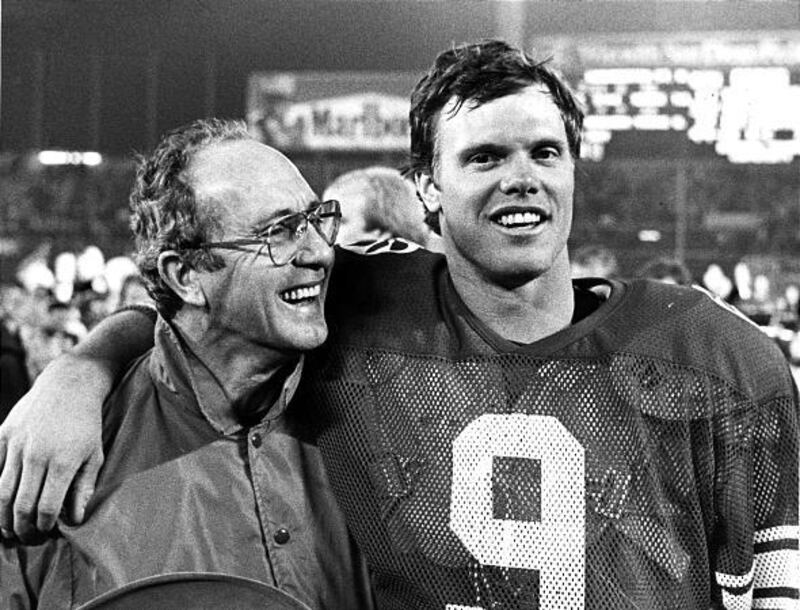
But in the 1981 Holiday Bowl, the Cougars also made an incredible comeback. But it wasn’t the BYU Cougars — it was the Washington State Cougars. BYU nearly pulled an SMU, snatching defeat from the jaws of victory.
BYU defensive back Tom Holmoe — who later served as BYU’s athletic director for 20 years — picked off a WSU pass early in the third quarter as BYU took a 31-7 lead. But in fine Holiday Bowl tradition, BYU surrendered a comfortable lead as WSU came roaring back, scoring 21 third-quarter points. BYU held on to win, 38-36.
In 1983, Steve Young caught the game-winning touchdown pass from Eddie Stinnett in the final minute in a win over Missouri.
Oh yeah, and BYU captured the national championship by defeating 6-5 Michigan in 1984 as a gimpy Robbie Bosco threw a game-winning touchdown pass to Kelly Smith to cap perhaps the biggest win in school history.
After the game, a reporter asked Wolverine defensive back Ivan Hicks if BYU was the best team in the land.
“Yes, and I’ll tell you why,” Hicks replied. “We played our hearts out there and they still won.”
Yes, the early 1980s were very good to the Republican Party, Cabbage Patch Kids and BYU football.
Inflicting misery on Missouri (1983)
In the 1983 Holiday Bowl, No. 9 BYU met unranked Missouri.
It was Hall of Fame quarterback Steve Young’s final college game, and he accomplished a memorable and rare trifecta — he threw a touchdown pass, ran for a touchdown and caught a touchdown that night in San Diego.
While Young was named the offensive MVP, Missouri’s Bobby Bell received the defensive MVP.
The Cougars trailed 17-14 when they drove from their own 6-yard line with 3:57 remaining in the game, marching to the Missouri 15-yard line with less than one minute left.
On first-and-15, BYU dug into its bag of tricks.
Young handed the ball off to running back Eddie Stinnett, who ran right, then turned and threw the ball across the field to Young.
Almost miraculously, Stinnett’s pass floated just out of the reach of Bell’s outstretched fingertips. Young caught the back end of the ball, then scrambled into the end zone to lift the Cougars to a 21-17 advantage with 23 seconds remaining.

For Young, what a way to leave a lasting impression on college football, scoring a dramatic, game-winning TD on his final play.
Considering the church’s history with the state of Missouri, maybe a little bit of karma was involved. Or divine intervention.
The most disputed national championship (1984)
Boasting a perfect 12-0 record at the end of the 1984 regular season, BYU was ranked No. 1 for the first, and only, time in program history.
The Cougars, who opened the season unranked, wanted to play No. 2 Oklahoma in the Orange Bowl, and settle the national championship on the field. But BYU was contractually obligated to play in the Holiday Bowl as the WAC champions.
There was plenty of politicking and blustering when bowl bids were meted out. But the Cougars’ opponent ended up being a 6-5 Michigan team.
BYU never had more at stake in a game than it did on Dec. 21, 1984, in San Diego against the Wolverines. The Cougars’ dream of winning a national championship hinged on, in large part, beating Michigan.
All the pressure sat on BYU’s shoulder pads. And the Wolverines did everything they could to end the Cougars’ hopes of a national title.
For example, in the first quarter, quarterback Robbie Bosco dropped back to pass and was drilled by Michigan’s Mike Hammerstein, injuring Bosco’s left leg. Hammerstein was whistled for a late-hit penalty and Bosco left the field to attend to his left knee and ankle.

Backup Blaine Fowler replaced Bosco, who was taken to the locker room.
Bosco had suffered a partial medial collateral tear in the knee and a Grade 2 ankle sprain.
“I was thinking, ‘I can’t believe I went the whole season without being injured,’” Bosco remembered. “Now here’s the biggest game of our careers, and I get injured.”
In the second quarter, Bosco told quarterbacks coach Mike Holmgren he wanted to return to the field. He did.
A limping Bosco made plays when he needed to, completing 30 of 42 passes for 343 yards, two touchdowns and three interceptions.
“Never have I seen a more courageous performance by a kid,” coach LaVell Edwards said after the game. “He was in pain. But as long as he coud stand up, he wanted to play.”
BYU racked up 483 total yards compared to 202 for Michigan. But the Cougars’ six turnovers kept the game close. The Wolverines had a 17-10 lead early in the fourth quarter, setting the stage for another vintage Holiday Bowl finish.
The Cougars scored two touchdowns in the final 11 minutes, starting with a leaping grab in the back of the end zone by wide receiver Glen Kozlowski, who soared over a Michigan defender to tie the game at 17-apiece.
Running back Kelly Smith caught a 13-yard pass from Bosco with 1:23 remaining to lift the Cougars to victory, 24-17.

The touchdown came on third down, with the ball at the Michigan 13-yard line. The play came into the huddle — “69 halfback option.” While the play was designed to get the ball, Smith was double-teamed. So it ended up being a broken play.
“I went down the sidelines, and Bosco found me in the back of the end zone,” Smith said. “I wasn’t supposed to be there.”
Two weeks later, on Jan. 3, 1985, after the New Year’s Day bowl games were completed, including No. 4 Washington upsetting No. 2 Oklahoma in the Orange Bowl, BYU was officially crowned national champions in the Associated Press and United Press International polls.
The implications of the Cougars’ 1984 Holiday Bowl win were even more far-reaching than BYU simply winning the national title. In an attempt to prevent a program outside the power conferences from ever winning another national championship, college football’s power brokers would eventually change the way it would settle its national championship, by creating the Bowl Alliance, the Bowl Championship Series, etc.
BYU’s sustained success during the 1980s and 1990s, along with lawsuits and congressional hearings, paved the way for change and inclusion.
BYU was the original BCS-buster, before the BCS existed. The Cougars’ national title opened the door for other programs from lesser-regarded conferences, like Utah, eventually to play in major bowl games.
Before BYU faced Michigan in the ‘84 Holiday Bowl, Oklahoma coach Barry Switzer said the Cougars would deserve the national title if they beat the Wolverines.
That prompted Edwards to tell his team after the victory, “You’re the greatest BYU team that’s ever been. I guess if Barry Switzer says we’re No. 1, then we’re No. 1.”

The blowout bowls (1982, 1986, 1990, 1994, 1998)
Call it coincidence. Call it fate. Call it yet one more arcane statistic that’s been unearthed.
Every four years, from 1982 through 1998, BYU was involved in a blowout. Mostly, the Cougars found themselves on the wrong side — 1982 Holiday Bowl (Ohio State 47, BYU 17); 1986 Freedom Bowl (UCLA 31, BYU 10); 1990 Holiday Bowl (Texas A&M 65, BYU 14); 1994 Copper Bowl (BYU 31, Oklahoma 6); and 1998 Liberty Bowl (Tulane 41, BYU 27).
Sooner ... and later bowl (1994)
The 1994 Copper Bowl in Tucson, Arizona, marked the final game for Cougar quarterback John Walsh, who would, days after BYU walloped Oklahoma 31-6, announced he would be making himself eligible for the NFL draft.
Walsh said goodbye by completing 31 of 45 passes for 454 yards and four touchdowns against the downtrodden Sooners. It was, at the time, the most convincing bowl victory in Cougar history.

For Oklahoma, it was the final game for lame-duck coach Gary Gibbs. In attendance that night, sitting in the press box, was his successor, Howard Schnellenburger. Months after witnessing BYU’s dominating win, Schnellenburger, the architect of the emergence of the Miami Hurricanes as a national power in the 1980s, talked as if it was the nadir of Sooner football history. He called it “the line of demarcation” for the program and claimed OU would go up dramatically from there.
In Schnellenburger’s one and only season at the helm, in 1995, the Sooners finished 5-5-1.
But Schnellenburger was prophetic in a sense. In 1999, Oklahoma hired a guy named Bob Stoops and Oklahoma became, once again, one of the premier programs in the country.
Meanwhile, Walsh wasn’t drafted until the seventh round of the 1995 NFL draft by the Cincinnati Bengals and never played a down in the NFL.
The touch, the feel of cotton (1996-1997)
On Jan. 1, 1997, BYU found itself playing in its first New Year’s Day bowl game, in the legendary Cotton Bowl, in front of 71,000 fans, about 40,000 of whom were clad in Kansas State-purple.
But probably even more people cheered against the Cougars that day — including the Bowl Alliance, the precursor of the Bowl Championship Series.
The Bowl Alliance snubbed BYU despite its 13 wins, No. 5 ranking, stifling defense and powerful offense. The snub cost BYU an $8 million payday at the Fiesta Bowl (instead, the Cougars earned $2 million from the Cotton Bowl).
If it wasn’t enough of a slap in the face to be rejected by the Fiesta Bowl, the K-State Wildcats showed disrespect for BYU all week long during Cotton Bowl festivities leading up to the game. They wouldn’t talk or shake hands with Cougar players. They saved their talking for the field, where they belittled BYU and its conference, the WAC.
The Cougars, meanwhile, let their play speak for them, registering a dramatic 19-15 victory over the Wildcats.
It was a contest that featured a safety by BYU and a 41-yard Hail Mary touchdown pass on the final play of the half (ironically, BYU had scored on a 41-yard Hail Mary TD pass on the final play of the game in the 1980 Holiday Bowl), sending the two teams into the locker room at halftime with the Wildcats ahead by the baseball-like score of 8-5.
Things didn’t go much better for the Cougars in the third quarter as K-State took a 15-5 lead.
But BYU mounted a patented comeback, punctuated by a 28-yard touchdown pass from quarterback Steve Sarkisian, a future Texas coach, to K.O. Kealaluhi with about four minutes remaining. The win was preserved by a game-saving interception by cornerback Omarr Morgan. On first-and-10 from the BYU 12-yard line, Morgan anticipated a slant pass and picked it off with 55 seconds remaining.
Not only did the triumph secure BYU’s top-5 finish in the final rankings, but it also gave the Cougars an NCAA-record 14th win that season.

Just a year earlier, BYU finished with a 7-4 record but failed to go to a bowl game for the first time in 17 years.
The Cougars made up for that in 1996 — and on the first day of 1997.
Give me Liberty or give me frostbite (1998, 2001)
When the weather’s nice in Memphis, the Liberty Bowl isn’t a bad place to play.
But when the weather’s bad, you’d better bundle up. That humidity, as they say, will go right through you.
The Cougars went to the Liberty Bowl twice in four years, but you couldn’t blame the frigid temperatures for BYU’s poor showing in bowl games.
In their first trip to Memphis, the Cougars were waxed by No. 10 Tulane, a team with an undefeated record and seeking some respect. In a town that is home to Graceland, which belonged to Elvis Presley (“The King”), the Green Wave rolled by the Cougars, thanks in large part to the performance of quarterback Shaun King. If not for a 21-point outburst in the fourth quarter by BYU, the loss would have been much worse.

Three years later, the Cougars returned to the Liberty Bowl, in much different circumstances.
After starting the year 12-0 under first-year coach Gary Crowton, BYU fell at Hawaii, 72-45, in the regular-season finale. The Cougars, playing without Doak Walker-winning running back Luke Staley, who suffered a season-ending injury in a win at Mississippi State in early December, were upset that they were snubbed by the Bowl Championship Series consideration before playing the Warriors.
The Cougars had opened the season putting up 70 points in the season-opener against Tulane. They led the nation in scoring that year. But without Staley, BYU’s offense could manage only 10 points against Louisville in the Liberty Bowl.
The Cardinals, guided by former Utah State coach John L. Smith, smashed the Cougars 28-10.
BYU’s lone touchdown came on a 10-yard run by 6-foot-7, 305-pound Dustin Rykert on a tackle-eligible trick play.

By the time the game ended, the ink in the pens of sports writers standing on the sideline had frozen solid.
That was a harbinger of bad things to come for BYU. The Cougars suffered three consecutive losing seasons from 2002-2004 and would not go bowling again until 2005.
The ‘Y’-2K bowl (1999)
Talk about strange places to hold a bowl game.
How about Detroit? In late December? Who’s idea was that?
What, was Siberia booked?
At least the Motor City Bowl was played inside the climate-controlled confines of the Silverdome, home of the Detroit Lions.
Coach LaVell Edwards would have coached many games there had he taken an offer from the Lions to be their head coach after the 1984 season. As it turned out, the Silverdome was his final bowl appearance.

Despite the bowl-chilling temperatures outside, BYU experienced a meltdown of gigantic proportions against undefeated Marshall.
Like Tulane a year earlier in the Liberty Bowl, No. 11 Marshall (13-0) had something to prove against BYU.
How ironic that in 1984, the Cougars were the upstart team looking for respect in a bowl against a traditional national power. In back-to-back bowl years, BYU faced a version of its former self.
Marshall was feeling disrespected by the college football world. The Cougars, who had started the season 8-1, stumbled badly toward the end of the 1999 season, culminating with an embarrassing loss in the Motor City Bowl.
BYU mustered a field goal early in the first quarter, and was shut out from there.

It turned out to be the final game as a Cougar coach for longtime offensive coordinator Norm Chow, who ended up leaving BYU for North Carolina State weeks later. As it turned out, it was Edwards’ final bowl game (he retired after the 2000 season).
How bad was the Motor City Bowl? Well, at the time (just days before Jan. 1, 2000), there were plenty of concerns about Y2K — concerns about how computers could malfunction with the date change and send society into utter chaos.
Well, chaos described BYU that day.
It was a “Y”-2K disaster. The Cougar offense experienced the equivalent of a power outage, its motor stopped running, the game plan was short-circuited, its supply of composure ran out and quarterback Kevin Feterik was overthrown. And Marshall law was in full effect.
But the time the game clock struck zero, the Thundering Herd, led by NFL-bound quarterback Chad Pennington, had trampled BYU 21-3.
Viva Las Vegas (2005, 2006, 2007, 2008, 2009)
BYU and Las Vegas make quite the odd couple.
The church-owned school is the perennial No. 1 stone-cold sober university in the nation. It has a stringent honor code and coaches that emphasize the spiritual aspects of life.
Las Vegas is nicknamed Sin City and is known for glitz, glamour and gambling. It features The Strip, showgirls and racy billboards that can make a grown man blush.
BYU’s reputation, and that of Las Vegas, clash like the Tabernacle Choir at Temple Square and Elvis impersonators.
But when it comes to the Las Vegas Bowl, the two disparate entities have complemented each other well.

Thanks to this annual December football game — then held at nondescript Sam Boyd Stadium — for five straight years (2005-2009), it was a place where “Come, Come Ye Saints” and “Viva Las Vegas” converged. It was no coincidence Sam Boyd Stadium sold out every one of those years.
A Las Vegas television personality once asked then-BYU coach Bronco Mendenhall about the dichotomy of BYU making an annual tradition, and pilgrimage, of playing in a bowl game in Sin City.
“It’s an interesting thing, considering … it’s a fan base that doesn’t drink, doesn’t smoke, doesn’t gamble — at least isn’t supposed to. I’m not sure how excited Las Vegas is to have us, knowing we’re probably not generating a lot of income for them, other than on game day, we’re having a sell-out. Which is what the bowl game is for, from my understanding.”
In retrospect, it’s somewhat amazing to think that prior to 2005, BYU had never played in the Las Vegas Bowl before making five consecutive trips there as the Mountain West Conference representative.
In 2005, athletic director Tom Holmoe and Mendenhall predicted BYU’s frequent trips to Las Vegas. When BYU, after Mendenhall’s first season at the helm, accepted an invitation to face Cal in the Las Vegas Bowl, it marked the Cougars’ first bowl berth since 2001 and snapped a streak of three consecutive losing seasons. Everyone connected with the program was elated about going to the Las Vegas Bowl. And the feeling was mutual.
BYU actually saved the Las Vegas Bowl, which is now played at Allegiant Stadium, home of the Las Vegas Raiders.
At that time, the Las Vegas Bowl needed to sell more than 29,000 tickets to the 2005 game in order to maintain its bowl charter with the NCAA. That year, BYU delivered the bowl’s first-ever sell-out.

“This is the beginning of many more,” Mendenhall said in December 2005.
BYU fell in its first appearance, against Cal. But in 2006, the Cougars were ready for their challenge with Oregon, which finished in a fifth-place tie in the Pac-10 standings. Prior to the game, Ducks coach Mike Bellotti smugly insisted that BYU couldn’t compete with the upper echelon, or even mid-level, of the Pac-10.
Even after a 38-8 drubbing at the hands of the Cougars, Bellotti didn’t budge from his position.
“We didn’t play like a mid-level Pac-10 team, but no, my opinion of them hasn’t changed,” he said.
Former Cougar coach Gary Crowton was calling plays for Oregon that game. Crowton had led BYU to its previous, most recent, bowl appearance, in 2001.
It marked BYU’s first bowl victory since the Cotton Bowl at the end of the 1996 season.
The following year, in 2007, BYU earned a narrow win over UCLA (its interim head coach was former BYU defensive backs coach DeWayne Walker) on a last-second field goal attempt blocked by Cougar freshman Eathyn Manumaleuna.

In 2008, BYU fell to Rob Gronkowski and Arizona. But the Cougars bounced back in 2009, claiming a convincing 44-20 victory over Oregon State on a windy night in Las Vegas. Down 7-0 early, BYU scored 37 unanswered points to crush the Beavers.
It was a sweet victory for the Cougars’ senior class, which helped produce a 43-9 record over four seasons.

Heaps o’ fun ... but not for long (2010)
In 2010, the Cougars kicked off the college bowl season with a dominating 52-24 win over former WAC rival UTEP in the New Mexico Bowl in Albuquerque.
It marked BYU’s fourth bowl win in five years and secured coach Bronco Mendenhall’s fifth consecutive winning season.
The Cougars were led by true freshman quarterback Jake Heaps, who earned bowl Offensive MVP honors by completing 25 of 34 passes for 264 yards and four touchdowns.

At that point, it appeared Heaps was on the cusp of becoming BYU’s next great quarterback.
But after starting the first five games of his sophomore season, an ineffective Heaps was replaced by Riley Nelson. In early December 2011, Heaps announced he was transferring to Kansas.
‘Red alert’ in Dallas (2011)
With many observers expecting a high-scoring affair in the 2011 Armed Forces Bowl on a sun-drenched day in Dallas, BYU — playing in its first bowl game as an independent — and Tulsa staged a defensive struggle.
Quarterback Riley Nelson struggled for most of the game before helping lead the Cougars on a 12-play, 48-yard drive in the closing four minutes that ended with a 2-yard touchdown pass to Cody Hoffman on an audibled trick play with 11 seconds remaining.
BYU rallied for a 24-21 victory over the Golden Hurricane.
On the play, on second-and-2 at the Tulsa 2-yard line, BYU coaches had called a spike play to stop the clock. Instead, Nelson called an audible and executed a “Red Alert,” or fake spike.
“He did it completely on his own,” coach Bronco Mendenhall said of Nelson. “I do believe in the freedom of players, and I trust them to do what they think is right to help our team win.”
The other memorable play from that game occurred just before halftime, when senior left tackle Matt Reynolds, Nelson and Hoffman teamed up for a crucial touchdown. It was BYU’s first TD of the game.
On first down, as Nelson scrambled toward the sideline, Reynolds lost his helmet as he tussled with a Tulsa defender. Without his lid, Reynolds peeled back and delivered a crushing block near the sideline that allowed Nelson to keep the play alive.
Nelson completed a pass to Hoffman in the middle of the field, at about the 3-yard line. After catching the ball, Hoffman battled through a couple of defenders, then stretched the ball over the goal line for the score.
The postscript of this story: Reynolds’ helmetless block prompted the NCAA to create a new piece of legislation, a rule that states that a player can no longer participate in a play if he loses his helmet.

The Kyle Van Noy Show (2012)
For years, BYU established a reputation for playing high-scoring games at the Holiday Bowl in San Diego.
The Cougars returned there in 2012 for the Poinsettia Bowl, but that season, they didn’t have much of an offense when they faced former WAC/Mountain West rival San Diego State.
Once again, BYU, under the direction of quarterbacks James Lark and Riley Nelson, had a rough time moving the ball and scoring points that night. But fortunately for the Cougars, they had Ezekiel Ansah, who would be the No. 5 overall pick in the upcoming 2013 NFL draft.
They also had a one-man defensive wrecking crew named Kyle Van Noy.

The 2014 second-round NFL draft pick pretty much took matters into his own hands and controlled the fourth quarter.
From his linebacking position, Van Noy scored two touchdowns in the game. Early in the fourth quarter, BYU trailed 6-3 before he burst around the corner and drilled SDSU quarterback Adam Dingwell in the end zone, forcing a fumble. Van Noy pounced on the ball for a TD, giving the Cougars their first lead, 10-6.
With 6:09 remaining in the game, Van Noy scored on a 17-yard pick-six.
And, by the way, he also recorded a blocked punt in the third quarter.
In the end, BYU beat the Aztecs 23-6.
Not surprisingly, Van Noy was named the game’s defensive MVP; wide receiver Cody Hoffman earned offensive MVP after catching 10 passes for 114 yards; and punter Riley Stephenson was the special teams MVP after booting six punts inside SDSU’s 20-yard line, including the 5-yard line, the 1-yard line and the 2-yard line.
Many unhappy returns (2013)
BYU saw its school-record four-game bowl-winning streak snapped with a 31-16 loss to Washington in front of a crowd of 34,136 in the Fight Hunger Bowl at AT&T Park in San Francisco.
Three of the Huskies’ four touchdowns came on or were aided by long kickoff returns, including a 100-yard return allowed by the Cougars in the second quarter.

“The turning points,” BYU coach Bronco Mendenhall said, “were our kickoff cover team.
“The difference in the game, to Washington’s credit, was their kick return game.”
Washington was led that night by interim coach Marques Tuiasosopo, who stepped in for former BYU QB Steve Sarkisian, who left Seattle to take the head coaching job at USC.
Miami Beach brawl (2014)
BYU faced Memphis in the inaugural Miami Beach Bowl. Although it was a wildly entertaining game — the Tigers earned a 55-48 double-overtime victory at Marlins Park — it will always be remembered for what happened right after it ended.
The game was marred by an ugly, violent postgame brawl between the two teams on the field. It began when Memphis players began celebrating the win, taunting BYU’s sideline. Havoc ensued and a melee broke out. A shoving match ensued, punches were thrown.
BYU safety Kai Nacua, who threw one of the punches, left the locker room holding an ice pack over his swollen cheek as a result of the fight.

“We expect better of our athletes, even in the face of a difficult loss,” BYU athletic director Tom Holmoe wrote on social media. “We intend to fully review this matter. I apologize to Cougar Nation.”
A few months later, coach Bronco Mendenhall said “10-ish” players would be disciplined for their role in the fight. Memphis suspended a number of players, who were scheduled to attend mandatory anger management counseling and perform community service hours.
Goodbye, Bronco, hello, Kalani (2015)
For BYU, one era ended Saturday in the Las Vegas Bowl — and a new one began.
In the Cougars’ 35-28 loss to archrival Utah, Bronco Mendenhall coached his last game for BYU.
The Cougars trailed Utah 35-0 with 4:38 left in the first quarter after five turnovers in BYU’s first five possessions. BYU rallied to get to within one score late in the game but fell.
It marked the only time the two teams have played each other outside the state of Utah.
The Utes prevented Mendenhall from reaching his 100th victory at BYU. He finished with a 99-43 record in 11 seasons at the helm.

After the game, as part of the postgame press conference, athletic director Tom Holmoe announced, and confirmed, that Kalani Sitake, a BYU alum and former Utah defensive coordinator that had spent the previous season at Oregon State, had been hired as the program’s 14th head coach.
Two days later, Sitake was formally introduced in Provo as the new leader of the program. Fittingly, LaVell Edwards was in attendance at the event, along with many other former BYU players and coaches, held inside the BYU Broadcasting Building.
Jamaal runs wild on a rainy night in San Diego (2016)
In a town known for its mild, balmy weather — San Diego — nobody expected Mother Nature to play a factor at Qualcomm Stadium for the Poinsettia Bowl. It marked Kalani Sitake’s first bowl game as the Cougars’ coach.
As a steady rain fell in the first half, creating soggy conditions, BYU and Wyoming made miscues.
But the Cougars took a lead when the rain subsided in the second half, and they hung on for a dramatic 24-21 victory over the Cowboys. BYU was clinging to a tenuous 3-point lead with 1:22 remaining when Kai Nacua intercepted Wyoming quarterback Josh Allen — the No. 7 overall pick in the next spring’s draft — to seal the win. It was Nacua’s final play as a Cougar.
Another senior playing in his final game at BYU was running back Jamaal Williams, who rushed 26 times for 210 yards and a touchdown in his mud-stained, rain-soaked, all-white uniform.

I say potato, you say ... (2018)
True freshman quarterback Zach Wilson broke a single-game record by completing his first 18 pass attempts in BYU’s 49-18 whipping of Western Michigan in the Famous Idaho Potato Bowl on the (in)famous Blue Smurf Turf in Boise.
It was the Cougars’ first time in a bowl game since 2016, following a disastrous 4-9 campaign in 2017.
Wilson finished with 317 passing yards and four touchdowns. He was named the game’s MVP and his 18 consecutive completions topped the 14 straight completions set by Steve Sarkisian and Steve Young.

The Cougars rallied from a 10-7 halftime deficit by scoring 35 unanswered points and a total of 42 second-half points. Linebacker Sione Takitaki, who had a checkered career at BYU, went out in his final game by tallying 19 tackles.
During the postgame trophy ceremony, which saw Wilson standing in front of the Famous Idaho Potato Bowl trophy, featuring a giant bowl of raw potatoes, an ESPN sideline reporter congratulated the winners over the loudspeaker as the “BYU Tigers.”
The Final Four of independence (2019, 2020, 2021, 2022)
As part of being an independent program, BYU played in a variety of far-flung bowl games from 2011-2022, wherever ESPN needed the Cougars. Most of their bowl destinations were known well before each season kicked off.
During those seasons as an independent, BYU posted a 6-5 record, splitting the final four bowls.
In 2019, at the Hawaii Bowl on Christmas Eve, BYU faced homestanding Hawaii at Aloha Stadium. It was reminiscent of many of the games played between the two schools over the previous decades when they were WAC rivals.
Among other things, it featured, in the third quarter, quarterback Zach Wilson running toward the goal line, leaping up and getting smashed by Hawaii defenders, who spun him completely around mid-air like a helicopter blade. The ball came loose and instead of a touchdown, it resulted in a turnover. In the end, the Cougars fell 38-34.

In the pandemic season of 2020, BYU (which finished with an 11-1 season, with the lone setback coming in controversial fashion at Coastal Carolina, a game set up just days before it was played) faced UCF in the Boca Raton Bowl. Wilson outplayed UCF’s talented QB, Dillon Gabriel, and it was his final game in a Cougar uniform before becoming the No. 2 overall pick in the 2021 NFL draft. BYU thrashed the Knights 49-23.
In 2021, BYU played UAB in, fittingly, the Independence Bowl in Shreveport, Louisiana. The Cougars trailed 14-0 before rallying to grab a 28-24 advantage. But in the end, UAB put together a 15-play, 75-yard, game-winning touchdown drive that took 8:16 off the clock in the Blazers’ 31-28 victory.
In 2022, BYU returned to the New Mexico Bowl and, with Sol-Jay Maiava-Peters, a fourth-string QB starting for an injured Jaren Hall, rushed for 96 yards and a touchdown against SMU. Later, Maiava-Peters transferred to New Mexico. As for the game, cornerback Jakob Robinson made a game-saving tackle of Mustang quarterback Tanner Mordecai at the 1-yard line in a 24-23 victory over SMU.

Similar to the Miracle Bowl in 1980, the Cougars were fortunate to earn a 1-point victory over the Mustangs on the final play of the game.
That would mark BYU’s final game as an independent football program before entering the Big 12. The Cougars did not go bowling in 2023 after posting a 5-7 record.
An Alamo Bowl Colorado doesn’t want to remember (2024)
Going into the 2024 Alamo Bowl in San Antonio, Texas, most of the attention centered around No. 23 Colorado, coach Deion “Prime Time” Sanders, quarterback Shedeur Sanders and newly crowned Heisman Trophy winner Travis Hunter.
What many people, such as ESPN broadcasters, forgot was that the Buffaloes were playing an opponent — No. 17 BYU — in a meeting of a pair of Big 12 foes.
The Cougars rewrote the script by outplaying and outclassing Colorado 36-14.
It was never close, as BYU jumped out to a 17-0 lead, including a 64-yard punt return for a touchdown by Parker Kingston.
At one point, BYU linebacker Isaiah Glasker performed the “Deion Shuffle” after he intercepted Shedeur Sanders, creating a viral moment.
Millions were watching.
In fact, it marked the most-watched BYU football game in modern history, drawing a record 8 million viewers, and it was the most-watched non-CFP bowl game in years.
“No one expected us to win or dominate like we did,” said BYU running back L.J. Martin, who rushed for 93 yards and two touchdowns.

It ended up being the final game in a BYU uniform for quarterback Jake Retzlaff, who transferred to Tulane the next summer.
BYU held Colorado to 210 yards, including 2 yards rushing, and placekicker Will Ferrin booted field goals of 51 and 54 yards for the Cougars.
What moments, trends, ironies and performances — not to mention wins and losses — lie ahead for BYU football over the next 50 years?