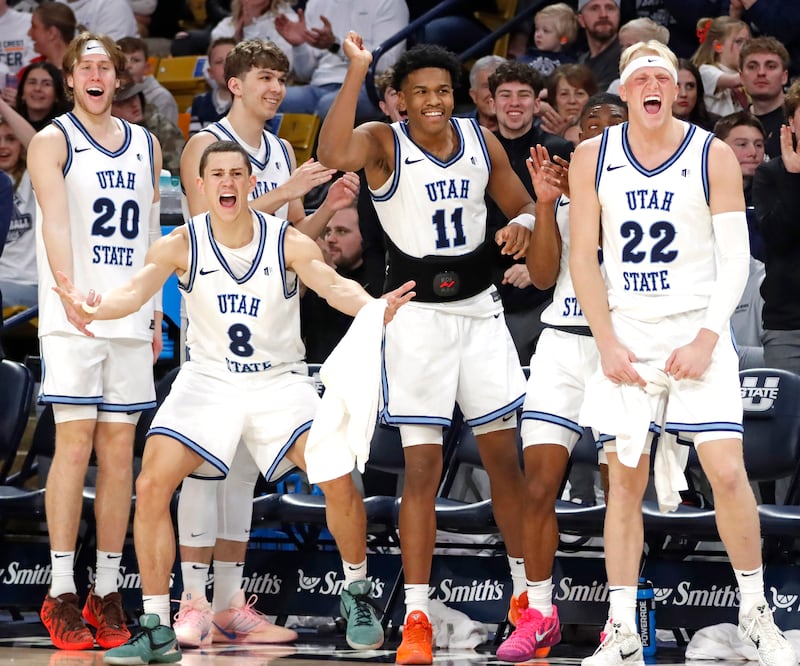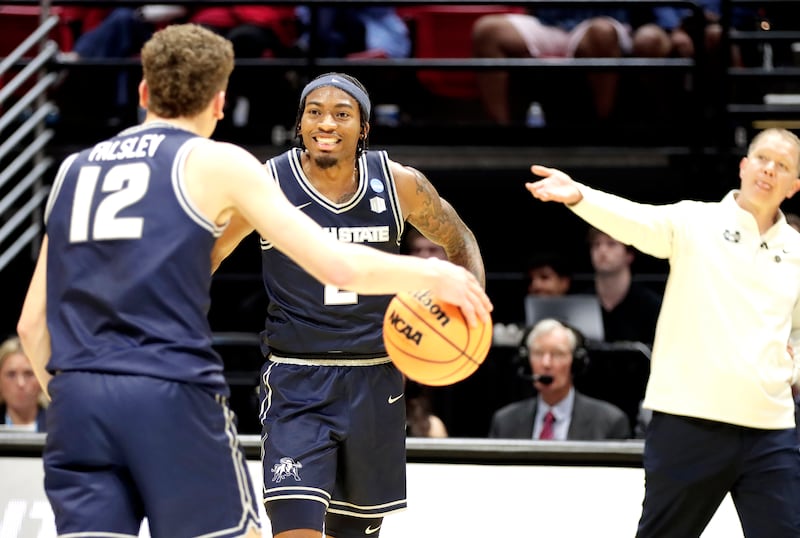
LOGAN — For Aggie basketball fans, the last few weeks have been rather chaotic.
Kind of like herding cats.
After winning the outright regular-season conference title on March 7, the Aggies completed their Mountain West run with a postseason tournament championship on March 14, in Las Vegas.
That led to a surprisingly low No. 9 seed in the NCAA Tournament and a clash with No. 8 Villanova in San Diego on March 20, and an 86-76 victory over those Wildcats set up a showdown with No. 1 seed Arizona two days later. And while a 78-66 loss to the top seed in the West Region ended Utah State’s season, the hits — and the cats — kept coming.
Before the Aggies could get back to Cache Valley Monday afternoon, news broke that head coach Jerrod Calhoun was leaving USU after two seasons to take over as the new coach of the Cincinnati Bearcats.
While Calhoun’s departure for UC didn’t exactly come as a shock, the leaking of the decision made for an awkward exit for Calhoun as he got off the team bus when the Aggies arrived at the Spectrum parking lot. And by Tuesday, the Ohio native was back in the Queen City, while relatively new USU athletic director Cam Walker and the Utah State fan base contemplated the reality of welcoming yet another new basketball coach to Logan.
“I am thankful for Jerrod’s efforts the last two seasons leading our men’s basketball program, including two NCAA Tournament appearances, regular-season and tournament championships, and most recently a victory in the first round of the NCAA Tournament,” Walker said in a statement on Tuesday. “I wish him, Sarah and their daughters all the best.”
Calhoun was hired by former USU athletic director Diana Sabau, who left Utah State last July after two years in Logan. Danny Sprinkle, the previous USU head coach who spent just one year at the helm of the Aggies, was hired by Jerry Bovee, who was serving as interim athletic director at the time.
Bovee stepped into that role after John Hartwell suddenly resigned as USU athletic director in November 2022 following seven years at the post. It was Hartwell who fired Tim Duryea in March 2018 after three subpar seasons, leading to the hiring of Craig Smith less than two weeks later.
Hartwell also tabbed Ryan Odom in the spring of 2021 after Smith left to take over the program at the University of Utah.
All told, between Smith, Odom, Sprinkle and Calhoun, Utah State has cycled through four coaches in eight years, and the Aggies are now looking for a fifth coach to keep the university’s stunning run going. After ending the 2025-26 campaign with a 29-7 record, the Utah State program is averaging 25 wins a year over the last eight seasons, while making six trips to the NCAA Tournament (not including 2020, when the Aggies won the Mountain West tourney just before the start of the COVID-19 pandemic).
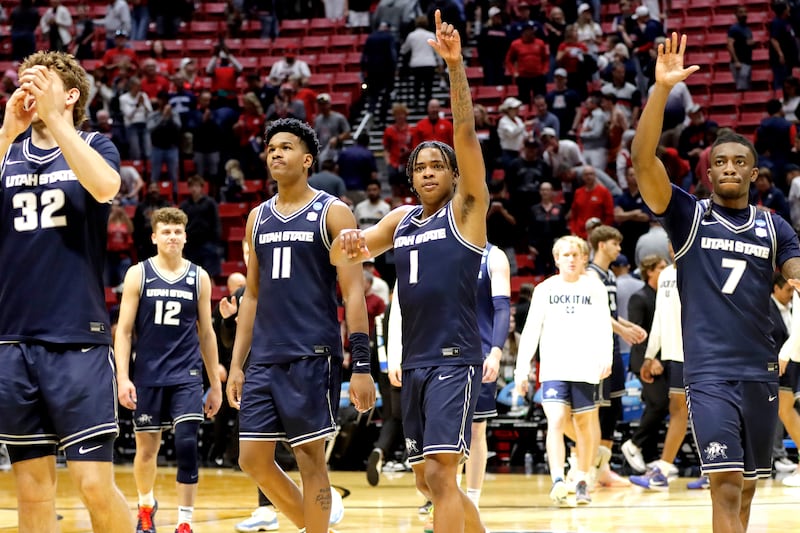
“Utah State men’s basketball is one of the premier basketball programs in the country,” stated Walker, who was hired last fall by a USU search committee that included Calhoun. “We will continue investing at a high level as we pursue championships and competitive excellence in the new Pac-12. The support of Cache Valley further enhances this amazing opportunity in Logan. Our fans and the HURD are phenomenal. We will work relentlessly to identify the next men’s basketball leader, who will continue to build on our rich tradition.”
While Calhoun certainly embraced that tradition, reaching out to former Aggies and becoming friends with several of his USU predecessors, he also took time during his introductory press conference Wednesday at Cincinnati to point out one of his major concerns involving USU moving forward as they get set to join the new version of the Pac-12 in July.
‘A top-30 job in America’
“Utah State is a top-30 job in America. It truly is,” Calhoun declared. “It’s a place that has an incredible student body; 3,800 students every night. … But I can tell you this: When we got the No. 9 seed after winning 28 games and a regular-season and tournament title, you know, that was pretty telling. The game has changed, and college basketball has changed forever. We don’t have one team outside of Iowa — which is a No. 9 seed and they’re a Big Ten team — in the Sweet 16.”
The Aggies made their own little run at advancing to the Sweet 16, cutting Arizona’s lead in Sunday’s second-round game to as few as four points on three occasions down the stretch. And when you now consider the Wildcats’ 109-88 beatdown of No. 4 seed Arkansas Thursday night, it’s hard not to wonder what Utah State might have been able to do had the NCAA Tournament Selection Committee given USU a better seed.
After all, the Aggies’ body of work and various rankings on the way to winning the second-most games in school history certainly seemed worthy of at least a No. 7 seed. Not only did Utah State win the regular-season title and the postseason tourney, the Aggies also boasted the 2026 Mountain West Player of the Year (Mason Falslev), the MW Coach of the Year (Calhoun) and the Sixth Man of the Year (Karson Templin), and senior guard MJ Collins Jr. finished fourth in the conference in scoring.
“I think what you’re seeing in college basketball is the size discrepancy for mid-major-pluses to Power Fours,” Calhoun said after the loss to the Wildcats. “Not only the size, but you’re seeing the spending. You’re seeing the amount of dollars that are spent on these guys, their bodies, their size.
“It’s a big difference the last four or five years. So for us to do what we did with what we have is pretty remarkable.”
Spending wisely
During the NCAA Tournament, Calhoun, who went 26-8 in his first season in Logan, noted that he and his staff managed to triple the Aggies’ NIL budget from $800,000 to $2.4 million. With a new coach coming in, it’s impossible to know what USU basketball’s coffers will look like in 2026-27, but the Aggies could benefit from some of Calhoun’s buyout, which is believed to have been around $4 million at the time of his departure.
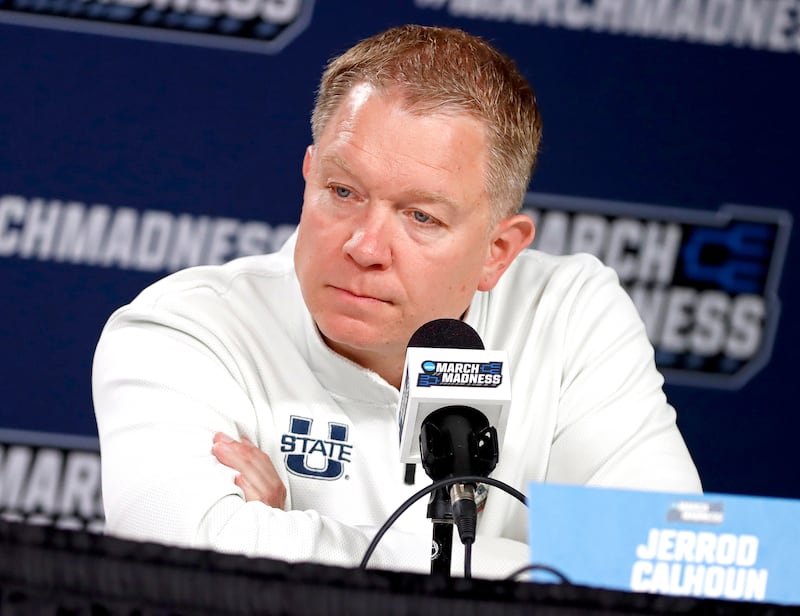
But as Calhoun pointed out during his press conference in Cincinnati, mid-major programs also need to use the money they do have very wisely.
“We have a very unique system. We have a different style of playing basketball. And we’re very precise on how we recruit, how we operate on a day-to-day basis,” Calhoun stated. “In the modern era of college basketball, I think you’re seeing a lot of people just accumulate talent. We want to accumulate winners.
“Utah State, two years ago, we went to the NCAA Tournament with $800,000; we were the lowest at-large team in America. This year, we went and spent $2.4 million on our roster, and we won a regular-season title, we won a tournament title, we won a first-round NCAA game, and we took Arizona to the final four or five minutes in that game.
‘The right people’
“I’m not here to say we don’t need money by any means. We need a lot of it, that’s for sure. But I think what it shows you is our ability to evaluate the right people. You have to have the right people.”
Coming up with the “right people” first falls on Walker’s shoulders. Since USU’s all-time winningest head coach Stew Morrill retired in 2015, all of the Aggies’ coaches other than Duryea, Morrill’s longtime assistant, have previously been head coaches at smaller programs. Earlier this week, Walker said that won’t necessarily be the case with his new hire, but Utah State’s recent success with hiring men with head coaching experience certainly makes it likely the Aggies will go that route again.
The list of potential candidates so far is extremely long, with no solid names yet to emerge. But whomever USU’s new coach is, it seems certain he won’t have much of a returning roster to work with.
Utah State’s 2025-26 roster was comprised of five graduate/seniors, led by Collins, point guard Drake Allen, shooting guard Kolby King and forwards Garry Clark and Zach Keller. Calhoun also brought in a much-heralded freshman class, led by wing Adlan Elamin and backup point guard Elijah Perryman. Forward David Iweze, wing Kingston Tosi and guard Brayden Boe all redshirted this season.
But none of the freshmen have direct ties to Utah, Iweze has already said he’s planning to transfer, and it seems likely that Calhoun will try to convince the 6-foot-9 Elamin (6.7 ppg, 3.1 rpg) and/or Perryman (4.4 ppg, 3.1 apg) to join the Bearcats after the promise they showed this season.
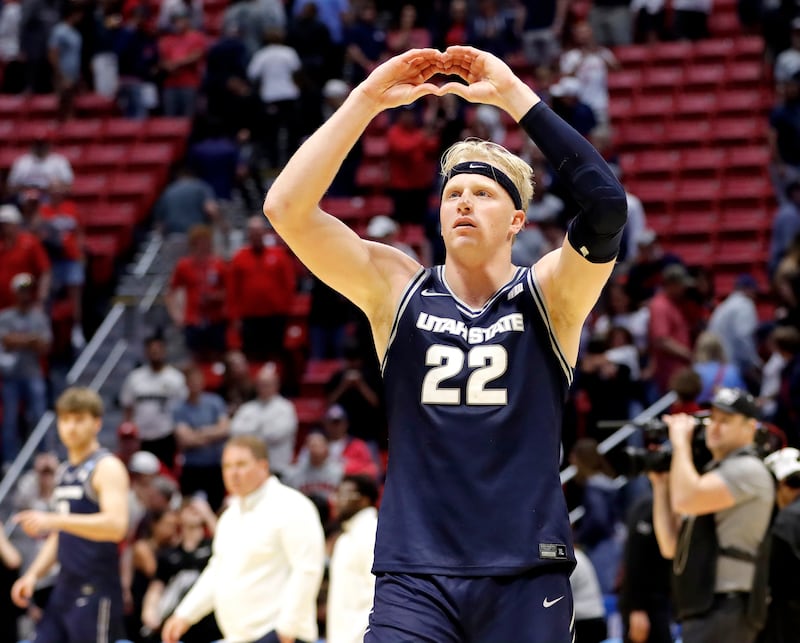
As for the veterans, Templin — an Aggie fan favorite the past three years for his physicality and relentless hustle — has already announced that he plans to enter the transfer portal when it opens for two weeks on April 7. Templin, a Texas native, averaged 8.8 points and 4.2 rebounds per game last season, while also becoming more of a perimeter offensive threat (21 for 64 from 3-point range).
But Falslev is the true mainstay of the USU program. A Cache Valley native who redshirted under Odom following his mission, Falslev has given Utah State three very impressive seasons, culminating with his POY award this year after leading the Aggies in points (16.0 ppg), rebounds (5.7 rpg) and minutes (32.0 ppg), while also totaling 70 steals, 112 assists and 48 3-pointers.
Keeping Falslev around for a senior season would be huge, but after already playing for three coaches in four years, Aggie fans are certainly bracing for the possibility that Falslev will leave, considering what his market value is going to be after his award-winning junior season.
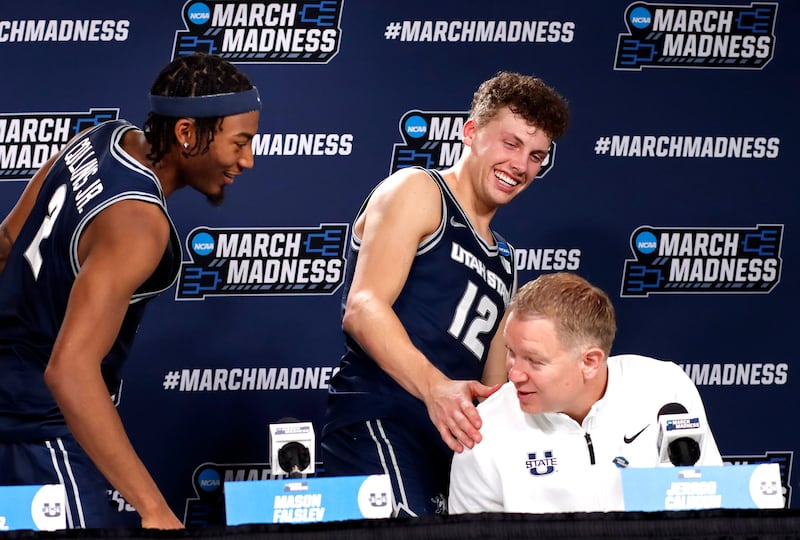
Two of the remaining three Aggies, Tucker Anderson (Central Arkansas) and Luke Kearney (Air Force) saw diminished playing time this season after transferring from other schools. And while backup point guard Jordy Barnes played less this year than his freshman season, the former Olympus High standout is from Utah and his father, legendary Titans coach Matt Barnes, also played for the Aggies.
So, it seems all-but-certain that a massive roster overhaul — likely on par with the one that Sprinkle endured during his one-and-only season at USU before moving onto Washington — is probably coming Utah State’s way this spring. But despite retaining zero points from Odom’s last season before leaving for VCU, Sprinkle and his staff went 28-7, won the outright Mountain West regular-season title and ended USU’s 23-year-long drought in the NCAA Tournament with a win over TCU.
Combine what Smith was able to do in his three years, what Odom did in his two and Calhoun’s remarkable two-year run, and there’s been a lot of talk in recent weeks centered around Utah State’s ability to help create future head coaches at larger programs in more prestigious conferences.
But Stew Morrill finds that thought a little bit concerning. Even though he now has the court at the Spectrum named in his honor after winning 402 games with the Aggies over 17 seasons, Morrill cautioned that it takes more than a fabled history to win basketball games.
“I saw something online not long ago where somebody made the statement that ‘It isn’t the coaches, it’s the place,’” said Morrill, who now lives in Colorado. “And I thought, Oh boy, when people start thinking that way, that’s when it becomes a tougher job.
“There’s no question your home court and your tradition and all that helps a ton, but, you know, there’s got to be some coaching going on, too,” Morrill continued. “But they’ve hit on all these quick changes. They’ve hit on some good guys. And you’ve got to give them credit for the hires.”