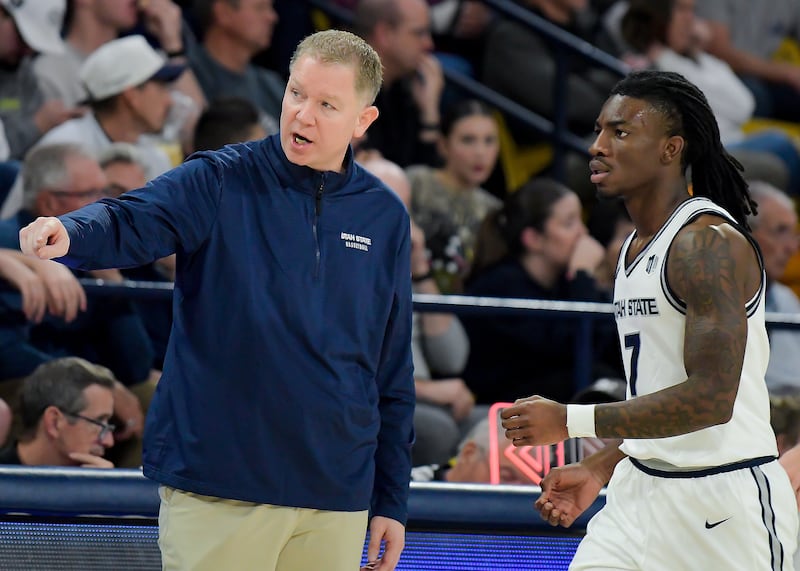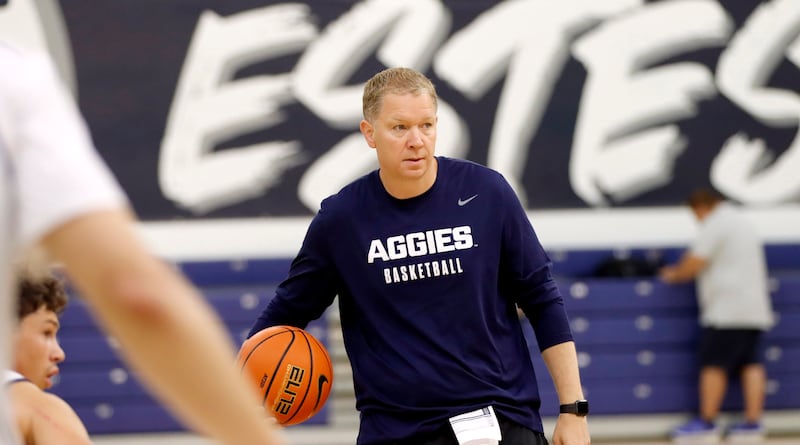
LOGAN — Utah State head coach Jerrod Calhoun is normally fairly subdued while patrolling the sidelines at the Dee Glen Smith Spectrum.
While some of his predecessors, like, say, Craig Smith, might make their way to midcourt after forcing an opponent into calling a timeout, all but threatening to break out of their shirt like the Incredible Hulk or pose like a pro wrestler, Calhoun usually focuses on game strategy and rarely acknowledges the deafening sound of cheers that makes the Spectrum one of the greatest home-court advantages in college basketball.
The veteran coach will keep his head down, walk to a vacant space on Stew Morrill Court and peruse a note card while waiting for his Aggies to stop high-fiving each other and get back down to business.
But during Utah State’s win over Boise State on Feb. 18, Calhoun suddenly removed those self-restraints with just under nine minutes left in the Aggies’ 75-56 victory over the rival Broncos.
With USU already up by 20 points, forward Karson Templin managed to disrupt an interior pass by Boise State, tipping it out to point guard Drake Allen, who promptly fired a long, two-handed outlet pass ahead to a streaking MJ Collins Jr. The senior guard needed to dribble only once before elevating for a dunk that forced longtime BSU head coach Leon Rice to call a timeout.

The sellout crowd of 10,270 exploded, leading Calhoun to abruptly turn toward the section of Aggie fans on the north side of the Spectrum and lift his arms and hands upward, as if conducting a symphony of spectacular noise. But Calhoun’s moment of unbridled jubilation was rather brief, and he quickly turned his back on the crowd, wandered back onto the court and gathered his assistants together before sliding into the Aggies’ huddle.
When asked later about the somewhat out-of-character moment, Calhoun explained that he was trying to get the “general public; the season-ticket holders up.”
“This (is) a pretty special group, you know? And it’s about the amount of work that everybody’s put into this thing, and any more energy we can bring,” Calhoun said in the postgame press conference. “The HURD brings it every night, right? So, it’s just trying to get some of our season-ticket holders up during those big breaks, or when we’re making a run, you know?
“I think it just adds more value and more intensity to our guys, and when they have the ball and they can’t hear, that really helps us, right?”
Calhoun then went on to compare the value of crowd noise at the Spectrum to that at football games, and he shared a recent exchange he had with a leader from The HURD — USU’s fervent student section.
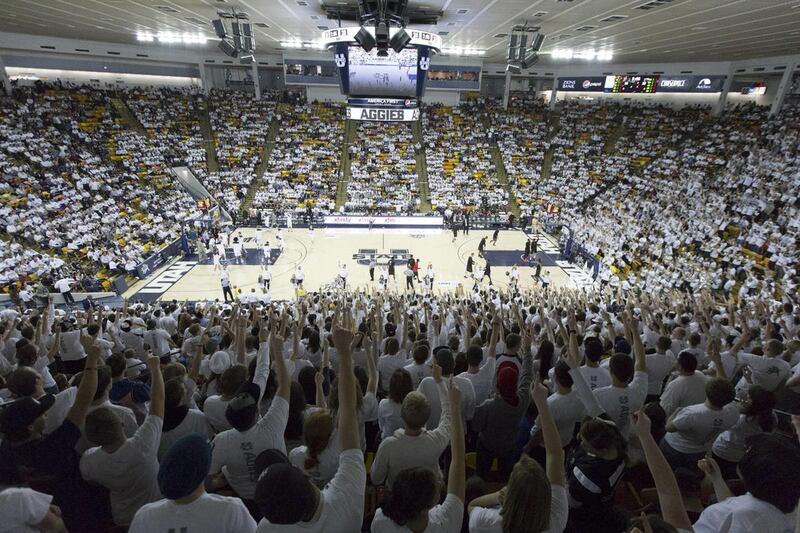
“When we have the ball, we’d like for it to be a little quieter so we can run the play and not have to look at the (dry-erase) board, but that’s what an atmosphere we have,” Calhoun noted. “So, it’s pretty unbelievable that someone from The HURD came to me and said, ‘Coach, I listened to one of your press conferences. When you guys get the ball, we’re going to calm it down a little bit.’ You know, that’s how in sync they are.”
And that’s not hard to believe when you hear the student section chant “CAL-houn! CAL-houn! CAL-houn!” in unison shortly before the tipoff of a home game. Nearing completion of just his second season in Cache Valley, there is clearly a strong mutual affection between the Ohio native and Aggie fans, as has been made evident by the school-record number of sellouts — eight — at the Spectrum so far this year.
Sitting in sole possession of first place in the Mountain West heading into the final week of the regular season, Utah State (24-5 overall, 14-4 in the Mountain West) is 13-1 at home during the 2025-26 season, and 56-6 at the Spectrum over the past four seasons.
But while the Aggies have traditionally been very good on their home floor — their .857 winning percentage since 2000 is the eighth best in the country during that span — what’s remarkable is how they’ve been able to maintain that advantage despite cycling through four different coaches over the past eight seasons.
And while he’s followed highly successful stints by Smith, Ryan Odom and Danny Sprinkle, the 44-year-old Calhoun has managed to live up to — if not exceed — expectations since being hired by former USU athletic director Diana Sabau in March 2024. Calhoun, who spent the previous seven seasons building up the program at Youngstown State, guided the Aggies to a 26-8 record and an NCAA Tournament appearance during the 2024-25 season.
After losing Sprinkle to Washington after just one year, the fear in Logan was that Calhoun might also be lured away by a more lucrative offer. But ultimately, Calhoun was given a new deal with Utah State, and he signed five transfers and five freshmen to complement the Aggies’ core of five returning veterans. And that led to USU selling out of season tickets to men’s basketball games before the year started for the first time in school history.
Utah State rewarded the faith of its fans by opening the season 7-0, then winning eight straight games on two separate occasions. The Aggies are scoring more on offense this season, while also holding opponents to fewer points, which has led to the 55-year-old Spectrum being as loud or louder than it has ever been.
“If you haven’t gone to a Utah State home game, then you need to go. I can’t even describe what we had to endure and then play in front of.”
— Memphis coach Penny Hardaway on his first trip to USU’s home court
Take the personal testimonial of former NBA star Penny Hardaway. Although it was his first trip to USU’s home court, Memphis’ veteran head coach clearly did not love his experience on Valentine’s Day and shared his thoughts on the atmosphere at the Spectrum after returning home to western Tennessee.
“If you haven’t gone to a Utah State home game, then you need to go,” Hardaway proclaimed. “I can’t even describe what we had to endure and then play in front of.
“The loudest gym I’ve probably ever been in,” the four-time NBA All-Star added. “A great basketball atmosphere.”
The Cleveland kid rocks
A basketball fan since he was a child, Jerrod Calhoun grew up idolizing two NBA stars: Penny Hardaway and Larry Bird. Little did he know that he would end up coaching against Hardaway in a Division I basketball game, while one of his best friends, Joe Mazzulla, would win an NBA championship as the head coach of the Boston Celtics.
But growing up in the Rust Belt, Calhoun learned the value of hard work and importance of developing deep connections with people, first as a player and then as a coach.
“You know, when you’re in this business long enough, you know certain guys are going to be really good. And I always thought Jerrod would be very successful,” says Paul Molinari, Calhoun’s chief of staff at Utah State. “He thought that and believed that, and so did I.”
Molinari was an assistant coach at Cleveland State in the early 2000s when Calhoun first showed up on campus. A disciple of Rollie Massimino, who shocked the basketball world by winning the NCAA championship as an eighth seed in 1985, Molinari worked under Massimino at Villanova before following him to Cleveland State after a two-year stint at UNLV.
He first met Calhoun in 2000, when the former high school standout served as a student manager for the Vikings while he worked on improving his academic status. Calhoun ended up earning a walk-on spot in 2001-02, seeing action in 20 games and averaging 2.5 points per night while shooting 47.2% from the floor.
“He was just a hard-nosed, gritty guy, who could really shoot the ball,” Molinari says of Calhoun. “He wasn’t great laterally, so he wasn’t a great defender, but he figured out how to play at that level.”
Eventually a member of the dean’s list and a scholarship athlete, Calhoun started all 20 games he saw action in as a sophomore in 2002-03, putting up 3.5 points an outing for an 8-22 team. And while breaking his wrist during practice derailed Calhoun’s hopes of a better season, Molinari says one of the most memorable things from that rough campaign was watching Calhoun continue to stay involved as he recovered from the injury.
“Jerrod was infuriated that he was going to be out for a certain number of weeks, but he would still come to practice every day with a cast on his wrist and run around the court the whole practice like he was going to come back in better shape than he before he broke it,” Molinari notes. “He didn’t want to just sit there. He wanted to stay busy. And he watched practice, but he was also trying to keep himself in shape so that he was ready to go. And the day the cast came off, he was ready to go.”
Prior to suiting up for Cleveland State, Calhoun spent the majority of his formative years in North Royalton, Ohio, a suburb of Cleveland about 15 miles south of downtown. His parents, Lisa and Andy, divorced when he was just 6 months old, and young Jerrod lived primarily with his mother.
Calhoun, who started playing basketball in the seventh grade, attended Villa Angela-St. Joseph High School, a private Catholic school in Cleveland, and ended up putting together an impressive prep career while playing for legendary coach Ted Kwasniak.
Known as “The Big Guy,” Kwasniak won seven state titles before he died in 2024. Calhoun, who actually lived with Kwasniak and his family for the last year and a half of his college career, transferred to VASJ as a sophomore and commuted 50 minutes a day from the west side of Cleveland to the east side “because I wanted to play for that storied program.”
“So, that’s where I kind of learned my love for sports tradition was from my high school coach,” Calhoun says. “I was really fortunate in high school; I learned from a legend. … Coach Kwasniak and Coach Massimino really taught me about family, getting the players around, treating them the right way and integrating them into a family atmosphere.”
Calhoun, who wore No. 33 in honor of Bird, averaged 19 points during his senior season at Villa Angela-St. Joseph High and graduated as the school-record holder in free-throw percentage.
“I was a junkie my senior year; I stayed in the gym,” he says. “I loved the game, and I worked really hard. I was a skinny guy who got a bit stronger every year, and I was a knock-down shooter. I lived in the gym and could shoot.”
While the final game of Calhoun’s prep career ended up a win short of the state semifinals, it was certainly noteworthy because of the freshman he faced off against that night: LeBron James.
“I’ll never forget my high school coach saying, ‘This will be one of the greatest players to ever play the game,’” Calhoun recalls. “We were the two best teams in the state, but they ended up beating us. It was a great game.”
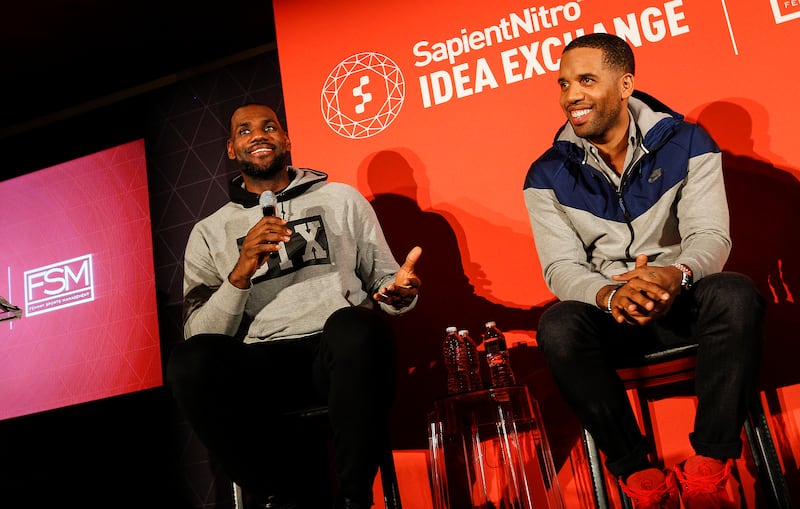
James, who was relatively quiet for most of the contest, helped spark an 11-2 run for St. Vincent-St. Mary down the stretch that lifted the Irish to a 58-51 victory and propelled the Akron high school onto a state championship and a perfect 27-0 season. Ironically, James was forced into a more prominent role when SVSM’s only senior starter, Maverick Carter, fouled out of the game with three minutes left.
Calhoun grew up close friends with Carter — “We would spend the night at each other’s house just about every weekend,” Calhoun says — and after his college career was over, Carter would end up serving as James’ manager and working for and alongside the NBA’s all-time leading scorer in numerous business ventures.
“So, I got to see LeBron dominate NBA players as a junior in high school. And then the last day, we were all in a room together — it was Michael Jordan, LeBron, Maverick and myself. It’s documented; there’s a story about it, although they don’t mention my name.”
— Utah State coach Jerrod Calhoun
And that leads to “probably one of the cooler stories of my life,” Calhoun proclaims.
While still playing at Cleveland State, Calhoun was also coaching an AAU team and became acquainted with an associate of Michael Jordan’s trainer. Representatives of Nike and Air Jordan were curious to see James match up against some of the pro athletes signed to the brand, and thanks to Calhoun’s connection to Carter, the three sons of the Buckeye State ended up flying to Chicago together a couple of weeks later.
That ended up being a notable trip for James, who ended up signing a huge contract with Nike and has primarily worn No. 23 during his career in honor of his childhood hero.
“So, I got to see LeBron dominate NBA players as a junior in high school,” Calhoun says with a grin. “And then the last day, we were all in a room together — it was Michael Jordan, LeBron, Maverick and myself. It’s documented; there’s a story about it, although they don’t mention my name.
“But I was there the first time LeBron ever met Michael Jordan. It was pretty neat.”
Betting on himself
Cleveland State let Rollie Massimino go after the 2002-03 season, and Jerrod Calhoun came to realize that his playing career was also over. The father of a young son named Jordan, Calhoun enjoyed his first taste of coaching an AAU team full of future college players, and an opportune meeting with Bob Huggins resulted in a position as a student assistant on Huggins’ staff at Cincinnati.
“That’s kind of where my love for coaching began, and I really started thinking about the future,” Calhoun says.
While he only spent one season with the Bearcats, Calhoun ended up graduating with a bachelor’s degree in criminal justice from Cincinnati in 2004 before taking his first full-time position as an assistant coach at Walsh University in Canton, Ohio. Calhoun says, “That was probably one of the greatest experiences for me,” as the Cavaliers won an NAIA Division II national championship during the first of his three seasons working under Jeff Young.
It was after that third season at Walsh when Huggins, who had moved on to West Virginia, offered Calhoun a position on his staff again. He was head of basketball operations for the Mountaineers for his first four years at West Virginia before being promoted to assistant coach for the 2011-12 season. And it was at West Virginia where Calhoun first encountered Mazzulla, who was in Morgantown from 2006 to 2011 and was a captain on the Mountaineers’ 31-7 team that advanced to the Final Four in 2010 before losing to eventual national champion Duke.
“I think it just started with him showing that he cared about getting you better as a player, and then spending time off the court, whether it was going out to eat, or breaking down film,” Mazzulla says of Calhoun. “I think his ability to show how he cared, on and off the court, was important for me as a player.”
That was a key point in both Calhoun’s professional and personal life, as he also married Sarah McKenna in Morgantown in 2011. A 6-foot, blonde West Virginia native, Sarah played basketball in high school — “I was a typical post player that blocked shots and got rebounds and stuff,” she says with a chuckle — and had a former boss who served on the board of governors at her alma mater, Fairmont State.
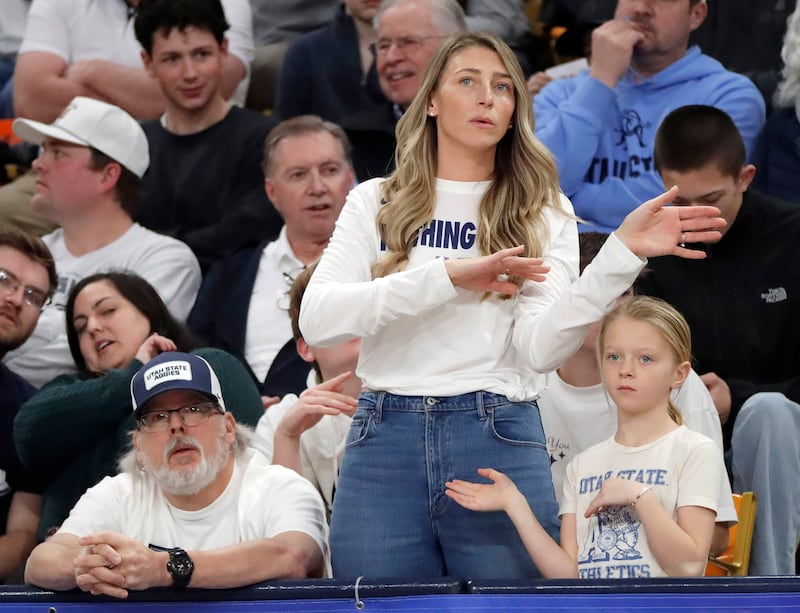
Located about 20 miles from Morgantown in Fairmont, West Virginia, Fairmont State is a university with an enrollment of about 3,000 students. Even though it seemed unlikely that someone working under a head coach of Huggins’ caliber would leave behind a secure position for a Division II job, Sarah’s former boss still gave it a shot.
“I didn’t know anything about it. But my wife went there, so that was kind of one of the things that made me inquire about that job, and, you know, take a big pay cut,” says Calhoun, who accepted the Fighting Falcons’ head coaching job in 2012 at the age of 29. “People really thought it was a step down, but I didn’t see it like that. I just thought it was a great opportunity to be a head coach.
“But not a lot of people would do that, right?” Calhoun adds. “You’re at the pinnacle of the Big East and have worked your way up to an assistant. But I just wanted to be a head coach, so I took a Division II head job, and I kind of bet on myself. And, you know, that’s kind of what I’ve done every step of the way.”
Basketball is life
During the nine years that Jerrod Calhoun was bouncing between Cleveland, Cincinnati, Canton and Morgantown, Paul Molinari was firmly entrenched as an assistant coach at Winthrop. But he and Calhoun had stayed in touch since their time together at Cleveland State, so when he was hired as the new head coach at Fairmont State, he put the hard sell on Molinari to join him.
“He said, ‘I’ve got this great job that I’m going to take. It’s 20 minutes from Morgantown. We don’t have to work in the summer, there’s this great steakhouse nearby and we’ll go golfing at the Pete Dye Golf Club,’” Molinari remembers. “Well, guess what? The first two years, I don’t think we took any time off during the summer — other than a little bit in August — and we never went golfing at that golf course.
“Now, we would go eat steaks once in a while, but Jerrod’s not a golfer, and he has no hobbies. Basketball is his life. He’s dedicated to his family and the game of basketball, and that’s pretty much it.”
Calhoun did go 23-9 during his first season at Fairmont and led the Fighting Falcons to an appearance in the Division II NCAA Tournament, but Molinari says, “We had some tough times in those early years at Fairmont. We laugh about it now, but we really struggled.”
And yet, Calhoun won 20 or more games every season, and in his fifth and final year, the Falcons played in the national championship game and finished 34-3. In addition, he also hired Joe Mazzulla as an assistant coach after his first year, further solidifying the friendship between the two.
“Jerrod’s always had a passion for developing, for coaching and for teaching and for learning,” says Mazzulla, who had Calhoun serve as the best man at this wedding in 2014. “And from day one, he always wanted to be a head coach, and you don’t always get to pick the position or the job when you take over as a head coach. But he always carried himself as a head coach. ... So, when the Fairmont situation came open, it was kind of a no-brainer opportunity for him.”
Mazzulla took an assistant position for the NBA G League Maine Red Claws during Calhoun’s final season at Fairmont in 2016-17 but then returned to West Virginia to take over as head coach of the Falcons when Calhoun was hired by Youngstown State in March 2017. That was the only head coaching position Mazzulla held before suddenly being elevated from Boston assistant coach to head coach in 2022 and then guiding the Celtics to the NBA title at the end of the 2023-24 season.
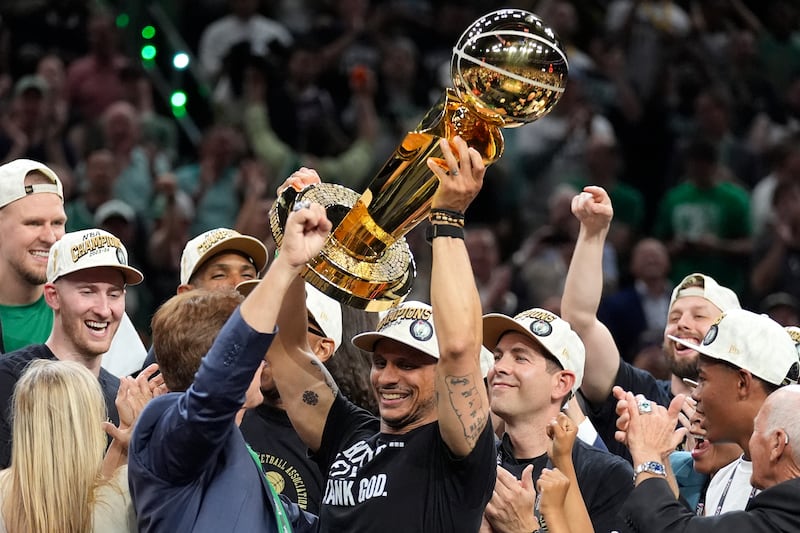
Calhoun, who frequently name checks Mazzulla during media gatherings as USU’s head coach, credits a visit to Boston with helping develop the way he coaches his players to dissect defenses and make the right decisions on offense. Calhoun also says a book Mazzulla shared with him, titled “Lead … for God’s Sake! A Parable for Finding the Heart of Leadership” by Todd G. Gongwer, has played a key role in his own development as the leader of a collegiate basketball program.
“We’re both just always looking to grow and get better, and talk about the game and where it’s going,” says Mazzulla, who is currently coaching former Aggie center Neemia Queta. “We started out in college together, and he’s stayed in college and I’m in the NBA, but we’re always having conversations about what can translate and what works and what doesn’t work.
“And I just think the evolution of the game starts with player development and the ability of guys to be able to make decisions on the floor and make the right read, so we spend a lot of time talking about that.”
‘The complete package’
Jerrod Calhoun made his first trip to the Spectrum in 2017, his inaugural season after being hired by Jim Tressel as the head coach at Youngstown State. While the Aggies, then coached by Tim Duryea, were playing short-handed due to injuries and illness, the home team still prevailed, 91-74, while playing in front of just 6,054 fans five days before Christmas.
That ended up being Duryea’s third and final season as head coach at Utah State, while Calhoun’s Penguins finished the year with just eight victories. But he slowly built up the program over seven years, managing to win 46 games over his final two seasons before being hired by Utah State by Diana Sabau, who stepped down as athletic director in July 2025.
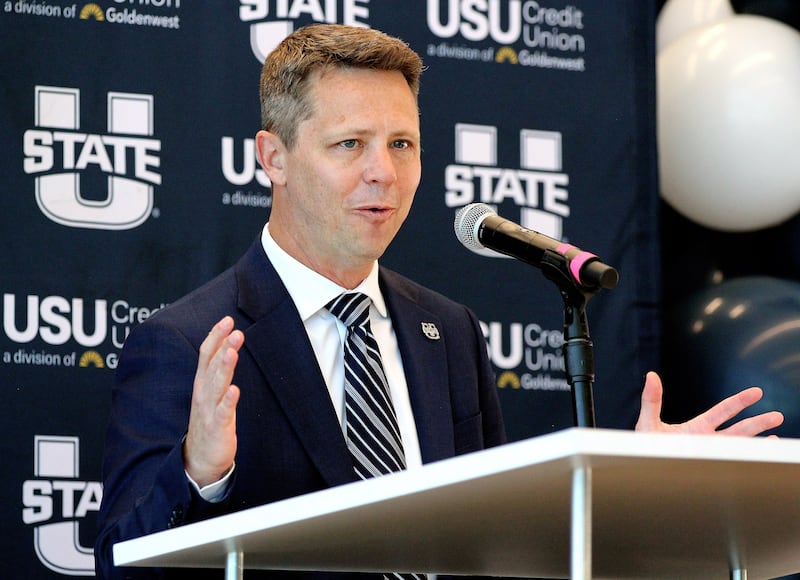
Conversely, Calhoun ended up on the search committee that settled on hiring Cameron Walker as Sabau’s replacement last September. Walker says he was impressed with Calhoun during his job interviews and has been even more astonished with him now that he’s Calhoun’s boss.
“I got to know Jerrod a little bit through that process and now know who he is and how he operates,” Walker says. “He’s the complete package when it comes to how he operates, and I’m thrilled to be working with him and excited to help build this basketball program. It’s got a historic history, obviously, and great things have been accomplished here. But I’m hopeful that we can get back to some of those extreme heights that we’ve had in our past.
“I’m no means a basketball guru,” Walker adds, “but I’ve been around it for a long time — my grandpa was a high school basketball coach — and I understand enough about the game to know when I see someone who’s elite at X’s and O’s, which I think he is. But I also think he’s an elite competitor who knows how to relate to his players. He seeks to get the most out of them, and push him, but they know he cares.”
Guard Kolby King has experienced his share of head coaches, arriving at Utah State after spending a year at St. John’s, a year at Tulane and the 2024-25 season at Butler. The senior guard has been one of Utah State’s most productive contributors off the bench this season (8.0 ppg) and is second on the team in 3-pointers made (44) and first in 3-point field goal percentage (.419) despite averaging just 20 minutes a game.
“I just love the freedom that (Calhoun) gives us,” King says. “And he’s very open and tells you the truth, straight up. He’ll never lie to your face. He really embraces players, and I feel like that makes him a great coach to play for. And he loves to win, so why not be on this team?”
So far, the Aggies, who have nearly the same record this season that they had at this time last season, have mostly won during Calhoun’s tenure. Which is good, because Paul Molinari says his longtime friend and boss is a “bad loser,” and Sarah Calhoun admits that her husband takes losses hard, so she and the couple’s three daughters — Kennedy, 11; Kendall, 9; and Quinn, 6 — try to “give him his space” after an Aggie setback.
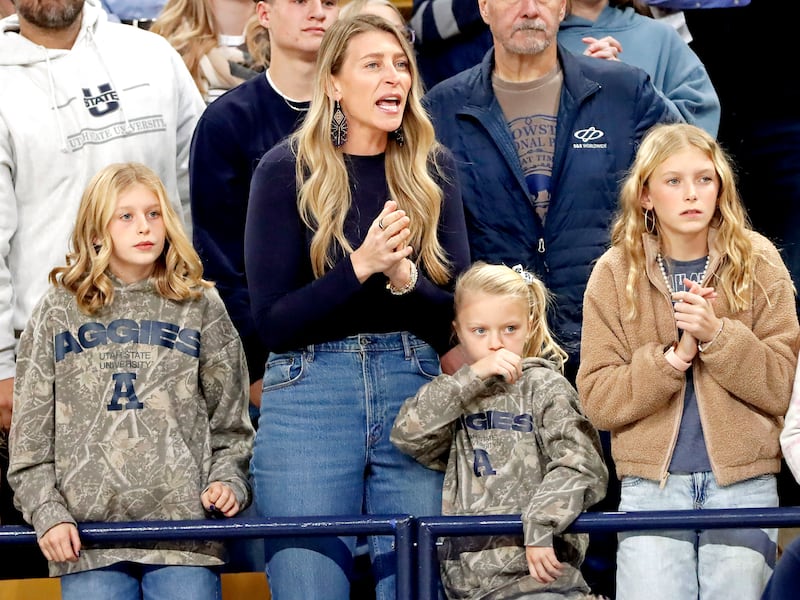
“We kind of know just to let him have some time, and then we talk about it the next day,” she says. “But none of us like to lose.”
Sadly, Calhoun and his family had to deal with a real-life loss last fall when Sarah’s mother, Lisa Constantin, died back in West Virginia at the age of 59. Navigating such a difficult situation just as the 2025-26 season was getting underway was obviously a challenge for the husband and father, but Sarah said it was a moment in time when she realized what makes Calhoun “a really good leader.”
“Jerrod leads with confidence and calmness,” she says, noting that includes when he’s in the stands watching the Calhoun girls playing basketball, volleyball or soccer. “I think that he’s calm most of the time. And when you have a leader that’s calm and confident, you know that you can trust them. And he’s very good with relationships with the players, as well.”
Closing in on a Mountain West title
As Aggie fans well know, with success comes the likelihood that you’ll end up losing your winning basketball coach sooner than later.
While the all-time winningest coach, Stew Morrill, stuck around for 17 years and made it quite clear he was very unlikely to ever take another position, more recently, Craig Smith was lured away by Utah after three seasons, while Ryan Odom parlayed a couple of good years at Utah State into two great years at VCU and is now thriving as the head coach at Virginia. And Danny Sprinkle spent just one season at Utah State before moving on to Washington after winning a Mountain West championship and USU’s first NCAA Tournament game in 23 years.
With a week left in the regular season, the Aggies hold a one-game lead in the conference standings over San Diego State and New Mexico and would clinch at least a share of the Mountain West title with a win at UNLV Tuesday night. But regardless of how the remainder of the 2025-26 season plays out, Calhoun will obviously have similar opportunities to secure a bigger contract in a more prestigious conference — his name immediately emerged as a potential hire for Kansas State’s recently vacated position — and keeping him in Logan, just as Utah State is preparing to make the jump to the new-look Pac-12 Conference on July 1, may prove difficult.
But that hardly means he’s looking to leave.
“I feel really good where we’re at as a university, and as a basketball program,” says Calhoun, whose contract would require around a $4 million buyout if he were to leave this spring. “I feel like our community, the state and former players have gone above and beyond the call of duty to step up and help move this program forward. I feel pretty confident that we’ll be very competitive going into the Pac-12.”
And Calhoun means both on the basketball court as well as in NIL money. The Aggies have been in the middle of the conference in those funds during their final year in the Mountain West, but getting there has required being creative, like bringing in Joe Mazzulla, Neemias Queta, and former Aggie and current Cleveland Cavaliers guard Sam Merrill for the Night with the Pros fundraiser last September.
And all those sellouts and rowdy crowds at the Spectrum suggest that “CAL-houn!” will continue to receive the kind of support he needs, both financially and in the stands.
“We are Logan’s team, and that, to me, is the neatest thing in the world is to see how much it means to so many people,” Calhoun states. “There’s a sense of responsibility and pressure to sit in the same chair as Stew Morrill, Larry Eustachy, Rod Tueller, Kohn Smith, Danny Sprinkle, Ryan Odom, Tim Duryea and Craig Smith. And the outcome of a game affects a lot of people’s moods the next morning because there’s a sense of pride when Aggie basketball wins, right?
“So, you know you’re not only doing this for yourself and your family and your players and your assistant coaches and their families, but you’re really doing it for a bigger population,” Calhoun continues. “And that, to me, is why you work the hours you work, and that’s why this is a great job.”