

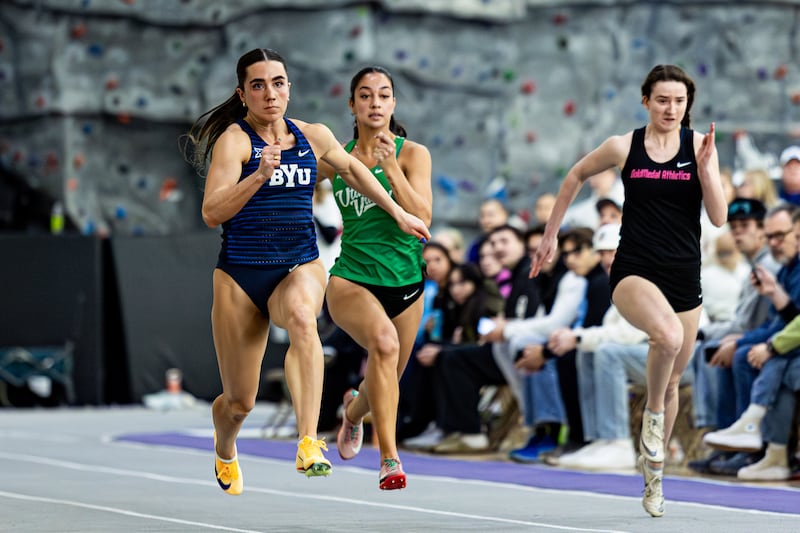

Paje Rasmussen, a junior sprinter from Corner Canyon High and BYU, almost quit and was almost cut from the team. Good thing for both parties that neither event happened.
Last weekend, she introduced herself as one of the fastest women in the country, posting a time of 11.06 in a trial heat of the Texas Relays 100-meter dash. It was a shocking performance, one that seemed to come out of nowhere. Only three women in the world have run faster so far this year. It also crushed the BYU school record.
The next day Rasmussen placed third in the finals of one of the most prestigious collegiate competitions in the country.
To put it in perspective, her previous personal record was 11.52 set a year earlier, and that was an outlier — it ended a streak of five consecutive races in which she had run in the 11.7 range. The gap between 11.52 and 11.06 is vast. That kind of improvement is almost unheard of at 100 meters. It was as if she pulled off a magic act.
“I was not shocked that I set the school record, I was shocked by 11.06,” says Rasmussen.
It was even more surprising that it came from an athlete whose school is renowned for distance runners. What, BYU has sprinters, too?
“I was in no-man’s land. (BYU coach) Kyle (Grossarth) didn’t know who I was. I wanted to go to BYU but I didn’t know if I’d get the chance. Both times I talked to Kyle, he said, ‘We’ll see if we’ve got a spot. I don’t really know you.’ It was super valid. I hadn’t run that fast in high school. I just got off a mission. I wasn’t in shape.”
— BYU sprinter Paje Rasmussen
Progress has come slowly in the school’s sprint department, or it did until Kyle Grossarth, the men’s sprint coach, was also given charge of the women’s female sprints in 2023. Let’s put it this way: Windy Jorgensen posted a time of 11.44 in 1997, and that endured as the school record for 22 years until Jaslyn Gardner finally broke it in 2019 with a time of 11.38.
In 2024, she dropped the record to 11.22. That lasted until Rasmussen broke it not quite two years later.
Rasmussen was trending up when she arrived in Texas last weekend. During the winter, she set BYU indoor school records in the 60- and 200-meter dashes. She clocked 23.01 in Albuquerque, followed by a 22.91 performance in the Big 12 indoor championships. She opened the outdoor season with a time of 23.11 at 200 meters at USC.
“Her 23.01 at New Mexico caught both her and myself by surprise,” says Grossarth. “ … That race was a huge breakthrough for her, and since then she has just been an absolute force. So to see her run 11.06 wind legal this last weekend was just validating her as someone who can make some noise on the national scene.”
Explosiveness
Her coaches at Corner Canyon High recognized Rasmussen’s explosiveness. They describe her as “twitchy,” referring to a supercharged neuromuscular system that enables her to produce incredibly rapid foot turnover. Yet she never won an individual state championship and never broke 12 seconds in high school.
She incurred two major knee injuries while playing for the Corner Canyon soccer team in the fall. As a result, she began both her sophomore and senior track seasons just six months after undergoing surgery to repair torn ACLs. Her best time in high school was 12.12 (24.87 for 200 meters).
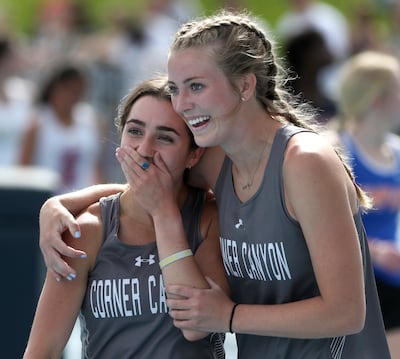
She showed enough promise that BYU and Utah recruited her. She signed with the Utes before she departed for an 18-month church mission in California. While she was gone, the sprint coaches at both BYU and Utah left their schools. Rasmussen de-committed from Utah and called Grossarth hoping to join the BYU team.
“I was in no-man’s land,” says Rasmussen. “Kyle didn’t know who I was. I wanted to go to BYU but I didn’t know if I’d get the chance. Both times I talked to Kyle, he said, ‘We’ll see if we’ve got a spot. I don’t really know you.’ It was super valid. I hadn’t run that fast in high school. I just got off a mission. I wasn’t in shape.
“There were faster girls coming into the program. I said, ‘If you don’t call me back, should I call you?’ He said, ‘No, I’ll call you.’ But he didn’t call — not until late August just before school started,” she continued. “He said he had an open spot on the team if I wanted it. He said he couldn’t give me any money, just gear. I could tell he wasn’t that excited, and I don’t blame him.”
“I remember her freshman year — she was unknown to me,” says Grossarth. “I had been working (only) with the men, so I was not really paying attention to what women would be a good fit for the team … I was trying to figure out my roster and fortunately a spot opened up and I told her I would give her a chance.”
Rasmussen was far from a finished product. Her sprint mechanics needed work. She had the rapid turnover, but she wasn’t getting anywhere — her strides were short, even for a woman who is “5-foot-4 on a good day”; she didn’t exert force into the track, she had low knee drive, etc.

Grossarth, the former school record holder in the 400-meter hurdles, has made a coaching career out of developing Utah high school athletes into national-class athletes — Sami Oblad (All-American at 400 meters), Gardner (who now runs professionally and placed fourth at the U.S. indoor championships at 60 meters), Michael Bluth (All-American at 400 meters), and Barber (a promising long sprinter recently returned from a mission), among others. He went to work on Rasmussen.
“When she came in, I saw right away that she had amazing frequency, which isn’t uncommon in shorter sprinters,” says Grossarth. “So we really worked on trying to get her to improve her stride length. We spent a lot of our time on that aspect of her running.
“She was great at being coachable and taking feedback and applying it on each rep. She has always been someone that takes feedback and applies it immediately, which I think is a huge secret to her success.
“She spent a lot of time in practice trying to improve her sprint mechanics. The way that she moves now did not happen overnight. That required a lot of intentionality on her part. And we are still working on things.”
Mechanics
For Rasmussen, it was the equivalent of Tiger Woods changing his swing; she had to take a step backward hoping it would ultimately produce better performances someday. She ran slower than she did as a high school athlete that season and was so frustrated that she seriously considered quitting the sport.
“I was ready to be done,” she recalls. “I was just going to quit. I was frustrated. It was a hard adjustment. They were the hardest workouts I had ever done in my life. I think I blamed circumstances when I wasn’t doing well. I gained weight. I was injured. I didn’t run what (the times) I wanted.”
“The first year in college for anybody is a tough transition,” says Grossarth, “and coming back off of a mission adds another layer to that. I think she felt like she needed to prove herself, and a lot of my attention was on other athletes that were seasoned veterans, and that can be tough.
“I do remember a couple of instances during some races, particularly relays, where I felt like she had more than what she was showing. But I think sometimes that pressure of feeling like you have to prove yourself can hinder your performance.”
She began to make progress late last year, running the aforementioned time of 11.52, but she was nowhere near ready to compete in individual sprints at the national level. Her biggest contributions to the team were in the relays at the Big 12 championships.
All that notwithstanding, last summer she again questioned whether she wanted to come back for another season. Then the choice was nearly taken out of her hands. The NCAA mandated roster limits, forcing coaches at each school to make cuts. Suddenly, it was difficult to find room for athletes who were still developing.
“I wasn’t given a spot,” says Rasmussen. “There were only six spots in the sprint-hurdle group and I was not going to be in that six. Basically, I got cut from the team. I was pretty hurt. I thought I had earned it.”
Rasmussen was given a reprieve when two spots opened up, and those spots were given to Rasmussen and another Corner Canyon athlete, Maddy Taggart.
A good break
It was a lucky break for Grossarth and Rasmussen. Everything is coming together for Rasmussen this season. She is a mere .02 short of Gardner’s outdoor school record in the 200 meters (23.10), which add to her record collection that so far consists of the 100, indoor 60, indoor 200 and the 4x400 relay, in which she joined Barber, Kali McEuen and Oblad to run 3:31.24 indoors. She also has been a force on the relay, splitting 52.4 at the Texas Relays.
“I decided if I’m going to do it, I would leave no stone unturned. I destroyed my workouts in the fall. I put that roster cut to shame. Every year I’ve leveled up in my own way, and this year’s roster cuts were motivation. Things began to happen. I knew the records were going to come.”
— BYU sprinter Paje Rasmussen
Ask Grossarth if he is shocked by Rasmussen’s performance in Texas, he says, “After watching her for the last three months, no.”
Not many sprinters can claim to have cut more than one second off their high school 100-meter PR.
“She has put in a lot of work on and off the track to get to where she is,” says Grossarth. “I know that she has worked on dialing in some things off the track that have been very beneficial to her as well.”
Rasmussen went all-in for her junior season. She consulted a nutritionist about her diet, she committed herself to training and cross training.
“I decided if I’m going to do it, I would leave no stone unturned,” she says. “I destroyed my workouts in the fall. I put that roster cut to shame. Every year I’ve leveled up in my own way, and this year’s roster cuts were motivation. Things began to happen. I knew the records were going to come.”
“It’s been very rewarding watching her progression,” says Grossarth.
