


Nick Saban will live forever in the lore of college football. He won. He spoke — often colorfully. He led with an iron will and became an icon of the game.
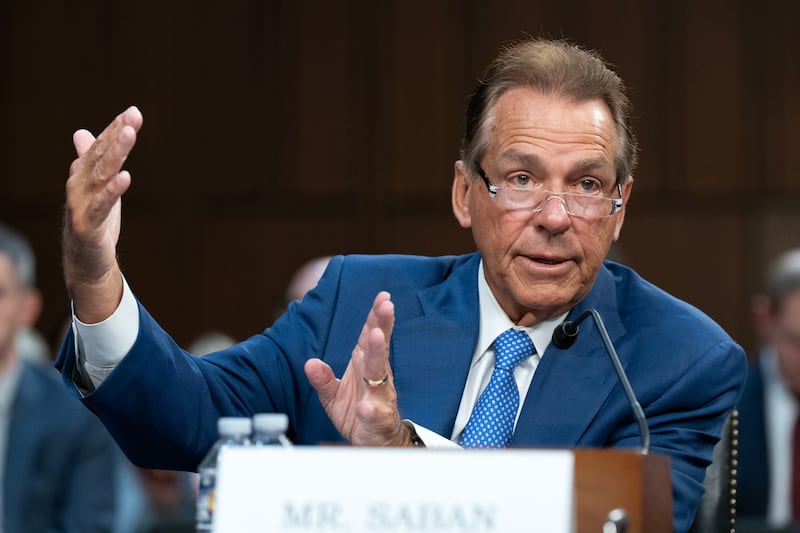
So when the legendary former Alabama coach voiced his blunt opinions before a U.S. Senate committee a few days ago on the chaotic state of college athletics, it landed like a thunderclap in Tuscaloosa and beyond.
Some of what he said wasn’t very nice. Much of it rang true to those watching the sport’s transformation with unease.
I have no axe to grind with Saban. I’ve stood outside his office in Tuscaloosa, walked the gleaming halls of that remarkable football facility and soaked in the tradition of the Crimson Tide — the Bear Bryant memorabilia, the weight of seven national titles under Saban’s watch, the electric roar inside Bryant-Denny Stadium. I’ve felt the pulse of those rabid fans. This is a program built on excellence, discipline, and yes, resources.
That’s what makes Saban’s testimony so fascinating. The man who helped turn college football into a high-stakes machine is now warning that the machine is careening toward the edge of a cliff.
In his appearance supporting the bipartisan Protect College Sports Act, Saban painted a stark picture of an “arms race” fueled by NIL collectives.
“It’s become an arms race,” he said. “Who spends the most has got the best chance to win, but I think it’s a race to the bottom because if you don’t spend to win, you lose your fan base and you don’t have any revenue.”
Saban candidly laid out the numbers from Alabama’s own trajectory. He said in his first year navigating the NIL era, the collective sat at $2.7 million. It climbed to $7 million, then $10 million. After his retirement, it jumped to $17 million, then $24 million.
Today, he noted, some schools are approaching $40 million rosters.
Saban wasn’t opposing athletes profiting from their NIL rights — he’s long been a supporter of legitimate endorsements that help young men build brands and life skills. His concern is the shift to outright pay-for-play through boosters and collectives, the transfer portal chaos and the erosion of development, academics and non-revenue sports.
Football and men’s basketball thrive while Olympic sports and scholarships get squeezed. It’s no longer about building programs; it’s about bidding wars.
The reaction was swift and, in some corners, savage.
Duke law graduate Dave McKenzie took to X to unload: “The last person with credibility on this issue is Nick Saban. ... This is the coach who built Bama into the unchallenged apex predator of the arms race he is now warning Congress about. ... Saban created the conditions for the race to the bottom and rode it to seven national championships, then retired the moment the players got a meaningful piece of the revenue. Now he is testifying before Congress as the moral authority on what went wrong. This clown is the arsonist trying to put out the fire.”
Former BYU and Green Bay Packers linebacker Brady Poppinga didn’t hold back either: “Nick Saban needs to be quiet! ... He gamed the system, and then when the system changed that he couldn’t game, he got bitter and left. He’s still just bitter. The Ego is crazy,” wrote Poppinga on X.
And Iowa fan David Burge (of IowaHawkBlog fame) pointed out the embarrassing fact that Indiana won it all with less:
“The fact of the matter is Indiana had half of Alabama’s NIL budget, a roster full of FCS transfers no SEC program would sniff at, and still beat Bama like a rented mule. That’s not destroying CFB, that’s saving it.”
Those are all fair points. Saban’s Alabama was a recruiting juggernaut long before NIL, leveraging every legal (and sometimes gray-area) advantage so it could dominate.
It looks kind of hypocritical, retiring just as players were gaining real leverage. Yet totally dismissing what he’s saying misses the bigger picture.
He didn’t make the wild west of NIL; he just navigated it like the competitor he is. Now, as an observer with lots of credibility, he’s pointing out what many insiders quietly admit: Unchecked spending, constant tampering and roster churn are not sustainable.
They threaten the core of college sports — regional rivalries, player development and the focus on education that separates it from the pros.
College football doesn’t need to return to amateurism. That ship has sailed. However, it does need guardrails — sensible rules on collectives, transfer limitations and antitrust protections that will let the NCAA enforce standards without getting sued into oblivion.
The super-conference era, when a handful of mega-programs hoard talent and revenue while others wither away, isn’t a feature. It’s a disease.
Saban built a dynasty on structure, accountability and long-term vision. The game he loves is losing those qualities in a frenzy of cash. Whether you think he’s a hero, a hypocrite, or something in between, his warning deserves serious discussion.
On Wednesday, Saban told senators, “If you had the biggest, baddest Ferrari and it was going 100 miles an hour toward the Grand Canyon, we need to tap the breaks. I think that’s what we all need to do here.”
The Senate, the NCAA and college administrators should listen — before there’s nothing left worth saving.