

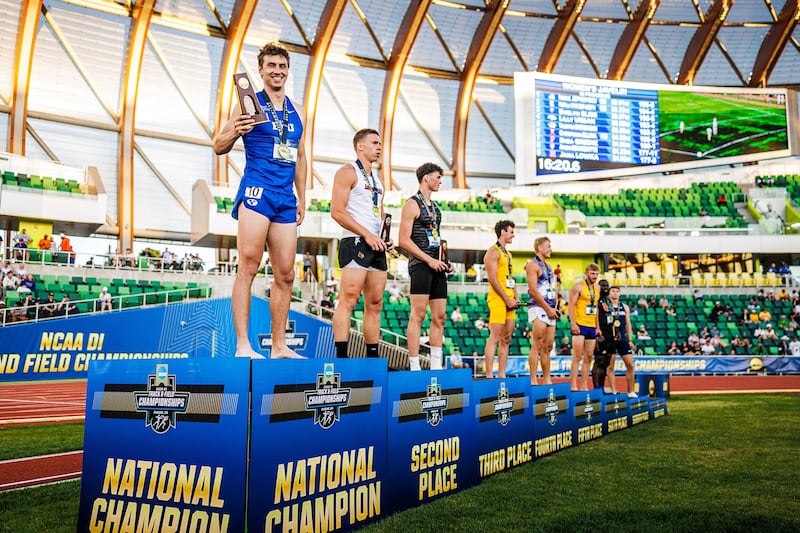

BYU’s Ben Barton, a 6-foot-5 senior from Michigan, won the decathlon at the NCAA Outdoor Track and Field Championships Thursday night and did so in dramatic fashion, with the competition being settled in the 10th and final event of the two-day competition.
A short time later, Jane Hedengren, the sensational freshman from Provo, stepped onto the track as a big favorite to win the 10,000-meter run, but it wasn’t to be.
After leading the field the last half of the 25-lap race, she was passed by two rivals and finished third.
Back to Barton, after nine events in the decathlon, he found himself trailing Louisville’s Kenneth Byrd by 50 points, with Louisville’s Luuke Pelkmans just 201 points behind him.
The last event was the 1,500-meter run, a strong event for Pelkmans. To win the overall competition, Barton had to beat Byrd by a little more than seven seconds and finish within about 13 seconds of Pelkman.
Barton labored visibly from start to finish, but he finished about nine seconds ahead of Byrd and nine seconds behind Pelkmans to claim the decathlon title.
It was close. Barton won by a mere nine points. He finished with a score of 8,169 points — the second-highest score ever by a BYU athlete — followed by Byrd with 8,160 points and Pelkmans with 8,079 points.
Barton’s previous best score was 7,998 points.
Barton led the field at the end of the first day Wednesday, winning the 100-meter dash in 10.65, the high jump at 6 feet, 11 ¾ inches and the 400-meter dash in 47.25 and finishing third in the long jump at 24-3 ½ and 13th in the shot put at 44-0 ¾.
He started the second day strongly by placing third in the 110-meter high hurdles with a time of 14.20, but Byrd was closing in on him.
Both Barton and Byrd had poor showings in the discus, but it was the pole vault that changed things. Byrd scaled 17 feet, 9 inches, while Barton cleared just 14-1.
Barton rebounded with a throw of 180 feet 11 inches in the javelin compared to Byrd’s throw of 159-1, with Pelkmans reaching 189-0. That set the stage for the final event and Barton’s dramatic win.
Barton is the first BYU athlete to win the decathlon since Tito Steiner in 1981 and the first American to win it in a BYU jersey. Steiner, from Argentina, also won the title in 1979 and 1977.
Raimo Pihl, a Swede, won it in 1973 and 1975, and Runald Beckman, another Swede, won it in 1974.
The finals of the women’s 10,000-meter run was billed as a rematch between Hedengren and New Mexico’s Pamela Kosgei, the defending NCAA champion from Kenya. They had met four times (counting a cross country meeting), and each race had been a close finish, with Hedengren the winner on each occasion.
Their race in early April produced the two fastest times in the world so far this year, 30:46.80 and 30:49.99. Hedengren’s time is the collegiate record.
Hedengren took the lead halfway through Thursday night’s race, with Kosgei running close on her heels. The ESPN announcers spent most of the race talking about Hedengren and Kosgei, and it appeared another showdown was in the works.
Hedengren and Kosgei ran in lockstep for a dozen laps. It was only a matter of who would make a decisive move first and when. Kosgei did so with just 200 meters to go and moved past Hedengren, but then Mercyline Kirwa, an Iowa State freshman from Kenya who had been largely overlooked, blew by both Kosgei and Hedegren and ran away with the win.
Kirwa finished with a time of 31:54.88, Kosgei 31:56.49 and Hedengren 31:57.94. Hedengren’s teammate, Jenna Hutchins, finished eighth in 32:16.16.
A number of other local collegians competed in semifinals on Thursday, hoping to advance to Saturday’s finals.
BYU’s Carlee Hansen, a senior from Woods Cross, qualified for Saturday’s finals in the 1,500-meter run with a personal-record time of 4:07.08 — the second-fastest in school history — placing fifth in the fast first heat.
Teammate Carmen Alder, a senior from North Carolina, also qualified by placing fifth in the second heat with a time of 4:09.88.
BYU junior Taylor Lovell turned in the fourth-fastest time of the day in the semifinals of the 3,000-meter steeplechase, clocking a time of 9:39.96 to qualify for the final.
Teammate Raygan Dimond grabbed the 12th and last qualifying spot with a time of 9:45.81, while Utah’s Mackenzie Rogers failed to advance in that event.
BYU’s Tessa Buswell and Krystie Solomon failed to advance out of the 800 semifinals. Solomon, a senior, clocked a personal-best time of 2:01.40 to post the 14th fastest time of the day; Buswell, a sophomore, was 21st with a time of 2:03.36.
In any other year, Solomon would have advanced, but this was an incredibly fast semifinal; all nine qualifiers broke two minutes.
BYU’s Paje Rasmussen, a senior from Draper who has been nursing a hamstring injury the past couple of weeks, failed to advance out of the trials of the 100- and 200-meter dashes, finishing 12th in the former in 11.27 and 19th in the latter in 23.13.
Utah’s Chelsea Amoah, a sophomore from West Jordan, also failed to advance in the 200-meter semifinals, finishing 21st with a time of 23.26.
The 100 was another incredibly fast race, with Georgia’s Adaejah Hodge breaking the NCAA record with a time of 10.63, the fifth-fastest ever at any level.
After resting a day following Wednesday’s semifinals, the men will return to the track Friday for the finals (the women’s finals will be Saturday).
BYU’s Carter Cutting, who is the defending NCAA indoor mile champion, will compete in the 1,500 final after setting a school record of 3:35.95 in Wednesday’s semifinals (he actually has produced a faster time, but it was based on an altitude conversion).
Cougar freshman Tayvon Kitchen has the fifth-fastest time heading into the 5,000-meter final — a school-record 13:16.27.