

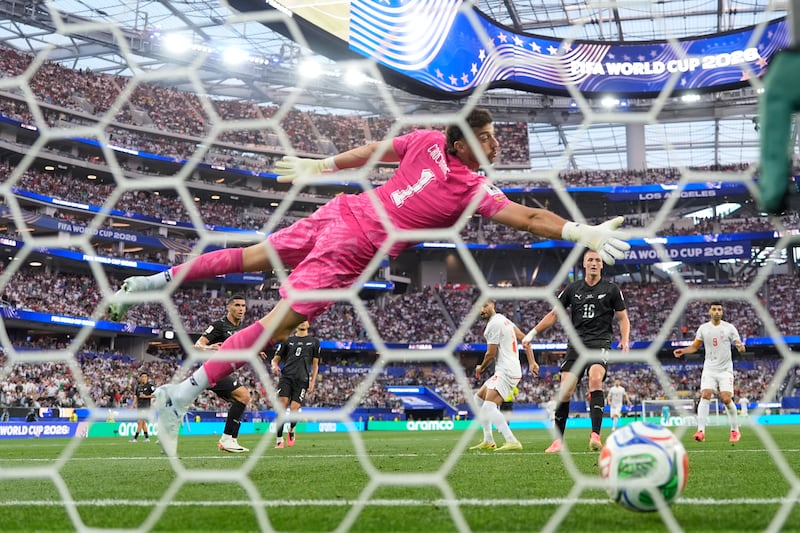

LOS ANGELES — As expected when the matchup involved a team from a country that has spent the past three months at war with the country hosting the event, there was plenty going on when the World Cup game between Iran and New Zealand occurred here on U.S. soil Monday night.
Hundreds of expatriated Iranians stood outside the gates of Los Angeles Stadium (also known as SoFi Stadium when FIFA isn’t in charge) protesting the playing of the game on the grounds that the Iranian national team doesn’t represent “the people of Iran,” but instead is a tool of the current regime in charge. These protesters waved the lion and sun flag of pre-revolutionary Iran, interspersed by American flags and “Make Iran Great Again” ballcaps.
Meanwhile, thousands more Iranians, many wearing or waving the “Islam emblem” flags of the current regime in charge, filed past the protesters and made their way into the stadium.
With an Iranian population upwards of 700,000 people in Southern California, earning Los Angeles the nickname “Tehrangeles,” it seemed like most of them were here.
None of this had anything to do with what drew my nephew Luke, my son Eric and me to the game.
We’d come for tradition.

Thirty-two years ago, the last time the United States hosted the World Cup, we were front and center in Los Angeles for the opening match between the U.S. and Colombia at the Rose Bowl. Luke was 11, Eric was 18. My brother Dee, who died from brain cancer six years ago, was also with us. I was covering the game for the Deseret News.
The U.S. didn’t play its opener in Los Angeles this time, so for old time’s sake we came to watch whoever was playing in the 2026 opener; plus, we wanted to see what a stadium that cost $5.5 billion — the most expensive sports facility ever built — looks like.
A lot has changed since 1994, needless to say, and that includes the World Cup. The tournament has doubled in size, from 24 teams to 48. It’s also gotten more expensive. Tickets for that game at the Rose Bowl 32 years ago ranged from $25 to $75 — $56 to $168 in 2026 dollars. Tickets for Iran-New Zealand ranged from $260 to $17,500 in 2026 dollars.
In 1994, ABC and ESPN, in keeping with soccer’s sacrosanct tradition of no breaks during the 45-minute halves, televised the World Cup matches without in-game commercials. In 2026, “hydration breaks” have been added in each half so Fox, which paid $485 million for the U.S. broadcast rights, can show commercials.
But they still play the game with one ball and two goals, and Luke, Eric and I — three guys from the Rocky Mountains, a small but very interested minority — settled into our seats in section 235 to see what would happen next.
Sitting next to me was a man wrapped in a Palestinian flag, breathlessly rooting for Iran. The fact that the match was taking place at all was a triumph. For months there was speculation that the Iran-U.S. conflict would kill the game. As a precaution, Iran switched its training camp headquarters from Tucson to Tijuana, Mexico. Donald Trump, as he is prone to do, added to the unease when he said Iran shouldn’t compete “for their own life and safety.”
Throughout the crowd there were Iranians wearing T-shirts with the lion and sun flag emblem, circumventing FIFA’s edict that the unauthorized flag wouldn’t be allowed in the arena. A sign was unfurled behind one of the goals in memory of the 168 schoolchildren killed by an errant U.S. missile strike in February in Tehran. When the Iranian flag — the authorized one — was unfurled on the stadium floor and the national anthem was played, a smattering of boos and jeers could be heard.

Tensions seemed a bit high.
And then the referee blew his whistle to begin … and a soccer game broke out.
For the next 90 minutes, plus 13 minutes of injury time, Iran and New Zealand did battle in one of the best-played games of the opening round. No fights. Few fouls. Excellent ball control. Well-executed game plans.
New Zealand, ranked 85th in the FIFA world rankings, scored first, sending a nervous tremor through the pro-Iranian crowd. But 26 anxious minutes later, Iran, ranked 20th in the world, countered.
The stadium shook. The roar that erupted was loud enough to be heard in Tehran and Washington, D.C. Flags of all colors waved. Team Melli hadn’t come all this way for nothing.
The second half was a repeat of the first, New Zealand striking first, then Iran countering 10 minutes later to finalize the 2-2 score. Another roar, if anything louder than the first.
Nobody wins, or loses, in a draw, but as the crowd lingered and then slowly began to peacefully disperse, it somehow felt like everyone won.
Sports hadn’t changed anything, or started anything, and certainly hadn’t solved anything. But for 90 minutes inside a perfect stadium in Southern California, a soccer match allowed a lot of people to take a break and think about something pleasant for a change.


