

Youth soccer is big business in the United States. Dangling the college scholarship carrot, private clubs convince millions of youth not only to play the game, but to play it year-round to the exclusion of other sports and activities. They enroll about 5.5 million boys and girls (ages 6-17) each year.
It’s not altruism or even love of the game; it’s for profit. One father told the Deseret News that he pays $12,000-$14,000 per year for his older son to play for an elite club in Utah. He pays another $6,000-$7,000 per year for his preteen son to play for a non-elite club.
A Utah high school girl — who has a Division I scholarship waiting for her when she graduates — told the Deseret News, “On average, we pay $4,000 a year for club fees, $5-7,000 for travel expenses with the club. On average (we pay) about $3,000 a year for private training.”
She is not an outlier. There are thousands more who are doing the same thing.
She continued, “It’s so expensive. I know lots of girls who have quit because of how expensive it is.”
Trickle-down effect
And there it is. In a single sentence, she wrapped up the biggest problem in the U.S. soccer system. American soccer is for people with money.
In the wake of yet another disappointing World Cup performance by the U.S. men’s national team, everyone is asking what’s wrong with the American system. She nailed it.
One current coach of an elite club in Utah, after requesting anonymity, was brutally honest when he told the Deseret News, “The only thing that this World Cup has done is expose U.S. soccer for what it is. It’s pay to play. That’s all it is. It’s a money grab. It gets more expensive every year. When I was a kid, my family just couldn’t afford it. And lots of my friends, too — I came up as a coach. We have kids slipping through the cracks.”
He noted that one of them is a player he had coached from the age of 8 until he reached high school and was forced to quit.
“He’s one of the kids that this system priced out,” says the coach. “He’d be playing for my team today if money were not a factor. He’d be one of our two best players. Money is not as much of a factor when the kids are younger, but when they get older it becomes super expensive. It became an issue for him. His mom told me that she couldn’t afford it any longer.”
Priced out
Kids are leaving en masse — soccer is losing kids. The expense contributes for the low retention rate. According to the Sports and Fitness Industry Association, soccer participation for all ages in the U.S. reached an all-time high of 16 million in 2025, with the biggest group being the 6-12 age group of 5.5 million. U.S. Soccer reported that by the time they reach the age of 14, 70% of them have quit.
It has been widely reported that only 2% of youth soccer players come from households with an annual income of less than $50,000, and about 35% of the players come from families who earn more than $100,000 per year.
For decades, Americans have been pointing to the massive youth soccer participation (about 16 million, counting non-club players) and telling themselves each time the World Cup rolls around that the USA has caught up with the world. It hasn’t.
Out of the 23 men’s World Cup tournaments, the U.S. failed to even qualify for 11 of them; since placing third in the inaugural World Cup in 1930, Americans have qualified for the knockout round only 11 times and have made it to the round of 16 five times but went no further.
Many anticipated that the 2026 World Cup would produce results, especially since the tournament was held in North America, mostly in U.S. cities. It was considered a tremendous opportunity for the men’s team.
Instead, for the fourth time in five World Cup tournaments, the team was eliminated in the Round of 16 (they didn’t qualify for the tournament the other year). The Americans’ World Cup ended with a comically bad performance in a 4-1 loss to Belgium.
The American men’s all-time record is 12 wins, eight losses, 22 draws. They have scored 51 goals and allowed 74.
Why does the U.S. women’s team outperform the men’s team?
You are probably wondering how all this squares with the performance of the U.S. women’s team, which has won four World Cup championships, had one runner-up title, and three third-place finishes. Like their male counterparts, the women come up through the club system too.
Credit their success to Title IX, which put America ahead of the curve. The rest of the world was slow to develop a women’s game. Women’s soccer wasn’t even included in the Olympics until 1996, which consisted of just eight teams (16 for the men).
The world has since caught up to the U.S. The American women were eliminated in the round of 16 in 2023, the last time the women’s World Cup was played. They have a huge advantage over the men at the college level. The NCAA grants 14 scholarships for women, 9.9 for men. There are 333 Division I women’s soccer programs and 205 men’s programs. The NCAA does this to compensate for the imbalance in men to women’s scholarships created by football.
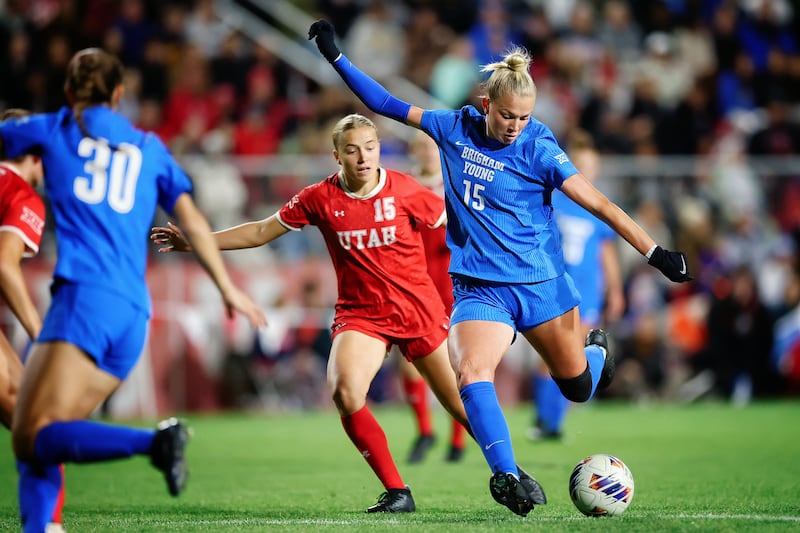
The development of the men’s national team faces still another difficult challenge: Football and basketball siphon talent that otherwise might find its way to soccer. Notwithstanding, the U.S. still has more youth soccer players than any country in the world.
Only eight countries have won the men’s World Cup and five of them are European. Six of the eight semifinalists in this year’s World Cup were European — Belgium, England, France, Norway, Spain and Switzerland (the other two countries were Argentina and Morocco).
European families pay $110 to $340 for an annual club membership fee for recreational and youth club soccer — a price that would cover uniform fees in the U.S. Elite academy players often play for free, with professional clubs and community sponsorships subsidizing all equipment and travel. The focus is the development of technical skills, not scholarships and winning, as is the case in the U.S.
High school soccer vs. club soccer
The U.S. system has evolved to the point where high school soccer is considered much inferior to private club teams and college coaches recruit the club talent almost exclusively (some of the best players don’t even play for their high school team). Scholarships — the brass ring of youth soccer — are won largely by club players, and the clubs are expensive.
What all this means is that the expense of soccer prevents kids from rising to the top and playing for college or national teams.
“In other countries, they go into the neighborhoods where kids are playing in the dirt, but in the U.S., if you’re not playing in (an elite club) you’re not going to get into college,” says the Utah club coach.

The U.S. has the most youth soccer players in the world, but it hasn’t translated into dominance, which is a commentary on the developmental system. Clubs seduce players and their parents by convincing them into believing that they will win a scholarship if they “play club” and play year-round.
This is misleading (and expensive), to say the least. In 2020, the Deseret News published a list of Utah high school athletes who won athletic scholarships — in soccer, there were 34 girls and seven boys for the entire state. Players (or their parents) lay out $1,500 to $6,000 per year for competitive travel teams, while clubs are $8,000 to $15,000-plus annually. To put it in perspective, that would cover the annual tuition at Utah universities.
More expenses
Even the club fees and travel costs are not the end of the expense. Private trainers are de rigueur for developing club players.
“They pay $90 to $100 an hour for a private trainer, one to two times a week,” says the club coach. “The reality is that they have to. The club coaches don’t develop talent. They are there to win. The coaches at the younger levels will develop skills, but as the kids get older, the focus of the coaches is on winning.”
This is largely what Jurgen Klinsmann, a former German soccer star who managed the U.S. national team for five years, told the world 16 years ago when he sounded the alarm following another disappointing World Cup loss in 2010:
“It’s really important that they lay out a philosophy for U.S. soccer — and say where do we want to go. … You need to know how you develop the players and it’s very difficult within American culture to talk about because you are the only country in the world that has the pyramid upside down. You pay for having your kid play soccer because your goal is not that your kid becomes a pro soccer player … your goal is … a (college) scholarship, which is completely opposite from the rest of the world.
“Soccer is similar to basketball. You need it out of the lower-class environment, and soccer worldwide is a lower-class environment sport. We all got up through moderate families and fought our way through … we need to find a way to connect with the Hispanics and to connect with everybody in the soccer environment.”
The sport became hugely popular among American youth in the 1970s and 1980s, and yet, decades later, they haven’t been able to seriously challenge the rest of the world. The U.S. system is broken. It will never be repaired because it’s so entrenched and because so much money is being made.
But there’s no going back now.