

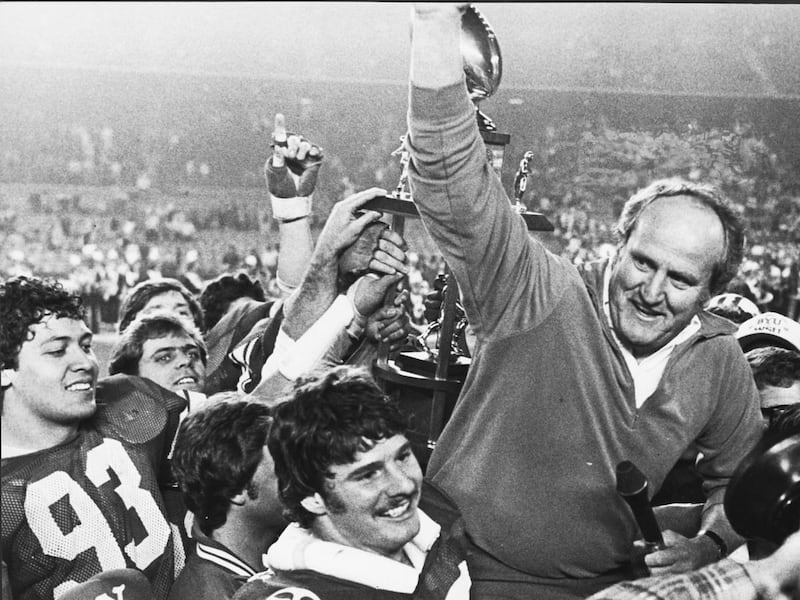

Editor’s note: Third in an occasional series exploring LaVell Edwards’ legacy of leadership.
LaVell Edwards was much more than a football coach. He was also a fortune teller, a prognosticator, a weatherman and a visionary, and — most of the time — his inclinations were right.
Mission advice
Defensive tackle Chris Hoke came to BYU in 1994. With his mission call to Brussels, Belgium, in hand, he sought out some advice from his coach. Hoke was worried a mission would rob him of his athletic edge for a football future.
“He was rock solid on me serving a mission,” remembered Hoke. “He said, ‘This is something you’ve got to do. The Lord has asked you to serve, and you are serving. I’ve done this long enough to know that if you go and serve the Lord, you’re going to come back and you’re going to come back bigger, stronger and faster than you were before you left.’ He was right. Everything did work out.”
After completing his mission, Hoke returned and played four seasons at BYU and 11 seasons with the NFL’s Pittsburgh Steelers, where he won two Super Bowls.
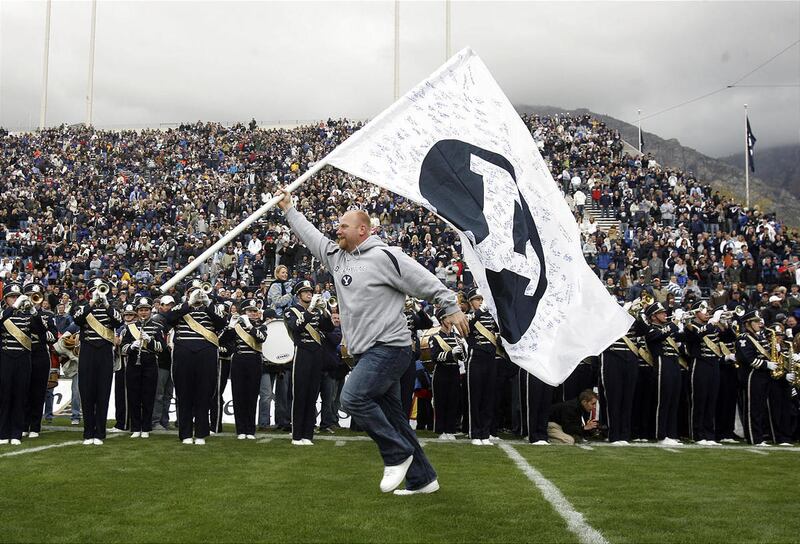
A position change that led to the NFL
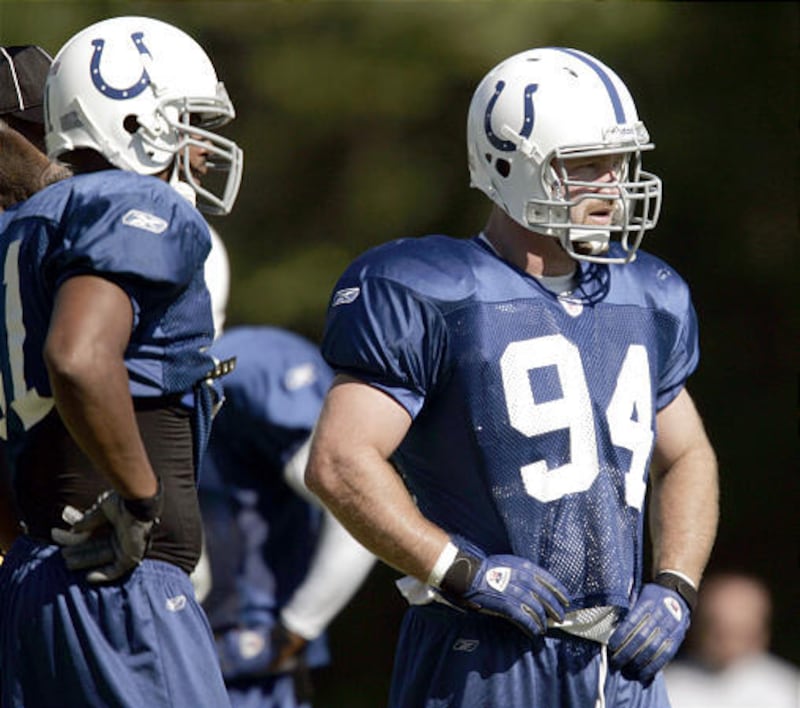
Edwards recruited Rob Morris to play running back, but during his freshman season in 1993, the defense needed some help, and several staffers asked Morris if he would switch to linebacker.
“‘No! I want to play running back,’” Morris told them. “That’s why I was recruited here and that’s what I want to do.”
Morris was pressed with the same proposition after his church mission, and he was torn until Edwards approached him during practice.
“He just drove around in that golf cart and every once in a while, he’d get out and chat with you,” Morris said. “He pulled up in the golf cart and motioned for me to get in. I’m like, ‘Oh man, I’ve never actually gotten in trouble at practice. This is new.’”
Morris wasn’t in trouble, but his life was about to change.
“He asked how I was doing and then, while chewing on his tongue, he said, ‘You can be a really good running back. We think you can play running back here and be good. If you play linebacker, you’ll play on Sundays.’”
The light went on.
“I said ‘OK,’ and that was the last time I ever played running back in my life,” Morris said. “Playing in the NFL is why I came to BYU because I want to go there. He seems to know. He seems to be right about everything else, so he’s probably right about this.”
Rob “The Freight Train” Morris was born. He became one of the most feared and successful linebackers in program history. After four years at BYU, Morris played defense for eight seasons with the Indianapolis Colts and won a Super Bowl.
Juggling a quarterback quandary
Marc Wilson and Jim McMahon split time at quarterback during the 1978 season. Afterward, Edwards rehired Doug Scovil as offensive coordinator. Edwards also knew he had a pair of quarterbacks who would both become first-round NFL draft picks, but he wasn’t going to rotate them anymore.
“He called me and asked me to come up to his house, which he never did. In fact, the entire time I was at BYU, I only did that one time,” Wilson said. “But he asked me to come up and I sat down in his living room and he talked about where we were and what was going on and the decision he was going to make.
“The feeling that I had was that this was as hard on him as you could possibly imagine. It was gut-wrenching on him to have to tell me that I was gonna sit down and someone else was gonna play, and that was the only reason it worked for me — because I had a guy who I felt like had some compassion and understood how difficult this was gonna be for me and that made it really difficult on him.”
In the end, Edwards chose to start Wilson in 1979, and a frustrated McMahon redshirted. Wilson’s team went 11-1 and he was drafted in the first round by the Los Angeles Raiders. McMahon started the 1980 and 1981 seasons and went 23-3 and was drafted in the first round by the Chicago Bears. Both quarterbacks retired with a pair of Super Bowl rings.
“I didn’t like it at the time, but coach did the right thing,” McMahon said. “It worked out for both of us.”

Focusing on a specialized skill set
Vai Sikahema wanted to play a bigger role in the offense during his junior and senior seasons in 1984 and 1985. Sikahema was a shifty running back with good hands, but Edwards saw his future as a kick returner and he told him so.
“I think you are going to play in the NFL because you have a specific skill set that they value at the next level and in college we don’t,” Edwards told Sikahema. “Our offense isn’t determined by where we start. We are throwing the football. In the pros, it’s different because their offenses are much more determined on where they start. Field position is going to determine the calls they make. If you consistently put the ball on the 25-yard line, that extra five yards makes a world of difference in the NFL and you’re going to play in the NFL.”
Edwards continued, “The other thing is you have fresh legs. We haven’t worn you down.”
“Well, I am fresh, yeah,” Sikahema answered, with a hint of protest to his voice. “And wouldn’t you know it, things played out exactly as he told me it would.”
Sikahema finished his BYU career with a national championship, and he returned kicks for eight seasons in the NFL and was named to the Pro Bowl in 1986 and 1987.

Finding a diamond in the rough
Chad Lewis landed a roster spot at BYU as a walk-on following his church mission in 1993.
“During spring ball, we were in a scrimmage, and I happen to be standing next to LaVell. So, we started talking and he said, ‘Now, you are Mike’s brother, right?’”
Mike Lewis was Chad’s older brother who had just finished his career at Utah.
“Yeah, I’m Mike’s brother,” Lewis said.
“Jim Fassel, when he got fired (at Utah), told me to look out for you,” Edwards continued. “He said that ‘Mike’s brother was a great athlete. Keep your eye on this kid. I think he’s going to be a great player.’”
Edwards turned and looked at Chad.
“Shows you what a lousy recruiter I am.” They both laughed.
A couple of months later, Edwards called Lewis into his office and offered him a full scholarship. Lewis vowed to never let him down. He finished his BYU career as an All-American and played nine seasons in the NFL and was named to the Pro Bowl in 2000, 2001 and 2002.
“I went into BYU thinking LaVell was larger than life,” Lewis said. “I left thinking he was even larger.”
Coaching advice for a record breaker
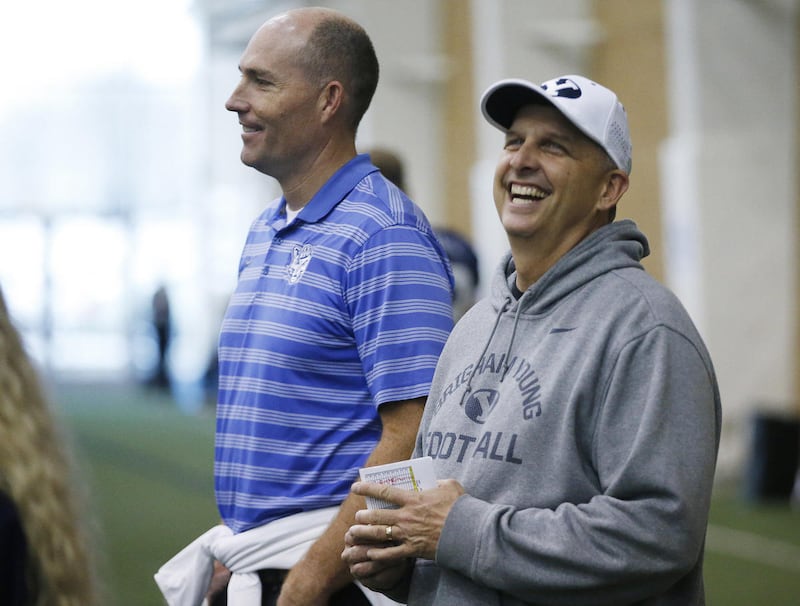
Ty Detmer rewrote BYU’s passing records and became the program’s first Heisman Trophy winner. After 14 seasons in the NFL, Detmer retired and decided to start coaching. The high school program he inherited had gone 0-10 the two previous seasons.
Detmer turned to his coach for some advice.
“I came to Provo and asked LaVell, ‘What did you do? How did you get things turned around here at BYU? Because I’m at a school right now that needs to get turned around.’”
Edwards’ answer was simple, but sublime: “We quit focusing on what we didn’t have and started focusing on what we did have.”
“That was great advice for me — not worrying about the things you don’t have,” Detmer said. “We still went 0-10 that year, but it kept my mind at ease knowing that you can only do what you can do with what you have. You can’t sit there and worry about all the things you don’t have.”
Edwards always knew Detmer would be a good coach because his dad, Sonny, was an excellent coach, and Ty had a firm understanding of the game. Since that first year, Detmer, who had a brief stint as BYU’s offensive coordinator, has evolved into one of the most successful high school coaches in Arizona.
A couple built on trust
While there are hundreds of stories about how LaVell could look into the future and see the successes ahead for his players, his wife, Patti, wasn’t so sure there were good times ahead for them.
“He didn’t ever tell me he wanted to be a football coach. He just went and did it — and I hated football,” she said, before Patti passed away in February of this year. “My father wanted to retire and give LaVell the family business and LaVell didn’t take it.”
Patti resisted for a while before eventually catching the vision.
“It was five years that I didn’t want to do football at all, but when I decided that that was what it was going to be, I jumped in with both feet. When he was offered a job as an assistant coach, I didn’t want to move to Provo. We had just built a little home in Holladay and never set foot in it — and he just came here.”
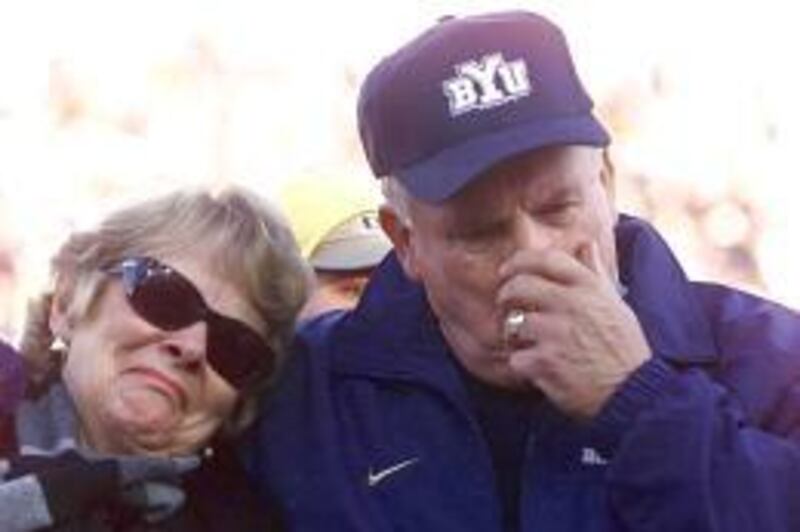
And she came with him. Decades later, the visionary couple stood together as BYU honored Edwards by renaming the stadium after him — and that’s one thing neither of them ever saw coming.
Dave McCann collected the content for this article while researching and writing the book “The Leadership Legacy of LaVell Edwards,” which he co-authored with Dr. Mark D. Ogletree.