


AMES, Iowa — The Utah Utes’ offensive line continues to be a work in progress as coaches work to find their best combination.
Kelvin Obot, the five-star freshman, started Saturday’s 31-17 win at Iowa State at left guard, marking his first start at the collegiate level. Obot played at least 23 snaps in each of Utah’s previous three games, including 46 against Idaho, but Saturday was the first time he was called upon to start.
Obot started alongside left tackle Zereoue Williams, center Alex Harrison, right guard Keith Olson and right tackle Cedric Jefferson. It was also the first start of the season for Olson, who missed Week 1 while working back from an injury and played just 10 snaps against Arkansas and 29 snaps against Utah State.
Will the starting lineup of Williams, Obot, Harrison, Olson and Jefferson be the Utes’ main five going forward?
The group didn’t have its best performance, but it was also going against probably the best defensive line it has faced this season. Iowa State’s defense forced nine pressures and seven quarterback hurries, both season-highs against Utah, which has been very good in pass blocking this season.
Obot, per Pro Football Focus, gave up two pressures, while Jefferson allowed three pressures and Harrison allowed two. While it wasn’t as dominant of a pass-blocking performance as the previous three games, Utah didn’t allow a sack all game.
PFF gave Utah’s pass blocking efforts a 73.4, which was a season low after a dominant start. Though PFF gave Utah just a 58.8 grade for run blocking, that area did look improved, especially compared to the week prior against Utah State.
Running back Wayshawn Parker helped his line look good with a career day toting the rock. Parker rushed for a career-high 174 yards, and while 137 of those came after contact, the blocking was improved, especially between the tackles, an area of concern after the Utah State game.
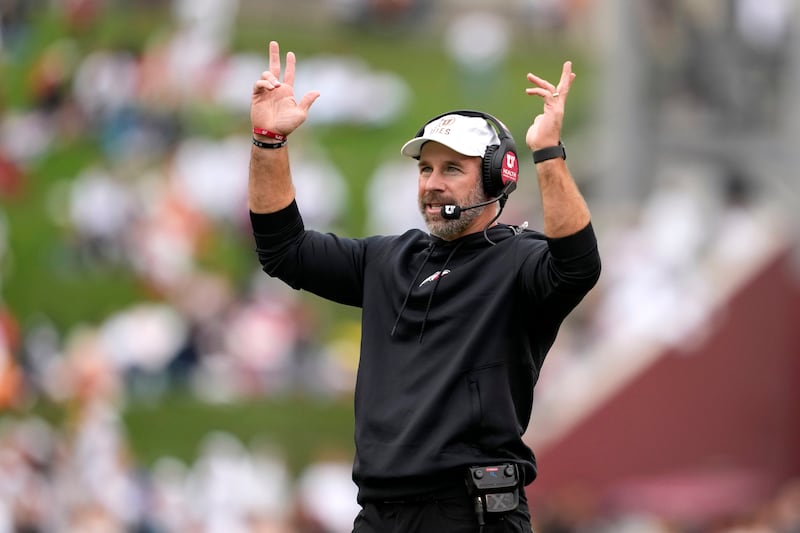
“This was more power, run inside the tackles. It was a little bit more Wayshawn and less Devon (Dampier) and Byrd (Ficklin) on the run,” Utah coach Morgan Scalley said.
Scalley said he challenged the offensive line and running backs last week and they responded well.
“This was a tough defensive front,” Scalley said. “You saw that, how they competed versus Iowa. Our guys answered the bell, man. They got push at the line of scrimmage. Wayshawn, I felt like our backs were breaking tackles.
“It was probably much more of a focus on the inside run game as opposed to the outside run game.”
Scalley praised the offensive line for helping pave the way for Parker’s career day, as did the running back himself.
“He’s got some pretty good speed for a big dude, but he’ll be the first to tell you that that offensive line did a heck of a job tonight. That offensive line, man, I’m so proud of those guys because they were challenged and that really was a gut check for them,” Scalley said.
“Really proud of Kelvin Obot for a start as a true freshman, the way he competed, Keith Olson back in the lineup, the way he played. Those dudes up front, they deserve a lot of credit for what happened in the run game tonight.”
Bye week comes at nonoptimal time for Utes
After starting the season 4-0, Utah heads into its first and only bye week of the season in Week 5 — an early one.
Last year, the Utes had two bye weeks, one in Week 6 after the West Virginia game and another in Week 11 after the Cincinnati game.
Those bye weeks came at the perfect times for the Utes, who were banged up before both.
In 2024, the Utes also had two bye weeks, one in Week 6 after facing Arizona and one in Week 10 after playing Houston and before BYU.
This time around, the single bye week comes at a time when the Utes don’t necessarily need it. Utah cruised through its first three games, and though it was challenged for the first time this season by Iowa State, a bye week would have much better placed later in the season.
The Utes also enter the bye week not necessarily needing it for health reasons like they did the past two seasons. While some players are undoubtedly banged up after four games, Utah has avoided major injuries to its starters.
“Knock on wood. As soon as you start talking about injuries, that stuff pops up,” Scalley said on Monday.
Scalley credited the sports science staff at Utah, the training staff and the strength and conditioning staff, which is led by Steve Saunders.
“A lot of it is the way we train, the sports science, the player loads, and managing that from a day-to-day basis, the care that our training staff, Chris Lacsamana and his staff (give). There are always meetings every day with our sports scientists and then you got Steve Saunders that is in on those meetings,” Scalley said.
“They do a great job of making sure that we’re very aware of where guys are at player load wise and who we need to back off and who we need to — because some guys don’t get enough work, and so we have to do more with those guys throughout the week. I’ve got a really good staff.”
Out of the bye, the Utes will face Kansas at Rice-Eccles Stadium on Oct. 10. The Jayhawks have started the season 1-2 with losses to Missouri and Arizona State and look to be one of the more beatable opponents on the remainder of Utah’s schedule.
After Kansas, the Utes travel to play Deion Sanders’ Colorado, which already looks to be in early-season trouble.
Colorado has lost its last two games to Northwestern and Baylor and has failed to break 14 points in each. Sanders turned to former Ute quarterback Isaac Wilson after benching five-star quarterback Julian Lewis in the Buffaloes’ 23-13 loss to Baylor.
Wilson threw for 156 yards and a touchdown on 48% completion.