



Returning home on the light rail after her evening shift at a pizza parlor in Charlotte, North Carolina, Ukrainian refugee Iryna Zarutska, 23, was brutally stabbed in the neck and pronounced dead on the scene in late August, reigniting debate about asylums and public safety among policymakers.
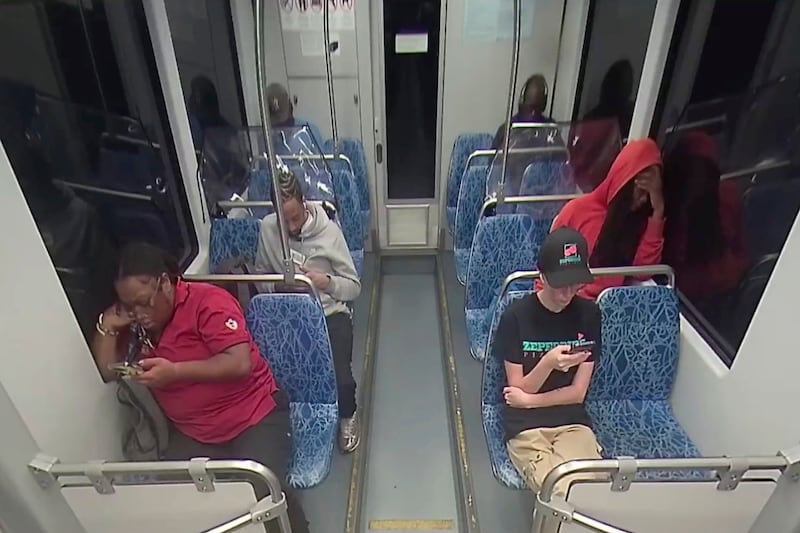
A video recently released by North Carolina’s Charlotte Area Transit System shows the graphic CCTV footage. Decarlos Brown Jr., 34, sat behind Zarutska with his head against the window until he suddenly stood and stabbed her from behind with a folding knife.
No passengers on the Lynx Blue Line train immediately approached Zarutska to help, while Brown exited at the next stop. After about 15 seconds, Zarutska fell to the floor, and three other passengers tried to help. One man used his shirt to dress the wound and attempted CPR.
Brown has been charged by both North Carolina and the Department of Justice. Attorney General Pam Bondi announced the DOJ will “seek the maximum penalty for this unforgivable act of violence — he will never again see the light of day as a free man.”
County court and jail records show Brown’s previous arrests for 14 cases, which date back to 2007 and include felony larceny, communicating threats and robbery with a dangerous weapon, as Newsweek reported.
Brown spent six years in prison and was released in 2020.
Upon his release in 2020, Brown moved back home with his mom, but she said, “He started saying weird things.” She got Brown placed under psychiatric monitoring, and doctors diagnosed him with schizophrenia. However, when Brown came back home, he became aggressive again, and she kicked him out.
Brown was homeless for the following years, and in January, the local police arrested him for “misusing the 9-11 system.” Magistrate Teresa Stokes released him from jail this year on cashless bail and a written promise to appear before court.
Trump and admininstration see Zarutska’s murder as a call to action
“What the hell was he doing riding the train, and walking the streets?” President Donald Trump posted on Truth Social, Monday. “Criminals like this need to be LOCKED UP. The blood of this innocent woman can literally be seen dripping from the killer’s knife, and now her blood is on the hands of the Democrats who refuse to put bad people in jail.”
Transportation Secretary Sean Duffy added on X, “If mayors can’t keep their trains and buses safe, they don’t deserve the taxpayers’ money.”
In July, Trump signed an executive order to tackle homelessness by ordering the U.S. attorney general and the HHS to remove federal obstacles to civil commitment (the legal process to court-order an individual to mental health treatment or confinement).
The order also directed departments to revise regulations and grant requirements that gave housing to homeless populations.
Federal housing assistance is now conditioned on the homeless individual’s participation in treatment for drug use disorders or severe mental illness.
Strong reactions to Zarutska’s murder are not contained to one side of the aisle. Charlotte Mayor Vi Lyles said her city “need(s) a bipartisan solution to address repeat offenders who do not face consequences for their actions and those who cannot get treatment for their mental illness and are allowed to be on the streets,” per the Charlotte Observer.
Reversing the 1963 Community Mental Health Act
President John F. Kennedy signed the Community Mental Health Act in hopes it would give freedom to the mentally ill and solve reports of horrific conditions in some mental institutions. It also promised it would reintegrate mentally ill people into their local communities.
Since the mid-1950s, state mental hospitals have eliminated more than 96% of their last-resort beds, and private hospitals have seen extreme shrinkage as well, the Treatment Advocacy Center reported.
If enrolled in a private institution, a patient or their caregiver would typically not be able to use insurance to pay for the $30,000 per month cost, NPR reported. And Medicaid has a provision that prohibits federal money from paying for long-term treatment.
However, Trump and many others including Stephen Eide of the Manhattan Institute believe the 1960s-on approach, however well intended, is not working. Since deinstitutionalization, suicide and overdose rates, mass shootings and the percent of the mentally ill in prisons have increased, Eide wrote in 2022.
“The public mental health care system’s inability to address serious mental illness has forced mental health responsibilities onto many other public programs and agencies, such as criminal justice and transit,” he said.
Trump re-extends federal law enforcement offer to Chicago and other cities
“The people of our country need to insist on protection, safety, law and order,” Trump said in a message from the Oval Office Tuesday afternoon.
He then referenced deploying the National Guard in Washington, D.C., “The capital of America was a bloodthirsty, horrible, dangerous place, one of the worst. And now it’s a crime-free city, and we’re going to keep it that way,” he said. “It can be done. It can happen fast.”
He said the White House just needs an invitation. “Chicago needs help. Other cities need help. We’ll do what has to be done, because we’re going to make America safe again,” he said.
Rep. Alma Adams, D-N.C., with jurisdiction over Charlotte, wrote on X, “Our Charlotte community mourns the tragic loss of Iryna Zarutska and my prayers are with her friends, family, and loved ones at this difficult time.”
She added, “We must be intentional about safeguarding the well-being of Charlotte and Mecklenburg County, and that begins with strong partnerships at the local, state and federal level.”
The internet is angry
Vice President JD Vance wrote on X, Tuesday afternoon, that “the big lie the Democrats told about violent crime is that it’s ‘systemic,’ and therefore no one’s really responsible.” However, the vice president believes, “The reality is that the gross majority of violent crime is committed by a very small group of people, and we should be throwing them in prison.”
Elon Musk responded, “Yes... Do you have more sympathy for those highly likely to commit murder or more for those at risk of being murdered?”
Utah Sen. Mike Lee also posted on X, critiquing The New York Time’s lack of initial coverage of Zarutska’s murder. “Americans deserve better,” he wrote, responding to a post from the political commentator Charlie Kirk.
But while some view the murder as a catalyst to crack down on crime, others view it as Trump trying to “seize control of other cities that he says are not safe,” as CNN reported.