

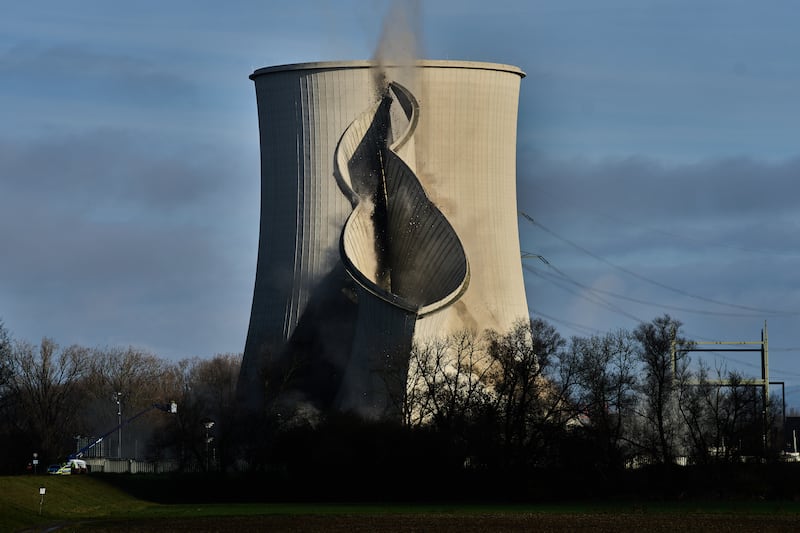

- Germany shut its last three nuclear plants in 2023 to favor renewables, which Chancellor Merz called a “serious strategic mistake," on Wednesday.
- Despite renewables supplying around 65% of domestic energy in 2024, Germany faces declining energy-generation capacity.
- Globally, nuclear power is resurging: France dominates in Europe, China rapidly expanded in the 2010s and the U.S. is pursuing a nuclear revival under Trump, with new reactors planned through 2030.
To mainstream renewable energy, Germany shut down its last three nuclear power plants in 2023. Just three years later, German Chancellor Friedrich Merz told business leaders it was a “serious strategic mistake,” and the country will rebuild nuclear production.
Merz, having held Germany’s highest political office for less than a year, criticized the previous administration for its highly restrictive energy policies during a publicized address. To counter the policies’ dampening effects on energy production, Germany is now “undertaking the most expensive energy transition in the entire world,” Merz said on Wednesday.
Germany’s energy-production decline accelerated in 2000, as the country began dropping its coal and oil production. By 2024, renewables made up around 65% of the country’s domestic energy.
And while their carbon emissions have dropped at least 32% since 2000, Germany “simply doesn’t have enough energy-generation capacity,” Merz said.
So the chancellor announced that “power plants are to be built,” and “all the necessary documents have been exchanged” to begin construction on new nuclear power plants, which will likely be put on the old sites.
In Merz’s speech, he said the heart of the issue is that Germany’s power industry is too heavily reliant on imports from other countries. In 2025, nearly 70% of its energy needs were met through international imports.
“I want us to eventually have acceptable market prices for energy production again, and not have to permanently subsidize energy prices from the federal budget. We can’t do this in the long run,” Merz said.
Germany joins the global nuclear-energy awakening
Germany’s western neighbor, France, has dominated Europe’s nuclear power industry since the mid-1980s. Its 57 operating reactors fulfill 70% of the country’s energy needs, and France sells €3 billion, $3.5 billion, of nuclear energy annually to other countries. Currently, France is building six new reactors and considering another eight.
Meanwhile, as of early 2026, China has 59 operating nuclear reactors with 37 more under construction, the World Nuclear Association reported. The country’s operable nuclear capacity shot up in the 2010s, and new growth has since leveled off slightly.
The U.S. currently has 94 operating nuclear reactors — the most of any country. But without expansion, China will take its title once it finishes construction on its 37 proposed reactors.
However, in mid-2025, President Donald Trump signed an executive order to jump-start the country’s nuclear industrial base and make it easier to start generating electricity. He proposed restarting closed reactors, increasing existing output, completing partially built reactors and begin construction on 10 new large reactors with full designs by 2030.