

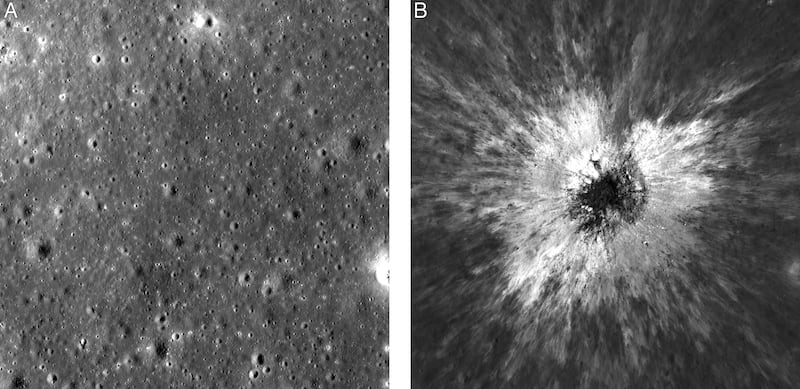

- Scientists discovered a massive new crater on the moon.
- The feature was spotted in scans gathered by the Lunar Reconnaissance Orbiter mission.
- The newly named McGetchin Crater is the largest newly formed crater ever found.
A new scientific report reveals details behind the discovery of a massive new crater on the moon, formed just two years ago by a comet or asteroid the size of a three- to six-story building smashing into Earth’s sole satellite.
Robert Wagner, a scientist with NASA’s Lunar Reconnaissance Orbiter, was scanning an enlarged moon map, looking at images gathered in 2024, when an “unusually large bright spot” captured his attention, and indication he interpreted as an area that had been “shaken up,” according to a NASA report published this week.
“I just stopped, dropped everything, and started looking into what that spot was,” said Wagner, an image-processing specialist from Intuitive Machines who works with data from the Lunar Reconnaissance Orbiter Camera system.
NASA said that when Wagner compared the images he was scanning with a set of lunar photographs gathered earlier, he realized he had discovered the “largest, newly formed crater ever found in the solar system” as scientists reported Wednesday in Science Advances.
The impact left a crater 728 feet wide that spans the length of two football fields. And at 141 feet deep, NASA says the crater could fit three vertically stacked yellow school buses.
The new lunar feature has been officially named the McGetchin Crater in honor of pioneering lunar scientist and former director of the Lunar and Planetary Institute, Tom McGetchin. Scientists said image analyses suggest the crater was created by a collision that occurred between April 11 and May 22, 204 on the moon’s eastern edge.
The Lunar Reconnaissance Orbiter launched in 2009 and has been gathering detailed imagery and other data in what is now the longest-lived lunar orbiting mission in history. The orbiter is a roughly rectangular craft that measures about 13 feet long, 9 feet wide and 9 feet tall and weighs a little over one ton. In addition to image gathering, the orbiter is capable of measuring the moon’s surface temperature, radiation levels and collecting composition data.
The newly discovered McGetchin Crater is three times bigger than the previous record-holder found by the lunar orbiter a decade ago, according to a report from Associated Press. Pockmarked since ancient times, the moon bears some of the solar system’s largest impact craters, including one that stretches more than 1,500 miles across.