

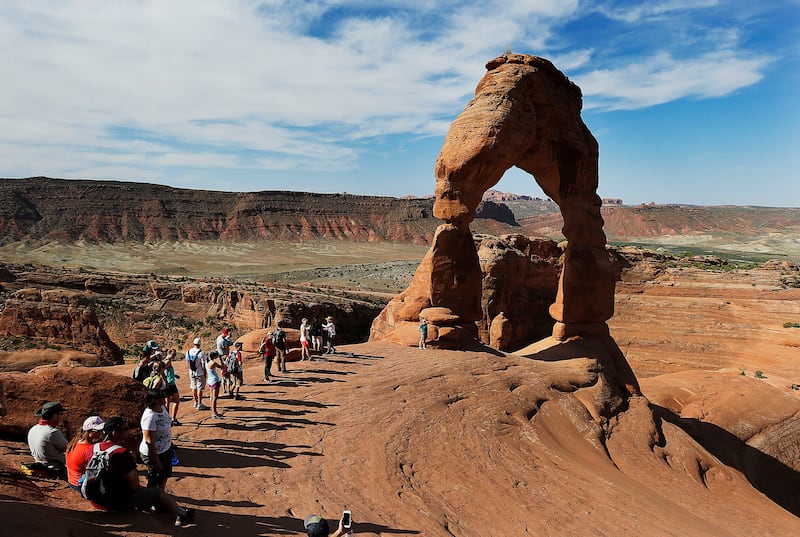

SALT LAKE CITY — Utah’s five national parks remain open but are adjusting their operations to stay within the public health guidelines for social distancing, even as three of the nation’s most popular parks shut down Tuesday due to the coronavirus.
Jim Ireland, the Utah state coordinator for the National Park Service, said parks are switching up operations to keep staff and visitors safe and monitoring the situation on a daily basis as visitor season heats up.
“It is changing rapidly as parks are evaluating their situation and doing risk management assessment,” he said. “The park service is trying to keep outdoor spaces open and available to the public.”
Yellowstone, Grand Teton and Great Smoky Mountains all closed their gates Tuesday. Zion in Utah ceased its shuttle service, and Ireland said some visitor centers are closed.
At Great Smoky Mountains, park officials said thousands of visitors were not practicing public health guidelines on social distancing, prompting the closure.
Ireland, who is superintendent of Timpanogos Cave National Monument, said the hope is the popular attraction in Utah County will open on schedule for Memorial Day weekend.
In Grand County, the sheriff’s office warned Tuesday that all campgrounds there are closed to everyone except residents and people like essential workers as the result of a regional public health directive issued last week.
“Nonresidents are not allowed to camp, including developed and primitive sites. Although we understand the great outdoors may be a good way to self-quarantine, our visitors can place heavy burdens upon our resources,” the sheriff’s office said in a statement.
“The rural nature of our health care facilities presents us with limited services that are already taxed by a potential COVID-19 incident in our area,” it continued. “One injured visitor who needs overnight medical care means one less of only 17 hospital beds for our locals in Grand County.”
Nonresident campers are being contacted by law enforcement officers and closure signage is being established at popular camping locations, the sheriff’s office added, emphasizing citations will be issued, especially in instances of repeat offenders.
Nathan Schwebach, spokesman for the Utah Department of Natural Resources, said his agency is coordinating with the National Park Service, the U.S. Forest Service and the Bureau of Land Management to put up a resource guide on recreation at coronavirus.utah.gov, with an intent to go live Friday.
“With all the various land management agencies, recreating in Utah can be confusing overall,” he said. “Now you are adding another layer of confusion with the coronavirus.”
Schwebach said an additional concern hovers around the coming spring break which will foster more visitors to public lands.
“People are still getting out and enjoying nature, and with spring break kicking off next week, more people could be out recreating.”
There are already reports of crowded trails in the Wasatch Canyons, including Millcreek and other popular recreation spots in Salt Lake County, such as the Draper Trail.
Loyal Clark, spokeswoman for the Uinta-Wasatch-Cache National Forest, said while the forest remains open, there may be adjustments made for the health and safety of its work force and the public.
Anyone recreating in the forest needs to abide by the mantra of “Pack it in and pack it out,” she added.
The Utah Division of Wildlife Resources is also experiencing trouble with people trespassing at its wildlife and waterfowl management areas, which are posted closed so mule deer can recover from the winter and due the migrating and nesting season for birds.
Last weekend, 17 people were cited for trespassing: seven at Henefer-Echo, four at Ogden Bay, three at Millville, two at Middle Fork and one at the public shooting grounds northwest of Corinne, according to the division.
“With the recommended social distancing guidelines due to the coronavirus, I think the need that people feel to get outside and away from others is higher than ever,” the division’s Lt. David Beveridge said. “But please remember that spring is a critical time for wildlife. It’s important that you obey the closures and not put wildlife at risk by stressing them.”
Schwebach said many of the problems with trespassing at the management areas involve people engaged in the ongoing shed hunt.
Most of the wildlife management areas in northern Utah are closed until April 11. Waterfowl management areas in northern Utah are closed until Aug. 1. The division advises reading the signs posted at the management areas for more details on the closures.
The closures for deer are necessary to help them build up strength after the winter. Deer are transitioning from eating a diet of browse (brush and twigs) to eating mostly green grasses. It takes time for their digestive system to make the switch.
“Combine a lack of nutrition with being weak after a long winter, and it’s easy to see how critical it is that people not cause the deer added stress,” the division’s regional wildlife manager Jim Christensen said. “For many of the deer, the added stress people put on them is all it will take to kill them.”
Spring is also a critical time for ducks, geese and other migratory birds in Utah, the division noted.
“The spring migration is currently at its peak,” said Rich Hansen, manager of the DWR’s Ogden Bay, Howard’s Slough and Harold Crane management areas.
“Thousands upon thousands of birds are on Utah’s marshes right now. While they’re here, it’s important that people not stress them. The birds need to feed and get the rest they need to continue their migration north.”
For some of the birds, Utah is as far north as they migrate, with many birds staying put to nest.
Meanwhile, Powder Mountain announced it is opening Thursday for hiking and other activities, but with restrictions in place to protect public safety. Details are available on the resort’s Facebook page.