

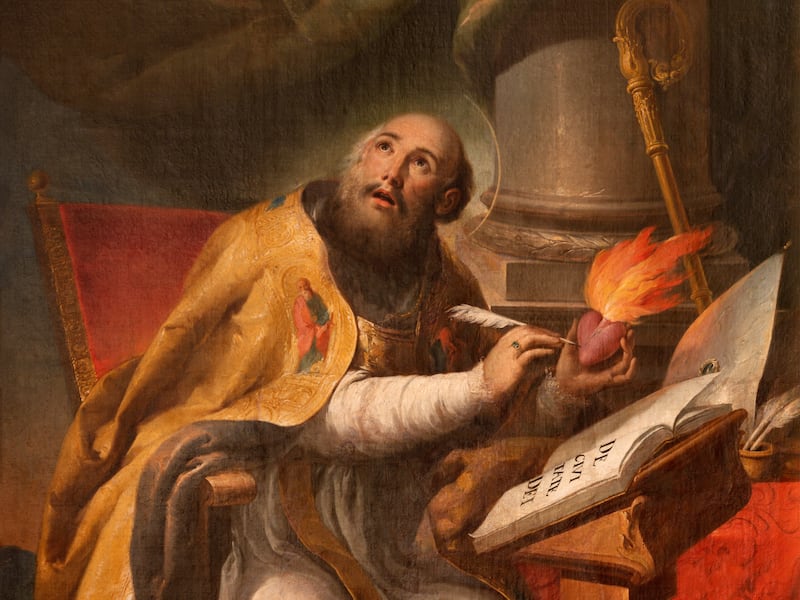

A seemingly ordinary request to examine a 12th-century manuscript containing several sermons by St. Augustine, an early Christian theologian, turned into an unexpected discovery.
In 2024, Professor Christian Tornau, a scholar of Latin studies at the University of Würzburg in Germany, received a call from a researcher asking to help decipher a manuscript that contained six sermons by one of Christianity’s most influential theologians, Augustine of Hippo (also known as St. Augustine).
One Augustinian idea is the “just war theory” recently featured in the debate between Pope Leo XIV and Vice President JD Vance. Vance has invoked Augustine’s “City of God” to support the idea that governments may have a special obligation to their own citizens.
This new manuscript originally belonged to Doberan Abbey, a Cistercian monastery in Germany, but was kept in a monastery in Pelplin, a town in Poland. While studying the sermons, Tornau, whose research focuses on late antique literature, including the writings of St. Augustine, was delighted with the discovery but also cautious about its authenticity.
“We transcribed the new texts and began analyzing them with a view to a future edition. We were fascinated, of course, by the idea of having found new sermons by St. Augustine, but we soon became skeptical because, in some places, the sermons did not seem to have been written by Augustine,” Tornau told ACI Prensa.
Tornau worked with a group of Latin scholars in 2025 and spent two years examining the authenticity of the text to confirm its legitimacy. He believes that the manuscript is based on an older version from a historic Lutheran monastery called Amelungsborn Abbey in Lower Saxony in Germany.
The newly discovered sermons, which are being prepared for publication, explore the Old Testament story of King Saul and the witch of Endor, who summons the spirit of the prophet Samuel before Saul’s final battle. The story comes from the first book of Samuel, chapter 28, one of the Bible’s most mysterious and debated passages.
After God stops responding to King Saul through prophets and dreams, Saul secretly visits the medium, or witch, of Endor.
“Saul believes himself to be in a hopeless situation shortly before a battle against the Philistines. God does not listen to his prayers. He turns to a witch,” Tornau explained in a press release from the University of Würzburg.
Saul asks the witch to summon the deceased prophet Samuel. This move is controversial, because he had previously outlawed necromancy — the practice of communicating with dead people — in Israel.
The apparent spirit of Samuel appears and tells Saul that because of his disobedience to God, he and his sons will die in battle the following day. The prophecy is fulfilled in a passage in 1 Samuel when Saul is killed fighting the Philistines.
Tornau explained that Augustine’s two new sermons try to wrestle with the interpretation of the passage and its theological implications. “Why can a necromancer summon the spirit of a prophet? This in turn opens up the theodicy problem: How can an omnipotent God allow this or is he not really omnipotent?”
According to the scholars who authenticated the sermons, Augustine does not immediately settle the debate. In the first sermon, preached on a Sunday, he lays out the competing interpretations and leaves the congregation to wrestle with the problem.
He returns to the passage in the second sermon, delivered the following Wednesday. The second time, according to Tornau, Augustine weighs the possibilities more fully.
The texts suggest that Augustine intentionally encouraged his listeners to grapple with challenging biblical questions on their own before offering a theological analysis. This kind of preaching approach has been documented in the early theologian’s other works before, scholars noted.
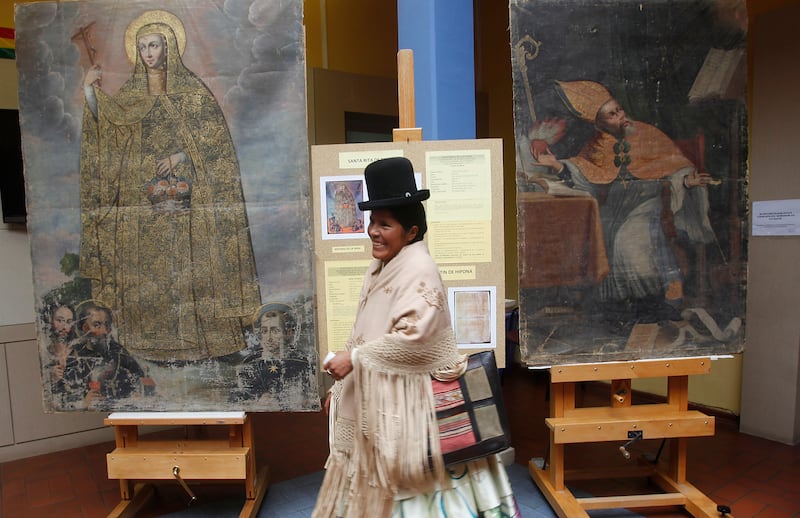
But the researcher points to the most insightful takeaway.
“The most notable element of the new sermons is the idea that Saul, after hearing Samuel’s prophecy, could have repented and been redeemed,” Tornau told EWTN News. This interpretation is unlike anything else found in Augustine’s surviving writings or in early Christian biblical commentary, where Saul is generally depicted as a flawed and negative figure.
The Latin text will be presented in a critical edition with German translation, the outlet reported, with background about the discovery of the sermons.
In 1990, the French scholar François Dolbeau identified a remarkable collection of 26 previously unknown or incomplete sermons by St. Augustine in a 15th-century manuscript held by the Mainz City Library in Germany. The discovery was significant given its scope and how much new material it added to the corpus of Augustine’s teachings.
“This is not a sensational find like the 30 writings of St Augustine that were discovered in Mainz in 1990. But we are supplementing Augustine’s extensive body of writings with two further exciting texts in a critical edition,” according to Tornau.